
Explore the country and target locations of the investment opportunity.
Country
Vietnam
Region
- Red River Delta
- Mekong Delta Region
Situate the investment opportunity within sustainability focused sector, subsector and industry classifications.
Sector
Health Care
Development need
Regional disparities exist in access to quality and affordable healthcare services between rural and urban areas (1); Increased non-communicable diseases (NCDs) due to unhealthy habits, like excessive smoking and drinking; NCDs were the cause of 77% of deaths in 2016, as opposed to 68% in 2010 (1); Slow reduction of under-5 mortality rate, i.e. 23 in 2013 and 20.6 in 2020. (13)
Policy priority
Specified in Decision 531/QĐ-TTg: Increase healthcare service quality, improve the healthcare system efficiency towards accommodating the aging population, international integration, and digital application; diversify medical services, encourage private sector participation, and increase healthcare access for the population (6, 23)
Gender inequalities and marginalization issues
Limited access to healthcare for ethnic minorities and mountainous areas where maternal mortality is 3 times higher than the national average of 2019 (11). The adolescent birth rate in the 15-19 age group strongly increased in the past 10 years, from 24‰ in 2009 to 35% in 2019. The adolescents in the 15-19 age group in rural areas have a higher fertility rate than in urban areas, 45% vs 16% (16)
The healthcare market size was USD 17.3b in 2018, with the spending per capita projected to increase from USD 170 per capita in 2017 to USD 400 in 2027; the Pharmaceutical market is the second largest in Southeast Asia, i.e. USD 5.9b in 2018, and is projected to grow at 14% CAGR by 2025 (18); Medical equipment is estimated at USD 1.6b (2021), growing at a CAGR of 10% for 2017-2021. (19)
Key bottlenecks
Some constraints exist on registration for licensing for medical devices, pharmaceuticals, and patents, regulations on divestment, coverage of healthcare insurance for private health facilities. The form of public-private partnership involves the problem of state assets, lack of human resources, and limited financial affordability for patients in certain areas.
Sub Sector
Health Care Providers
Development need
Hospitals in large cities are overloaded, with two to three patients sharing a bed. Bed occupancy rates have reached 120–160%, especially in the central hospitals of some large cities (9). Healthcare service is understaffed (3): only 8 doctors for every 10,000 population, compared to 15 doctors in Malaysia and 23 in Singapore (14)
Policy priority
Ministry of Health's Decision 2628/QĐ-BYT/2020: Develop a hospital system with distant medical consultation capacity at the provincial and district level, and provide affordable quality healthcare for the population in rural areas (17), Ministry of Health Decision 5316/QĐ-BYT: digital transformation is promoted across all sectors, including healthcare (10).
Gender inequalities and marginalization issues
Under-performing healthcare services for ethnic minorities, for example, in 2020 more than 30% of Mang, Mong, and Cong (13) have births not attended by skilled medical staff, and the percentage of ethnic minority women accessing antenatal care services (at least 4 antenatal care visits) is 58 percentage points lower than the national rate (16% versus 74% in 2017) (15). Limited availability of old-age care services.
Investment opportunities
Digital solutions for telehealthcare like medicinal teleconsultation or teleprescription; Revenue in the digital health market is projected to reach US$607.10m in 2021 (5)
Key bottlenecks
Regulatory framework is still in the development stage for distant medical consultation; underdeveloped digital skills of healthcare staff and limited access to online services for certain population groups. Traditional habits of patients to visit clinics limit the growth of telemedicine.
Industry
Health Care Delivery
Discover the investment opportunity and its corresponding business model.
Investment Opportunity Area
Telemedicine
Business Model
B2C models to provide medical consultations, diagnosis, and prescription via digital platforms to patients. The business model may also combine online and offline (traditional in-person) services. Examples of companies active in this space are:
Doctor Anywhere: a Singapore-based start-up operating in Vietnam since the end of 2019, serving more than one million users in Vietnam, Singapore, and Thailand, offering teleconsultation services in internal medicine and pediatrics through a smartphone application. Successful deal of Series C of USD 8m in 2021 (4)
Med247: New generation medical start-up, combining traditional model and technology. It is the first family medical service in Vietnam to provide a full cycle of medical examination and treatment from In-person (Offline) to Online (Online), targeting not only big cities but also remote areas. It has raised $4.5 million in a round of funding led by Altara Ventures on March 31, 2022
Learn about the investment opportunity’s business metrics and market risks.
Market Size and Environment
Market Size (USD)
USD 100 million - USD 1 billion
CAGR
15% - 20%
Critical IOA Unit
Over 60 million people living in rural areas generally have limited access to healthcare services.
Health care expenditure in Vietnam is estimated at 6% of GDP, more than 17b in 2018 (12) 66% of the population with internet access, 94% of the population have daily use of the internet (6)
Indicative Return
ROI
15% - 20%
The return generated from digital healthcare solution providers depends on multiple factors including products, leadership, and business management. Venture capitalists expect the value of investment to be at least 3-4 times the initial investment.
Investment Timeframe
Timeframe
Medium Term (5–10 years)
Investors suggest telemedicine businesses would take a minimum of 5 years to break even. Doctor Anywhere and Buy Med was established more than 3 years ago [since 2019 and 2018] (4) and have continued to call for investments to fuel the growth. Med247 successfully raised $ 4.5 million in 2022 (29)
Ticket Size
Average Ticket Size (USD)
Depending on the stage of investment in the business model, start up cost range between a few hundred-thousand dollars to a few millions at Series A or B stage of investment.
Market Risks & Scale Obstacles
Business - Supply Chain Constraints
The difficulty in changing the behaviors of medical professionals and patients to use digital applications in delivering the service. Old patients and people living in remote areas have limited access to technology, thus requiring additional infrastructure to leverage digital health. If the investment involves established mortar & bricks hospitals, limitations exist in synchronizing the digital technology with the current operation;
Read about impact metrics and social and environmental risks of the investment opportunity.
Sustainable Development Need
Tele-medicines, like teleconsultation, diagnosis, or prescription can keep patients not traveling for medical care to urban areas where the hospitals are overloaded (120 - 150% at major hospitals in cities) (8)
Tele-medicine service will contribute to meeting the demand of the increasing population of those aged 65 and over (from 7% to 21% between 2015 and 2050 (1)
The telemedicine service will help to address the demand of 65% of the Vietnamese population who live in rural areas where the access to and the quality and affordability of healthcare are not equal to that in urban areas due to the shortage of doctors (1)
Gender & Marginalisation
Tele-medicine service is needed as a solution to increase the access to healthcare services for people in remote areas - more than 30% of Mang, Mong, and Cong (13), for example, have births not attended by skilled medical staff.
Expected Development Outcome
Improve access to health care services for the population, especially for those who reside in remote areas, or cannot physically visit the brick-and-mortar clinics.
Reduce the burden on hospitals in large cities to serve more patients than the available capacity, thereby enabling them to invest in more locations, and improve the healthcare service quality.
Gender & Marginalisation
Provide opportunities for access to healthcare services for people in remote areas in the long run.
Primary SDGs addressed

3 - Good Health and Well-Being
3.4.1 Mortality rate attributed to cardiovascular disease, cancer, diabetes or chronic respiratory disease
Current Value
NCDs are the cause of 77% of death in 2016 (1)
Target Value
2025: reduce 20% compared to 2015; 2030: reduce 25% compared to 2015 (13)
To achieve 30 hospital beds, 10 doctors, 2.8 university pharmacists, and 25 nurses per 10,000 people. The rate of private hospital beds reaches 10% (24)
Secondary SDGs addressed
8 - Decent Work and Economic Growth
10 - Reduced Inequalities
Directly impacted stakeholders
People
People with difficult conditions, limit access to brick-and-mortar health care services.
Gender inequality and/or marginalization
The technology for telediagnosis, like tele-ultrasound, can be used to help diagnose pregnant women who are in remote areas.
Planet
Reduce environmental burden as companies can leverage technology for reaching customers, thereby reducing the use of transport facilities that are significant emitters of Greenhouse gases (GHG).
Corporates
Hospitals will benefit by reducing the burden of overcrowding. Also, collaborating with telemedicine platforms can enable many existing healthcare players (pharmacists, doctors, hospitals, and the like) to capture a larger share of the market and reach patients in remote areas.
Public sector
Ease of burden of budget to improve the condition at overloaded public hospitals; reduce inequalities by improving access of constituents to good quality healthcare; fulfill commitments to ensure health care for the population.
Indirectly impacted stakeholders
People
Households and communities benefit from improved access to healthcare, improved quality of life, and lowering of negative coping mechanisms to manage healthcare emergencies.
Gender inequality and/or marginalization
Telemedicine can help in reducing the gender and regional divide by ensuring the last-mile reach of quality healthcare.
Planet
Reduction in GHG emissions because of a reduced burden on transportation services to access healthcare facilities.
Corporates
Improved access to healthcare services will lead to improved quality of life of laborers, contributing to productivity increase for businesses, especially those located in rural areas.
Public sector
Healthier population results in a more productive workforce and improved quality of human capital contributing to economic gains for the country.
Outcome Risks
The investment fails to attract a sufficient number of users due to operational reasons (e.g. lack of qualified doctors or inefficient marketing).
Users in rural/ remote areas may not get used to using telemedicine services, especially due to the availability of efficient internet infrastructure.
Low-cost services to improve access for the underserved population can impact the quality of healthcare staff available for providing consultations, thereby impacting the health of patients.
Gender inequality and/or marginalization risk: digital illiteracy may prevent women/disadvantaged groups (e.g. ethnic minorities) from using the service.
Impact Risks
The lack of improved regulation for reimbursement schemes from Vietnam’s Social Security or private insurance providers for telemedicine undermines the potential growth of the investment.
A fragmented healthcare value chain may result in ineffective health management if online consultation is not followed by expert care services.
Gender inequality and/or marginalization risk: Pregnant women may require real-time access to healthcare facilities that may not be readily available in remote areas without internet connectivity.
Impact Classification
C—Contribute to Solutions
What
Provide online access to quality healthcare services with time and cost savings for the population.
Who
Pregnant women, senior citizens requiring at-home care services, and the general population which would otherwise lack access to quality healthcare would benefit from telemedicine.
Risk
Service quality, affordability, and digital connection may limit many patients from using the platforms.
Contribution
The Ministry of Health's Decision 2628/QĐ-BYT/2020 approved a scheme for developing telehealthcare capacity for public hospitals, of the fund is mobilized from various sources (31)
How Much
Improve the access to medical service for over 60 million people living in rural areas where the quality and affordability of healthcare are generally not available.
Impact Thesis
Improving access to healthcare services for the population that cannot visit physical healthcare clinics, and for reducing patient overload at large hospitals.
Explore policy, regulatory and financial factors relevant for the investment opportunity.
Policy Environment
GoV, Decision 531/QĐ-TTg: National Strategy on development of services, including healthcare (23)
GoV, Decision 749/QD-TTg: Developing a platform for remote medical examination and treatment to support people to receive medical examination and treatment remotely; 100% of medical facilities have remote medical examination and treatment departments (22)
GoV, Decision No. 5316/QD-BYT issued by the Minister of Health on December 22, 2021: Approval of the medical digital transformation program to 2025, with orientation to 2030
Financial Environment
Fiscal incentives: Investors are guaranteed by the local Credit Guarantee Fund to borrow capital at credit institutions Decree No. 34/2018/ND-CP dated March 8, 2018; preferential interest rates - Section 2, Article 13 of Circular No. 39/2016/TT-NHNN dated December 30, 2016 (7)
Health care service is allowed for preferential income tax rate (10% versus 20% of normal businesses) (21)
Regulatory Environment
GoV, Circular 49 in 2017 by MOH for telemedicine in Vietnam: Doctors are allowed to offer telemedicine services to patients, subject to certain requirements including IT infrastructure and licenses (25)
GoV, Circular No. 53/ 2014/TT- BYT: prescribes conditions for medical operation in the network environment in terms of information technology technical infrastructure, assurance of information safety and security, human resources, and information technology application. (26)
GoV, Circular No. 49, 2017: Describes permissible telemedicine services (27)
GoV, Circular No. 54, dated 2017: Guides IT applications in healthcare facilities (28)
Discover examples of public and private stakeholders active in this investment opportunity that were identified through secondary research and consultations.
Private Sector
Current digital healthcare businesses, including Med247, Doctor Anywhere, Medigo, Jio Health, and other local businesses - local hospitals, pharmacies, and advertisement agencies.
Government
Ministry of Health (MOH) at the national level or Department of Health (DOH) at the provincial level, municipal authorities.
Multilaterals
World Health Organization (WHO), United Nations Development Programme (UNDP), UN Women, United Nations Children's Fund (UNICEF), Asian Development Bank (ADB), World Bank (WB), GIZ, United Nations Population Fund (UNFPA):
Non-Profit
Private Hospital Association, Vietnam Public Health Association, Vietnam Medical Device Association, National Center for Health Communication and Education.
See what country regions are most suitable for the investment opportunity. All references to Kosovo shall be understood to be in the context of the Security Council Resolution 1244 (1999)
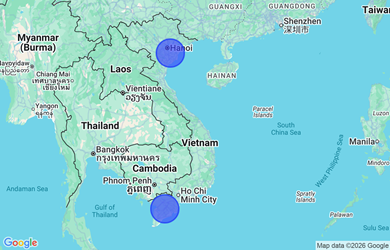
Red River Delta
The investment could start with urban areas, especially in Hanoi to establish an initial customer base and attract medical talent. Expansion into semi-urban area is advised where customers are more familiar with the use of smartphones and apps
Mekong Delta Region
The investment could start with urban areas, especially in Ho Chi Minh to establish an initial customer base and attract medical talent. Expansion into semi-urban area is advised where customers are more familiar with the use of smartphones and apps.
SECTOR SOURCES
1) SHAABAN, N. (2020). Digital Health Entrepreneurship in Vietnam. Retrieved from https://legatum.mit.edu/wp-content/uploads/2020/07/Digital-Health-Vietnam-MIT-Legatum-Center.pdf
3) World Bank. (n.d.). Physicians per 1,000 people. Retrieved from https://data.worldbank.org/indicator/SH.MED.PHYS.ZS
5) Statista. (2022, Aug). Digital Health - Vietnam. Retrieved from https://www.statista.com/outlook/dmo/digital-health/vietnam
6) KPMG. (2020, Aug). Digital Health in Vietnam. Retrieved from https://assets.kpmg/content/dam/kpmg/vn/pdf/publication/2021/digital-health-vietnam-2020-twopage.pdf
9) Vietnam Plus. (2018, Jul 1). Overloaded central hospitals in need of support. Retrieved from https://en.vietnamplus.vn/overloaded-central-hospitals-in-need-of-support/133794.vnp
10) Ministry of Health. (2020, Dec 12). Phê duyệt chương trình chuyển đổi số y tế đến năm 2025, định hướng đến năm 2030. Retrieved from https://thuvienphapluat.vn/van-ban/The-thao-Y-te/Quyet-dinh-5316-QD-BYT-2020-phe-duyet-chuong-trinh-chuyen-doi-so-y-te-den-2025-460152.aspx
11) Duong, S. (2021, Aug 15). Nâng cao chất lượng dịch vụ chăm sóc sức khỏe sinh sản cho người dân tộc thiểu số. Retrieved from https://www.qdnd.vn/xa-hoi/dan-toc-ton-giao/chinh-sach-phat-trien/nang-cao-chat-luong-dich-vu-cham-soc-suc-khoe-sinh-san-cho-nguoi-dan-toc-thieu-so-668448
13) UNDP. (2021). Vietnam National Report on SDGs Implementation 2020. Retrieved from https://www.undp.org/sites/g/files/zskgke326/files/migration/vn/Bao-cao-QG-SDG_VN.pdf
14) World Bank. (n.d.). Physicians per 1,000 people. Retrieved from https://data.worldbank.org/indicator/SH.MED.PHYS.ZS
15) UNFPA. (2017). Những rào cản trong tiếp cận các dịch vụ chăm sóc sức khỏe bà mẹ của đồng bào dân tộc thiểu số việt nam. Retrieved from http://mch.moh.gov.vn/Upload/Documents/2018/4/882d370e55159f31989c9b95b3f15210-R%C3%A0o%20c%E1%BA%A3n%20ti%E1%BA%BFp%20c%E1%BA%ADn%20d%E1%BB%8Bch%20v%E1%BB%A5%20CSSKBM%20v%C3%A0%20KHHG%C4%90%20c%E1%BB%A7a%20%C4%91%E1%BB%93ng%20b%C3%A0o%20thi%E1%BB%83u%20s
16) UNDP. (2021). Vietnam National Report on SDGs Implementation 2020. Retrieved from https://www.undp.org/sites/g/files/zskgke326/files/migration/vn/Bao-cao-QG-SDG_VN.pdf
17) Ministry of Health. (2020, Jun 22). Quyết định phê duyệt đề án “khám, chữa bệnh từ xa” giai đoạn 2020 - 2025. Retrieved from https://thuvienphapluat.vn/van-ban/The-thao-Y-te/Quyet-dinh-2628-QD-BYT-2020-phe-duyet-De-an-Kham-chua-benh-tu-xa-giai-doan-2020-2025-447231.aspx
19) Babuki JSC. (2021, Jun 6). Tổng quan thị trường y tế Việt Nam. Retrieved from https://babuki.vn/thi-truong-thiet-bi-y-te-viet-nam-tong-quan-va-xu-huong-phat-trien/
23) Government of Vietnam. (2021, Apr 1). Quyết định số 531/QĐ-TTg của Thủ tướng Chính phủ: Phê duyệt Chiến lược tổng thể phát triển khu vực dịch vụ của Việt Nam thời kỳ 2021 - 2030, tầm nhìn đến năm 2050. Retrieved from https://chinhphu.vn/?pageid=27160&docid=202997&tagid=6&type=1
IOA SOURCES
1) SHAABAN, N. (2020). Digital Health Entrepreneurship in Vietnam. Retrieved from https://legatum.mit.edu/wp-content/uploads/2020/07/Digital-Health-Vietnam-MIT-Legatum-Center.pdf
2) Quang, V. (2019, Jun 4). Việt Nam đẩy mạnh thực hiện mục tiêu bình đẳng giới trong tiếp cận và thụ hưởng các dịch vụ chăm sóc sức khỏe. Retrieved from http://consosukien.vn/viet-nam-day-manh-thuc-hien-muc-tieu-binh-dang-gioi-trong-tiep-can-va-thu-huong-cac-dich-vu-cham-soc.htm
4) DoctorAnywhere. (n.d.). Retrieved from https://doctoranywhere.vn/ Med 247. (n.d.). Retrieved from https://med247.vn/
7) Báo Điện tử Chính phủ. (2019, Jan 4). Các chính sách ưu đãi tín dụng cho doanh nghiệp ngành y tế. Retrieved from http://baochinhphu.vn/Tra-loi-cong-dan/Cac-chinh-sach-uu-dai-tin-dung-cho-doanh-nghiep-nganh-y-te/356064.vgp
8) Phuong, T. (2019, Sep 9). Giải pháp khắc phục tình trạng quá tải khám, chữa bệnh tại các bệnh viện. Retrieved from https://www.tapchicongsan.org.vn/web/guest/chuong-trinh-muc-tieu-y-te-dan-so/-/2018/810905/giai-phap-khac-phuc-tinh-trang-qua-tai-kham%2C-chua-benh-tai-cac-benh-vien.aspx
12) British Group Vietnam. (2019). Vietnam 2019 Health Care. Retrieved from http://www.ukabc.org.uk/wp-content/uploads/2019/04/Sector-Briefing-Healthcare-In-Vietnam-2019.pdf
18) British Group Vietnam. (2019). Vietnam 2019 Health Care. Retrieved from http://www.ukabc.org.uk/wp-content/uploads/2019/04/Sector-Briefing-Healthcare-In-Vietnam-2019.pdf
21) Dịch vụ kế toán thuế. (2019, Dec 6). Ưu đãi Thuế cho Dịch vụ y tế, sức khỏe là như thế nào ??? Retrieved from https://blog.1ketoan.com/uu-dai-thue-cho-dich-vu-y-te-suc-khoe-la-nhu-the-nao/1718/
22) Health Strategy and Policy Institute. (2021, Mar 5). Chuyển đổi số trong lĩnh vực y tế: Cơ hội cho Y tế từ xa. Retrieved from http://www.hspi.org.vn/vcl/Chuyen-doi-so-trong-linh-vuc-y-te-Co-hoi-cho-y-te-tu-xa-t102-9070.html
24) Vietnam Communist Party. (2017, Oct 25). Nghị quyết 20-NQ/TW về tăng cường công tác bảo vệ, chăm sóc và nâng cao sức khoẻ nhân dân trong tình hình mới. Retrieved from https://thuvienphapluat.vn/van-ban/The-thao-Y-te/Nghi-quyet-20-NQ-TW-2017-tang-cuong-cong-tac-bao-ve-cham-soc-nang-cao-suc-khoe-nhan-dan-365599.aspx
25) Ministry of Health. (2017, Dec 28). Thông tư về hoạt động y tế từ xa. Retrieved from file:///C:/Users/Admin/Downloads/1-3-2020_49_2017_TT-BYT_347138.pdf
26) Ministry of Health. (2014, Dec 29). Quy định điều kiện hoạt động y tế trên môi trường mạng. Retrieved from https://thuvienphapluat.vn/van-ban/Cong-nghe-thong-tin/Thong-tu-53-2014-TT-BYT-hoat-dong-y-te-tren-moi-truong-mang-262861.aspx
27) Ministry of Health. (2017, Dec 28). Thông tư về hoạt động y tế từ xa. Retrieved from file:///C:/Users/Admin/Downloads/1-3-2020_49_2017_TT-BYT_347138.pdf
28) Ministry of Health. (2017, Dec 29). Ban hành bộ tiêu chí ứng dụng công nghệ thông tin tại các cơ sở khám bệnh, chữa bệnh. Retrieved from https://thuvienphapluat.vn/van-ban/Cong-nghe-thong-tin/Thong-tu-54-2017-TT-BYT-Bo-tieu-chi-ung-dung-cong-nghe-thong-tin-tai-cac-co-so-kham-chua-benh-373292.aspx
29) Thanh, D. (2022, Apr). Startup 'phòng khám số' gọi vốn 4,5 triệu USD. Retrieved from https://startup.vnexpress.net/tin-tuc/hanh-trinh-khoi-nghiep/startup-phong-kham-so-goi-von-45-trieu-usd-4444949.html
30) Ho, R. (2022, Jan 20). Startup Việt “chơi vơi” giữa dòng vốn chảy mạnh của y tế số. Retrieved from https://thesaigontimes.vn/startup-viet-choi-voi-giua-dong-von-chay-manh-cua-y-te-so/
31) Ministry of Health. (2020, Jun 22). Quyết định 2628/QĐ-BYT Đề án Khám, chữa bệnh từ xa giai đoạn 2020-2025. Retrieved from https://luatvietnam.vn/y-te/quyet-dinh-2628-qd-byt-de-an-kham-chua-benh-tu-xa-giai-doan-2020-2025-186524-d1.html