
Explore the country and target locations of the investment opportunity.
Country
Vietnam
Region
- Northern Key Economic Zone
- Central Key Economic Zone
- Eastern South Region
Situate the investment opportunity within sustainability focused sector, subsector and industry classifications.
Sector
Infrastructure
Development need
6.3% of the population in rural areas does not have access to sanitary water (2018) (9). An average of 84.3% of solid waste from urban activities is collected and treated as per national standards but this is mainly for landfills, and the ratio is much lower in some regions (e.g. 63% in the Highlands) (2018) (2), social housing achieved 41.7% of the national target (2020) (15)
Policy priority
As specified in the Socio-economic Development Strategy 2021-2030 of the Vietnam Communist Party, infrastructure development is one of Vietnam's key strategic development pillars. In addition, the application of high and green technology by the private sector is strongly encouraged by the government for infrastructure projects (10).
Gender inequalities and marginalization issues
Women account for half of the 64m population in rural areas (65% of Vietnam's total population) that suffers from underdeveloped infrastructure services, including pollution caused by solid waste, and unhygienic water supply (14, 16)
Investment opportunities
Vietnam's waste management market was valued at USD 3.8 billion in 2020 (4), the potential of electricity generation from solid waste is estimated at 1,517 MW with an average power output of 10,617,740 GWh/year (11), and the investment demand in the water sector is estimated between $1.3 billion to $2.7 billion over the next 10 years (12).
Key bottlenecks
Varied by investment but usually complex due to involvement with multiple partners and challenging negotiation with provincial authorities/ municipalities
Sub Sector
Waste Management
Development need
Vietnam lacks the adequate capacity to process solid waste: 75 % of collected solid waste is went into landfills in 2020 and 80% of this is not compliant with sanitary standards (TCVN 6696:2000 by STAMEQ); the rate of waste collection is only approximately 40% and 60-80% in rural and urban areas respectively (2)
Policy priority
As stated in the National Strategy on Waste Management, by 2025, 90% and 80% of solid waste in urban and rural areas respectively will be collected and treated as per environmental standards and the rate of directly buried waste will be less than 30%; 80% of waste from industrial activities is recycled and processed (22)
Gender inequalities and marginalization issues
Women account for half of the 63 m population in rural areas (16) that suffer from pollution caused by improper processing of solid waste and limited access to clean water (18). Over 50,000 women are working in waste management with polluted working condition that causes dangerous illness like respiratory tract or gastrointestinal infections(2).
Investment opportunities
(a) Solutions for solid waste recycling, (b) Application of advanced technologies for processing solid waste before going to landfills (The current investment in technologies is low; waste processing equipment/ machine is generally outdated causing environmental pollution), (c) Waste-to-energy generation
Key bottlenecks
The service cost for solid waste processing and land access is defined by the negotiations with the local governments (provincial and municipal).
Industry
Waste Management
Discover the investment opportunity and its corresponding business model.
Investment Opportunity Area
Solid waste processing using environmentally efficient technologies
Business Model
Invest in modern technologies for solid waste processing, e.g. pyrolysis with energy recovery, to reduce treatment costs, sanitary landfilling, and microbial production. The investment can focus on solutions for solid waste recycling or the application of advanced technologies for processing solid waste before landfilling. This IOA is B2B, in which the buyers are municipalities or businesses.
VWS (Vietnam Waste Solution) invests over USD m 100 in new technology at Da Phuoc Waste Treatment Complex to turn waste into electricity, liquid fertilizer, and compost to reduce the landfill rate, carbon, and Greenhouse Gas Emissions (3). The California Waste Solution is currently the major investor of VWS.
Learn about the investment opportunity’s business metrics and market risks.
Market Size and Environment
Market Size (USD)
USD 100 million - USD 1 billion
CAGR
5% - 10%
Critical IOA Unit
27.8 million tons of solid waste in 2018, 63,000 tons/day from households (4)
75% of Vietnam's solid waste (equivalent to about 20 m tons) is being landfilled, and 80% of the landfilled amount is unhygienic and is polluting the environment, due to improper processing. The cost of processing solid waste is approximately 20 - 40 USD/ton (2)
The five biggest cities in Vietnam -Hanoi, Ho Chi Minh City, Haiphong, Da Nang, and Can Tho – account for about 70% of the total waste generation. The municipal solid waste contains 60% to 70% of biodegradable residues by wet weight (2)
Indicative Return
ROI
10% - 15%
Citenco is a solid waste management business in Ho Chi Minh, having achieved ROI at a consistent level of 10% in the last 5 years (5). Other similar businesses listed on the stock exchange has ROIs in the range 5% - 15%.
Investment Timeframe
Timeframe
Medium Term (5–10 years)
ROI is estimated to be 10 - 15%. Revenue and cash flow are relatively guaranteed because the service price for waste processing is negotiated upfront with the provincial governments. The setup time realistically takes about 2 - 3 years.
Ticket Size
Average Ticket Size (USD)
Ticket size will vary by investment per-day capacity: a minimum investment is 50 tons/day capacity is in usual practice, and the maximum capacity can be up to a few thousand tons/day. The estimated investment standard is worth about 20,000 USD/ton/day (6)
Market Risks & Scale Obstacles
Market - Highly Regulated
The waste processing service is paid for by the local government. The service price is primarily framed by local regulations and the negotiations that follow with the operators, also driven by budgetary allocations and the type of waste management technologies.
Capital - CapEx Intensive
CapEx is directly proportional to the target capacity of the waste management plant. For example, Da Nang city is calling for an investment in solid waste processing at a capacity of 1000 tons/day and the CapEx is estimated at about USD 35 m. (27)
Read about impact metrics and social and environmental risks of the investment opportunity.
Sustainable Development Need
Waste management is an important area contributing to the mitigation-related goals to reduce Greenhouse Gas emissions [GHG] as identified by the Nationally Determined Contribution (NDC) of Vietnam.
Approximately 75% of solid waste collected throughout the country are treated by the landfill method, of which about 80% are sanitarily disqualified, leading to serious environmental pollution in the areas where the landfills are located (2)
Gender & Marginalisation
Women are a major force in the informal solid waste collection that accounts for over 30% of the waste. These are on low income due to limited collection, and also suffering from environmental pollution caused by leakages at the landfills.
Expected Development Outcome
Contribution to Vietnam's aspiration for a circular economy; Improvement of the quality of life of the population in general, by reducing pollution, especially in urban areas. For those involved in the waste management sector, it is the improvement in the income and working environment.
Contribute to reducing GHG emission, and energy-saving - the CO2 reduction is estimated to be 0.12 tons per garbage ton (37)
Gender & Marginalisation
Women and informal workers in the landfill areas will benefit from the improved environment that is resulted from the waste processing as per sanitary standards.
Primary SDGs addressed
11 - Sustainable Cities and Communities
11.6.1 Proportion of municipal solid waste collected and managed in controlled facilities out of total municipal waste generated, by cities
Current Value
84.3% of urban solid waste from households is collected and treated as per the national standards and technical regulations. This proportion is uneven across cities and regions. For example, this rate in urban areas in the Central Highlands only reached 61% in 2018 (2)
Target Value
Percentage of municipal solid waste collected and treated as per standards and regulations: 90% in 2025 and 95% in 2030 (7)
Secondary SDGs addressed
3 - Good Health and Well-Being
Directly impacted stakeholders
People
People that are living in the areas near the waste concentration and processing sites or working at the landfills will benefit from an improved waste management practices at the landfills
Gender inequality and/or marginalization
Women who are working at the waste concentration sites will benefit from health improvement due to the application of environmentally friendly waste management practices at the sites.
Planet
The environment of the locations where the solid waste processing facilities are invested/operated is improved. The planet will gain from the decrease in GHG emissions resulting from the reduction in waste generation.
Corporates
The investment can help other industrial businesses to process their solid waste from industrial activities thereby creating an additional revenue stream.
Public sector
The government benefits from savings by fostering private sector participation in waste management (avoiding large expenditures for waste recycling, treatment, etc.)
Indirectly impacted stakeholders
People
People across the country, especially those living in urban areas that are constituting 37 percent of the population at about 34 mn people.
Gender inequality and/or marginalization
Several jobs in recycling, remanufacturing, and composting, can be created for women as a result of the circular waste system.
Planet
Animals, both on land and in water, benefit from reduced hazards to their health by consuming waste, microplastics, etc. in contaminated water.
Corporates
Companies may improve performance from less expensive material inputs supplied by zero waste management practices.
Public sector
Reduction in the Government's burden for protecting the environment in terms of biosecurity and food security.
Outcome Risks
Improved environment and contribution to GHG emission reduction may not be fully achieved if wrong technologies are selected.
Thinly populated areas and rural areas may remain unserved, due to the need for densely populated geographies to realize economies of scale, leading to imbalances in waste management.
Business models, at a time, can deploy technology only for one type of waste recycling/processing, thus resulting in the exclusion of certain categories of waste.
Gender inequality and/or marginalization risk: In the absence of sufficient regulations/controls waste workers/ collectors stand to be exposed to exploitative practices by operators.
Impact Risks
Ineffective operational management leads to low profitability, and so, crowding out investment, unfavorably affecting the target of 95% of solid waste treated as per the required standards.
Scaling up the technology in waste processing without adequate safety, capacity building and income security measures for waste picker communities can lead to further marginalization challenges.
Gender inequality and/or marginalization risk: Lack of private participation in this sector will aggravate the burden on the Government to spend on waste management and environmental conservation.
Impact Classification
C—Contribute to Solutions
What
This investment help to improve the environment by reducing pollution and GHG emission by properly treating household and industrial solid waste
Who
All people and communities in Vietnam, especially those in the urban area
Risk
Low-to-medium risk given the demand is guaranteed in the beginning, and the demand is also increasing over time due to economic development and increasing public consciousness for waste management
Contribution
State investment in waste treatment infrastructure accounts for about 80% (35% from the state expenditure budget and 45% from ODA); the private sector covers about 20% (2)
How Much
About 16m tons of solid waste (80% of 20 m tons of landfilled solid waste) is being unprocessed (2)
Impact Thesis
This investment can improve household and commercial waste treatment performance, thereby reducing environmental pollution and improving health for local communities.
Explore policy, regulatory and financial factors relevant for the investment opportunity.
Policy Environment
National Strategy on Waste Management: Apply advanced environmental-friendly technologies in waste management, to generate energy, reduce emissions, and develop the recycling industry; Mobilize different sources for investment and promote public-private partnerships in waste management projects (22)
National Strategy on Integrated Management of Solid Waste to 2025, Vision for 2050: All solid waste is collected, reused, recycled, and thoroughly treated with advanced, environmentally friendly technologies, limiting the volume of solid waste to be buried to a minimum. (33)
GoV, Decision, 1979/QĐ-TTg, Decision 1440/QĐ-TTg, and Decision 1873/QĐ-TTg: Governmental Inter-region waste management plan sets out specific objectives for a percentage of waste collection and treatment; 59/63 provinces also have their own plan for solid waste management. (23)
GoV, Decision 2211/QĐ-TTg, 2013, Decision 07/QĐ-TTg, 2015 and Decision 223/QĐ-TTg, 2015: management plans on solid waste for three different river areas - Cau River, Dong Nai River, and Nhue River respectively (26, 32)
National Strategy on Integrated Management of Solid Waste to 2025, Vision for 2050: All solid waste is collected, reused, recycled, and thoroughly treated with advanced, environmentally friendly technologies, limiting the volume of solid waste to be buried to a minimum (35)
Financial Environment
GoV, Circular 121-2008-TT-BTC: Guidelines on financial incentives on investment in solid waste management. Various financial incentives: tax, land, a preferential rate of the loan (decided on a case-by-case basis) (25)
Decree 32/2017/NĐ-CP: provides preferential credit for encouraged investments, including solid waste processing businesses (28)
Other incentives: Decree 78/2014/TT-BTC and 31/2021/NĐ-CP: Guidelines on corporate income tax, provide the term of preferential income taxes, including the investments in waste management (33,34)
Regulatory Environment
Law of Environment Protection 2014: regulations on environmental protection, including rights, obligations, and responsibilities of agencies, organizations, communities, households, and individuals. It also covers technical standards on solid waste management infrastructure (21)
Law on Fees and Charges (2015): regulations on the list of fees and charges; fee and charge payers; organize the collection of fees and charges; principles of determining the rates of collection, exemption, reduction, collection, payment, management, and use of fees and charges (30)
GoV, Decree 38/2015/ND-CP: Regulations on waste management, including hazardous waste, domestic solid waste, ordinary industrial solid waste, liquid waste products, wastewater, industrial waste, and other specific wastes (31)
Law on Investment by Public-Private Partnership: regulations on investment under the public-private partnership, State management, rights, obligations, and responsibilities of agencies, organizations, and individuals related to investment activities in the form of public-private partnership (29)
Discover examples of public and private stakeholders active in this investment opportunity that were identified through secondary research and consultations.
Private Sector
Multiple players are active in different provinces/ regions in Vietnam, including Everbright Environment, Vietnam Waste Solution, Green Energy T&J, Hue Phuong Vietnam Green Environment, Thien Y Energy & Environment.
Government
Municipalities, provincial governments, Ministry of Resources and Environment (MONRE), Ministry of Science and Technology (MoST)
Multilaterals
World Health Organisation (WHO), United Nations Entity for Gender Equality and the Empowerment of Women (UN Women), United Nations Development Programme (UNDP), United Nations Children's Fund (UNICEF), Asian Development Bank (ADB), and World Bank (WB).
Non-Profit
Vietnam Environment Industry Association (VEIA), Vietnam Association for Solid Waste Management (newly established in 2022), Vietnam Association for Conservation of Nature and Environment (VACNE)
See what country regions are most suitable for the investment opportunity. All references to Kosovo shall be understood to be in the context of the Security Council Resolution 1244 (1999)
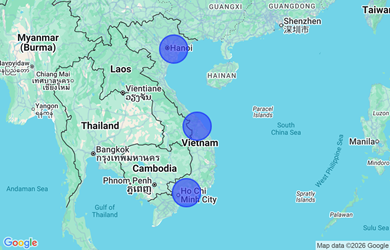
Northern Key Economic Zone
The government has plans for the development of solid waste capacity for three major regions with high population density in the North, South, and Centre. Waste management is specifically planned for 03 river basins including Cau River, Dong Nai river, and Nhue - Day river (26, 32)
Central Key Economic Zone
The government has plans for the development of solid waste capacity for three major regions with high population density in the North, South, and Centre. Waste management is specifically planned for 03 river basins including Cau River, Dong Nai river, and Nhue - Day river (26, 32)
Eastern South Region
The government has plans for the development of solid waste capacity for three major regions with high population density in the North, South, and Centre. Waste management is specifically planned for 03 river basins including Cau River, Dong Nai river, and Nhue - Day river (26, 32)
SECTOR SOURCES
2) MONRE, 2019. Bao cao hien trang moi truong quoc gia. [Online] Available at: http://dwrm.gov.vn/uploads/news/2020_11/bao-cao-hien-trang-moi-truong-2019.pdf
4) Mordor Intelligence, 2021. Vietnam waste management market - growth, trends, covid-19 impact, and forecasts (2022 - 2027). [Online] Available at: https://www.mordorintelligence.com/industry-reports/vietnam-waste-management-market-study
9) VUNDP, 2021. Vietnam National Report on SDGs Implementation 2020. [Online] Available at: https://www.undp.org/sites/g/files/zskgke326/files/migration/vn/Bao-cao-QG-SDG_VN.pdf
10) Vietnam Communist Party, 2021. Digital News of Vietnam Communist Party. [Online] Available at: https://tulieuvankien.dangcongsan.vn/ban-chap-hanh-trung-uong-dang/dai-hoi-dang/lan-thu-xiii/chien-luoc-phat-trien-kinh-te-xa-hoi-10-nam-2021-2030-3735
11) EVN, 2021. Bảo đảm công khai, minh bạch, khoa học, khách quan trong xây dựng Quy hoạch Điện VIII. [Online] Available at: https://www.evn.com.vn/d6/news/Bao-dam-cong-khai-minh-bach-khoa-hoc-khach-quan-trong-xay-dung-Quy-hoach-Dien-VIII-0-12-29551.aspx 12) Lambert, D., 2021. Necessary reforms to boost investment into Vietnam’s burgeoning water sector. [Online] Available at: https://vir.com.vn/necessary-reforms-to-boost-investment-into-vietnams-burgeoning-water-sector-85184.html
14)Department of Water Resource Management, 2020. Tiếp tục báo động an ninh nước sạch. [Online] Available at: http://dwrm.gov.vn/index.php?language=vi&nv=news&op=Hoat-dong-cua-dia-phuong/Tiep-tuc-bao-dong-an-ninh-nuoc-sach-9344
15) Phan, N., 2021. “Bỏ quên” nhà ở cho người thu nhập thấp. [Online] Available at: https://vneconomy.vn/bo-quen-nha-o-cho-nguoi-thu-nhap-thap.htmho-nguoi-thu-nhap-thap.htm
16) MOLISA, 2019. [Online] Available at: http://www.molisa.gov.vn/Pages/tintuc/chitiet.aspx?tintucID=29769
18) Thu, H., 2020. Rác thải nông thôn - Thực trạng và định hướng quản lý. [Online] Available at: https://consosukien.vn/rac-tha-i-nong-thon-thu-c-tra-ng-va-di-nh-huong-qua-n-ly.htm Completed APA
IOA SOURCES
1) Vietnam Communist Party, 2021. Digital News of Vietnam Communist Party. [Online] Available at: https://tulieuvankien.dangcongsan.vn/ban-chap-hanh-trung-uong-dang/dai-hoi-dang/lan-thu-xiii/chien-luoc-phat-trien-kinh-te-xa-hoi-10-nam-2021-2030-3735
2) MONRE, 2019. Bao cao hien trang moi truong quoc gia. [Online] Available at: http://dwrm.gov.vn/uploads/news/2020_11/bao-cao-hien-trang-moi-truong-2019.pdf
3) Business case - Vietnam Waste Solution, 2022. Vì lợi ích cộng đồng. [Online] Available at: http://vnwaste.com/vi/; Business case - Huy Hoang: Eco Institute for Environment and Agriculture, n.d. Tin hoat dong. [Online] Available at: http://ieco.com.vn/vn/tin-tuc/tin-hoat-dong/hieu-qua-xu-ly-moi-truong-bai-rac-soi-nam-1009.51.htmll
5) CITENCO, 2019. Báo cáo Tài chính. [Online] Available at: https://citenco.com.vn/uploads/files/%5BCITENCO_2019%5D%20BAO%20CAO%20TAI%20CHINH%20DA%20KIEM%20TOAN%20NAM%202019.pdf
6) Investment norm and expense for waste management, Decision 1354/QĐ-BXD, 2017: https://thuvienphapluat.vn/van-ban/Tai-chinh-nha-nuoc/Quyet-dinh-1354-QD-BXD-2017-suat-von-dau-tu-xay-dung-muc-chi-phi-xu-ly-chat-thai-ran-sinh-hoat-374363.aspx
7) Government of Vietnam, 2017. Decision 622/QĐ-TTg Về việc ban hành Kế hoạch hành động quốc gia thực hiện Chương trình nghị sự 2030 vì sự phát triển bền vững. [Online] Available at: https://vanban.chinhphu.vn/default.aspx?pageid=27160&docid=189713
8) Tran, V. H., 2021. Environment Magazine. [Online] Available at: http://tapchimoitruong.vn/nghien-cuu-23/phuong-phap-tinh-gia-dich-vu-xu-ly-chat-thai-ran-sinh-hoat-o-viet-nam-thuc-trang-va-de-xuat-mot-so-giai-phap-21775
13)Government of Vietnam, 2011. Decision 2127/QĐ-TTg Phê duyệt Chiến lược phát triển nhà ở quốc gia đến năm 2020 và tầm nhìn đến năm 2030. [Online] Available at: https://chinhphu.vn/default.aspx?pageid=27160&docid=152934
17) Government of Vietnam, 2011. Decision 2127/QĐ-TTg phê duyệt chiến lược phát triển nhà ở quốc gia đến năm 2020 và tầm nhìn đến năm 2030. [Online] Available at: https://chinhphu.vn/default.aspx?pageid=27160&docid=152934
21) Vietnam National Assembly, 2014. Law on Environment Protection. [Online] Available at: http://vanban.monre.gov.vn/Admin/Uploads/VanBan/Lu%E1%BA%ADt%20B%E1%BA%A3o%20v%E1%BB%87%20m%C3%B4i%20tr%C6%B0%E1%BB%9Dng%202014.pdf
22) Government of Vietnam, 2018. Phê duyệt điều chỉnh Chiến lược quốc gia về quản lý tổng hợp chất thải rắn đến năm 2025, tầm nhìn đến năm 2050. [Online] Available at: https://vanban.chinhphu.vn/default.aspx?pageid=27160&docid=193601
23) Government of Vietnam, 2016. Phê duyệt Quy hoạch quản lý chất thải rắn vùng kinh tế trọng điểm Bắc Bộ đến năm 2030. [Online] Available at: https://chinhphu.vn/default.aspx?pageid=27160&docid=186757 Government of Vietnam, 2008. Quy hoạch xây dựng xử lý chất thải rắn 3 vùng kinh tế trọng điểm Bắc Bộ, miền Trung và phía Nam đến năm 2020. [Online] Available at: https://chinhphu.vn/default.aspx?pageid=27160&docid=87042 Government of Vietnam, 2015. Phê duyệt quy hoạch quản lý chất thải rắn lưu vực sông nhuệ - sông đáy đến năm 2030. [Online] Available at: https://thuvienphapluat.vn/van-ban/Tai-nguyen-Moi-truong/Quyet-dinh-223-QD-TTg-2015-phe-duyet-Quy-hoach-quan-ly-chat-thai-ran-luu-vuc-song-Nhue-song-Day-2030-266177.aspx
24) Tran, L. B., 2021. Tạp chí môi trường. [Online] Available at: http://tapchimoitruong.vn/chuyen-muc-3/mot-so-giai-phap-tang-cuong-dau-tu-theo-phuong-thuc-ppp-trong-xu-ly-chat-thai-ran-sinh-hoat-22933
25) Ministry of Finance, 2008. Thông tư 121/2008/TT-BTC Hướng dẫn cơ chế ưu đãi và hỗ trợ tài chính đối với hoạt động đầu tư cho quản lý chất thải rắn. [Online] Available at: https://thuvienphapluat.vn/van-ban/Dau-tu/Thong-tu-121-2008-TT-BTC-co-che-uu-dai-ho-tro-tai-chinh-hoat-dong-dau-tu-quan-ly-chat-thai-ran-82694.aspx
26) Government of Vietnam, 2013. Quyết định 2211/QĐ-TTg của Thủ tướng Chính phủ: Phê duyệt Quy hoạch quản lý chất thải rắn lưu vực sông Cầu đến năm 2020. [Online] Available at: https://vanban.chinhphu.vn/default.aspx?pageid=27160&docid=170835 Government of Vietnam, 2015. Quyet dinh 07/QD-TTg-2015: phê duyệt quy hoạch quản lý chất thải rắn lưu vực sông đồng nai đến năm 2030. [Online] Available at: https://thuvienphapluat.vn/van-ban/Tai-nguyen-Moi-truong/Quyet-dinh-07-QD-TTg-2015-Quy-hoach-quan-ly-chat-thai-ran-luu-vuc-song-Dong-Nai-den-nam-2030-262502.aspx
27) Da Nang Government, 2020. Dự án: Nhà máy xử lý chất thải rắn sinh hoạt 1.000 tấn/ngày đêm tại Khu liên hợp xử lý chất thải rắn thành phố Đà Nẵng theo hình thức PPP. [Online] Available at: https://danang.gov.vn/chinh-quyen/chi-tiet?id=42113&_c=100000144
28)Government of Vietnam, 2017. Nghị định 32/2017/NĐ-CP của Chính phủ: Về tín dụng đầu tư của Nhà nước. [Online] Available at: https://vanban.chinhphu.vn/default.aspx?pageid=27160&docid=189062
29) Vietnam National Assembly, 2020. Luật đầu tư theo phương thức đối tác công tư. [Online] Available at: https://thuvienphapluat.vn/van-ban/Dau-tu/Luat-Dau-tu-theo-hinh-thuc-doi-tac-cong-tu-so-64-2020-QH14-374160.aspx
30) Vietnam National Assembly, 2015. Luật phí và lệ phí. [Online] Available at: https://thuvienphapluat.vn/van-ban/Thue-Phi-Le-Phi/Luat-phi-va-le-phi-2015-298376.aspx
31) Government of Vietnam, 2015. Nghị định 38/2015/nđ-cp về quản lý chất thải và phế liệu. [Online] Available at: https://thuvienphapluat.vn/van-ban/Tai-nguyen-Moi-truong/Nghi-dinh-38-2015-ND-CP-quan-ly-chat-thai-va-phe-lieu-272929.aspx
32) Government of Vietnam, 2015. Phê duyệt quy hoạch quản lý chất thải rắn lưu vực sông nhuệ - sông đáy đến năm 2030. [Online] Available at: https://thuvienphapluat.vn/van-ban/Tai-nguyen-Moi-truong/Quyet-dinh-223-QD-TTg-2015-phe-duyet-Quy-hoach-quan-ly-chat-thai-ran-luu-vuc-song-Nhue-song-Day-2030-266177.aspx
33) Ministry of Finance, 2013. Hướng dẫn thi hành nghị định số 218/2013/nđ-cp của chính phủ quy định và hướng dẫn thi hành luật thuế thu nhập doanh nghiệp. [Online] Available at: https://thuvienphapluat.vn/van-ban/Doanh-nghiep/Thong-tu-78-2014-TT-BTC-huong-dan-218-2013-ND-CP-thi-hanh-Luat-Thue-thu-nhap-doanh-nghiep-236976.aspx
34) Government of Vietnam, 2021. Nghị định quy định chi tiết và hướng dẫn thi hành một số điều của luật đầu tư. [Online] Available at: https://thuvienphapluat.vn/van-ban/Dau-tu/Nghi-dinh-31-2021-ND-CP-huong-dan-Luat-Dau-tu-462291.aspx
35) Government of Vietnam, 2009. Phê duyệt chiến lược quốc gia về quản lý tổng hợp chất thải rắn đến năm 2025, tầm nhìn đến năm 2050. [Online] Available at: https://thuvienphapluat.vn/van-ban/Bo-may-hanh-chinh/Quyet-dinh-2149-QD-TTg-phe-duyet-chien-phe-duyet-chien-luoc-quoc-gia-luoc-quoc-gia-quan-ly-tong-hop-chat-thai-ran-den-nam-2025-tam-nhin-den-nam-2050-99096.aspx
36) Manh, D., 2022. Năng lượng tái tạo chiếm tới 16,8% trong tổng sản lượng điện sản xuất. [Online] Available at: https://vneconomy.vn/nang-luong-tai-tao-chiem-toi-16-8-trong-tong-san-luong-dien-san-xuat.htm
37) Vuong, H. X., Dang, V. Q. & Vu, N. D., 2018. Viet Nam institute of meteorology, hydrology and climate change. [Online] Available at: http://imh.ac.vn/files/doc/TBDB_Khihau/Cac%20bai%20tap%20chi%20so%206/Bai%207.pdf