
Explore the country and target locations of the investment opportunity.
Country
Indonesia
Region
- Kalimantan
- Java
- Sumatra
Situate the investment opportunity within sustainability focused sector, subsector and industry classifications.
Sector
Renewable Resources and Alternative Energy
Development need
The use of new renewable energy (NRE) has increased, but not realized for its full potential. (1) The energy mix for NRE is ~11%, still lower than 2025 target of 23%. (2) GoI pledged to reduce emissions during 2020-2030 by 29% (unconditional) upto 41% (conditional) against the 2030 business as usual scenario. (3)
Policy
Presidential Regulation no.18/2020 - NRE is prioritized to fulfill energy demand. Improving Environment, Increasing Disaster and Climate Change Resilience, including energy policy, is designated as one of the national priorities (PN6).(1.2) Under COP26, Indonesia pledged to commit: 2030: >50% new electricity capacity from RE 2040: partial coal phase-out 2060: achieve a net-zero target (6).
Gender inequalities and marginalization issues
In 2021, ~12.5 mn poor and vulnerable households, mostly in rural areas, still use firewood for cooking. (7) Clean energy could offer low-income communities, including women, an alternative to their daily use of traditional wood-fired stoves, which have been categorized as unclean, inefficient and unhealthy.
At the micro/household level, women play an important role in energy efficiency efforts, such as electricity-saving or water usage. The energy and RE sector could reap significant benefits from the value-add of women across levels (including entrepreneurs, RE consumers, or decision-making).
The Ministry of Energy and Mineral Resources (MEMR) has sought efforts to mainstream gender in the RE sector and observed an increase in women employment from 22.8% in 2011 to 27.5% in 2021. (8)
Investment opportunities
Indonesia's total power investment needs are estimated at USD 9.14 bn annually over 2021-30, or 1.6x the actual spending power in 2019 to meet its net-zero target. With PLN expected to contribute USD 5.14 bn/year for such needs, private sector participation is encouraged to ease financial burdens and tap into opportunities to strengthen the RE sector. (9)
Key bottlenecks
The absence of established guidelines and enforcements for clean energy, including incentives and disincentives and minimum performance standards, leads to a lack of verification of savings, demand policies for change, risk reduction and capacity gap for market entry for renewable energy players. (10)
Sub Sector
Alternative Energy
Development need
Electricity supply from the State Electricity Company (PLN) is still generated mostly from coal. PLN projects the energy demand to rise to 1,800 terawatt-hour by 2060 leaving a gap of 1,380 terawatt-hour. (11) The 2021-2030 RUPTL has targeted 20.9 GW electricity generation using NRE (9)
Policy
Sustainable, adequate, accessible, and affordable energy and electricity are among priorities to achieve 2020-2024 development agenda in energy sector. These are accommodated in the Priority Program (PP) 1 - NRE acceleration to meet energy needs and PP 2 - Efficient, equally distributed and reliable energy supply. (5)
Gender inequalities and marginalization issues
In 2020, there are 409 villages without electricity and 3,090 others without sufficient and reliable electricity. The villages are mostly located in eastern part of Indonesia such as Papua and NTT. (12)
Investment opportunities
Electricity consumption per capita grew from 1.06 MWH (2018) to 1.09 MWH (2020), indicating a growing domestic demand (13) and need to fulfill it through alternative means. 65% of additional capacity for power generation expansion plans is allocated to Independent Power Producers (IPP) (not PLN) to encourage private players to invest in renewable energy. (9)
Key bottlenecks
Investment cost for NRE power plants is still higher than that for fossil fuel, while the demand for electricity remains uncertain in some regions due to several problems such as industrial production capacity. (9)
Industry
Solar Technology and Project Developers
Discover the investment opportunity and its corresponding business model.
Investment Opportunity Area
Solar PV and Rooftop Solar Power systems
Business Model
Invest in or provide project financing for electricity generation for industrial (manufacturing units or plants) and commercial (office buildings) and residential energy needs through: > Solar PV systems under independent power producer (IPP) schemes or public-private partnership (PPP); and > Roof-top systems under private commercial investment.
Examples of some companies active in this space are: SolarKita, founded in 2018, is a Smart Solar Energy Company that provides solar products and end-to-end services to the residential market in Indonesia, consultation, site survey, installation, and monitoring & maintenance. It raised an undisclosed amount of funding from New Energy Nexus.
PT Xurya Daya Indonesia, founded in 2018, installs and leases rooftop solar panels. The company provides rooftop solar power plants (PLTS) that generate electricity. It also provides operation and maintenance services for solar panels. In 2022, it raised USD 21.5 mn in series A from East Ventures (Growth fund) and PT Saratoga Investama Sedaya Tbk. (Saratoga). (14)
PACE Energy, founded in 2015, is a wholly-owned subsidiary of Total Eren S.A. a leading French renewable energy Independent Power Producer (IPP) with over 27,500 MW of assets in construction or operations.
Learn about the investment opportunity’s business metrics and market risks.
Market Size and Environment
Market Size (USD)
USD 100 million - USD 1 billion
CAGR
Government targets to achieve New & Renewable Energy (NRE) mix of 23% by 2025 and 31% by 2050 (16)
Critical IOA Unit
Electricity consumption - 9000 TWh per year by 2050 (17) Solar rooftop potential - 32.5 GW (18)
Estimated Market Value of Rooftop PV Project for 2022-2025 is USD 65.4 mn. Market for utility scale solar PV is expected to be USD 423.5 mn during the 2022-2025 period. (15) Further, 17.8% of the total number of Indonesian households have financial capability to install rooftop solar, equal to 34-116 GWp. (19)
The National General Electricity Plan targets doubling the share of renewable energy generation to 23% of the country’s total generation mix by 2025. Currently, the renewable energy potential is 443 Gigawatts (GW), including a solar energy potential of 208 GW. (17) RE installed capacity has grown by ~4% annually since 2012 (18.9) and employs ~519,196 workers.(20)
Solar energy deployment with a target of 18GW is expected to attract investment of USD 14.4 bn. Further, solar costs currently range between USD 65-137/MWh (real 2020 dollars), but are estimated to fall to USD 27-48/MWh (real 2020 dollars) by 2030, due to lower costs, coupled with more attractive financing terms. (21)
Indicative Return
IRR
10% - 15%
GPM
15% - 20%
Xurya, a rooftop solar solution provider, tripled its construction of Rooftop Solar Power Plants in 2021. It has operated 57 Rooftop Solar Power Plants and is currently building in 38 other locations from various industries and businesses that are increasingly diverse. (22)
Other Solar PV operators like Vena Energy reported revenue of USD 32.1 mn in 2020. Revenue from Indonesia solar contracts in H1-2020: USD 3.7 mn (23)
Private Equity firms target 20-25% IRRs on their investment. Returns depend on stage of investment and the valuation at the time of exit. Example: Seed fund investors will earn a better return if they hold their investment, than the investors who enter at a later stage.
Investment Timeframe
Timeframe
Long Term (10+ years)
As per experts, most catalytic funds are patient investors and invest for 10 years and more. Most VCs invest for 5-8 years. As RE space is new and evolving, the investment gestation period is long. However, the gestation period for Solar rooftop based investments can be shorter than that for Solar PV.
As per expert discussions, the gestation time for solar rooftop project developments can be relatively short. If the initial set-up related approvals are in place, a good return could potentially range from 6 months to a year.
Concession period based on a Build-Operate-Transfer (BOT) model for RE projects can be for 20-30 years. (23)
Ticket Size
Average Ticket Size (USD)
> USD 10 million
Market Risks & Scale Obstacles
Market - Highly Regulated
Government imposes a 40% local-content requirement for solar panels (which are assembled from imported components). This can be an impediment in manufacturing and procuring low-cost solar PV unlike in other countries. (24)
Market - Volatile
Government regulations in RE are still evolving, and the existing regulations hinder uptake of renewable energy generation technologies such as PV. Current power purchase tariff regulations force clean energy to compete with subsidized coal power.
Business - Supply Chain Constraints
Since the battery cost is high (mostly imported), the overall initial cost of installation is high (despite PLN’s credit). Additional financial assistance and incentives may be required to encourage the demand for Solar Rooftop installations.
Read about impact metrics and social and environmental risks of the investment opportunity.
Sustainable Development Need
Need to accelerate the development of power plants to increase national electric power generation, focused also on the development of transmission, distribution, substation networks by increasing the utilization of new renewable energy. (1)
Need to increase the use of new renewable energy to its full potential. Out of Indonesia's total electricity generation in 2018, new and renewable energy constitutes only 17.1%, with fossil energy dominating a majority of the share at 81.3% (5)
Renewable power in Indonesia has not developed fully due to high initial investment costs, geographical location and low efficiency. As of now, NRE proportion to total primary energy is expected to reach 12.9% in 2025 and 14.9% in 2050, as against government's target of 23% by 2025. (1)
Gender & Marginalisation
Need to reduce regional disparities in access to electricity as several regions still lack equitable distribution of electricity. The electrification ratio in East Nusa Tenggara still lags behind at 61.9% while most provinces’ electrification ratios are >85%. (1)
Adequate and equitable access to clean energy services can drive economic opportunities to address the needs of vulnerable sections of society, including rural women or low-income households, who still use unclean and inefficient energy sources to cook using wood-fired stoves. (8)
Expected Development Outcome
Reduce dependence on the use of fossil fuel energy by developing solutions for clean and sustainable energy production and usage for household and commercial use. (14)
Development of technology and talent to accelerate the transition to a new renewable energy future and ensure a clean energy environment. (22)
Scaling-up of business models in this space could contribute to an estimated fall of solar costs in terms of lowered equipment and development costs, from USD 65-137/MWh (real 2020 dollars) to USD 27-48/MWh (real 2020 dollars) by 2030. (21)
Gender & Marginalisation
Encourage sustainable behaviour and lifestyle by promoting usage of Solar PV in households to improve access to electricity in all regions and help women in remote areas get access to efficient resources. RPRE provides electricity generation assistance and services to people in remote areas.
Provision of sufficient and equitable access to clean energy services to improve the livelihood of rural women by maintaining familial health and welfare, as well as increased income/economic opportunities, through energy-intensive activities such as weaving, cooking.
Expanding and evenly distributing the electricity supply throughout the country, including border and remote areas, and islands. (1)
Primary SDGs addressed
7 - Affordable and Clean Energy
7.1.1 Proportion of population with access to electricity
7.2.1 Renewable energy share in the total final energy consumption
7.3.1 Energy intensity measured in terms of primary energy and GDP
Current Value
Proportion of population with access to electricity 2011 - 72.95 2020 - 99.20 Electricity consumption per capital (KWH) 2011 - 740 2020 - 1089 (26)
2015 - 6.7 2020 - 11.20 (26)
2015 - 501 2019 - 424.87 (18.10) 2020-133.5 (12)
Target Value
Electric power consumption per capita: 2035 KWH Electric power consumption per capita in 2030 with business-as usual scenario 3,201 KWH Electric power consumption per capita in 2030 with intervention scenario (1)
Renewable energy mix: 12.1% - Renewable energy mix in 2030 with business-as-usual scenario 26.1% - Renewable energy mix in 2030 with intervention scenario (1)
138 in 2021, 136.6 in 2022, 135.2 in 2023, and 133.8 in 2024 (12)
Secondary SDGs addressed
13 - Climate Action
12 - Responsible Consumption and Production
11 - Sustainable Cities and Communities
Directly impacted stakeholders
People
Accessibility issues can be solved with alternate sources of energy, and with a higher contribution of RE to the total energy mix; people benefit from a cleaner environment too.
Gender inequality and/or marginalization
TWomen in rural areas benefit from accessible new sustainable electricity sources for the villages.
Planet
Reduced level of CO2 emissions lead to environment protection
Corporates
Industrial or commercial use of solar rooftop based electricity will enable corporates to reduce their electricity expenditure in the long-run.
Public sector
Increasing RE is not only in line with the Government's target to achieve net-zero emissions by 2060, but will also increase national energy security in the long term. (18)
Indirectly impacted stakeholders
People
Population benefits from clean energy generation which leads to protection of environment; People also benefit from jobs created in this sector.
Corporates
A consistent source of electricity supply will reduce the risk of business losses and operational unpredictability due to power cuts.
Public sector
Government benefits from an increase in the supply of electricity, thereby avoiding power cuts that can hinder efficient functioning of industrial set-ups.
Outcome Risks
Some experts state that an increase in the implementation of solar rooftop projects would increase the electricity supply in Indonesia, thereby worsening PLN’s [the State owned electricity company] debt burden (USD 35 bn in 2021). (18)
For this investment opportunity to be profitable, smart grids and energy storage development are required to resolve the intermittency of renewable energy supplies and to ensure the country’s future national electricity resilience. (18)
Currently, there are no incentives for the residential households to use solar PV panels. Since the initial cost of installation is high, the demand from households may continue to be restricted.
Consumers need to be educated to understand not only the benefits of using solar energy, but also the method of implementation and usage.
Gender inequality and/or marginalization risk: Regional disparity as some regions may be more suitable for efficient generation of solar power leading to fragmented access to alternative electricity sources.
Impact Risks
Usage of RE based electricity will reduce the burden on the grid during high consumption hours. (Example: summer months, night time, etc.)
Without increase in installation RE based power plants, the Government will not be able to achieve its target of net-zero emissions by 2060, and hamper its national energy security in the long term.
Existing regulations hinder uptake of renewable energy generation technologies (such as PV). Current power purchase tariff regulations force clean energy to compete with subsidized coal power.
Gender inequality and/or marginalization risk: Remote areas will continue to face electricity shortage, leading to regional disparities.
Impact Classification
B—Benefit Stakeholders
What
Usage of Solar PV and rooftop solar to generate electricity for household, industrial and commercial usage
Who
Various; Population benefits from clean energy generation which can enable them to reduce their electricity cost in the long-term
Risk
High upfront cost and low return on investment restrict the growth of solar rooftop development in Indonesia (18)
Contribution
Investment in RE projects in Indonesia is projected to reach USD 12 bn, creating 34,000 job opportunities, with 19 metric ton CO2 equivalent of emission reduction potential. (27)
How Much
Solar rooftop potential is ~32.5 GW. (18) Solar PV accounts for 908 MW of total planned generation capacity (2019 RUPTL), scaling up could increase the share of clean energy at 3.7 GW. (36)
Impact Thesis
Solar-based electricity generation to serve household, commercial and industrial needs and increase the proportion of RE in the total energy mix.
Explore policy, regulatory and financial factors relevant for the investment opportunity.
Policy Environment
2020-2024 MOEMR Strategic Plans: GOI's energy and electricity policies comprise of energy and electricity diversification, efficiency improvement, expansion of supply, and governance. NRE and energy conservation will be prioritized to fulfill energy demand (28)
2020-2024 MOEMR Strategic Plans: GoI aims to implement rural and last-mile electrification for communal villages/households, by providing microgrid off-grid solutions prioritizing the use of the nearest RE available, such as communal solar plants (PLTS). (28)
Law No. 30/2007 on Energy: NRE is managed and regulated by the GoI and is utilized for Indonesian citizens welfare (29)
MEMR Strategic Plans 2020-24: GoI aims to develop portable solar plants (PLTS), or Solar Home Systems for introducing electrification in remote villages in the Frontier, Outermost, and Least (3T) Developed regions, that are unable to access existing power transmission networks/grids. (28)
MEMR Strategic Plans 2020-24: Development Agenda 5 aims to strengthen infrastructure to support economy and basic services, including utilization of solar rooftops and floating solar power plants, and the development of solar cell or solar photovoltaic (PV) industry in the country. (28)
Financial Environment
Financial incentives: BKPM Regulation No. 5/2020, provides an Income Tax Facility through six-year net income reduction of 5% annually or 30% of the investment value in the form of tangible fixed assets including land, used for main business activities. (34)
Fiscal incentives: MOF Regulation No. 66/2015; BKPM Regulation No. 6/2018 allows 4-year duty free raw material import if the company uses at least 30% local production machines and equipment. (35)
Other incentives: MOF Regulation No. 35/2018 states that new pioneer industry investment can get tax holiday facilities of 100%, income tax reduction in 5-20 years with investment of USD 35 mn-2 bn, and mini tax holiday of 50% income tax reduction in 5 years with investment of USD 7-34.9 mn. (36)
Regulatory Environment
Government Regulation No. 79/2014 on Indonesia’s National Energy Plan: Energy development must take into account energy economy balance, energy supply security, environmental conservation, access to affordable energy, and local base energy resources (30)
Presidential Regulation No. 22/2017 on National Energy General Plans (RUEN): GoI targets 6.5 GW solar power plant capacity by 2025. All government buildings and houses/apartments would utilize ~30% and ~25%, respectively, of their rooftops for solar panels, with a building permit (IMB). (31)
Presidential Regulation No. 22/2017: It also mandates the facilitation of a sustainable solar power plant industry development. (31)
MEMR Regulation No 4/2020 concerns RE tariff guidelines in Indonesia, and are pegged to local and national average cost of generation: PT PLN is mandated to operate NRE base power plants to generate its supply (32)
BKPM Regulation Number 4 of 2021: The exception to the minimum investment value requirement for foreign capital states that the total investment should be >USD 0.6 mn, excluding land and buildings, covering Electrical Equipment Industry, including manufacture of photovoltaic module equipment. (33)
Discover examples of public and private stakeholders active in this investment opportunity that were identified through secondary research and consultations.
Private Sector
Corporates: PT Xurya Daya Indonesia, Solar Kita, PACE Energy, Right People Renewable Energy (RPRE), Vena Energy Investors: Clime Asset Management Pty Ltd., PT Saratoga Investama Sedaya Tbk, Schneider Electric, New Energy Nexus, East Ventures, South East Asia Clean Energy
Government
Ministry of Energy and Mineral Resources, Ministry of Public Works and Housing, Ministry of Transportation, Ministry of Environment and Forestry, Ministry of Finance, National Energy Council (DEN), Indonesian Chamber of Commerce (KADIN)
Multilaterals
United Nations Development Programme (UNDP), United Nations Environment Programme (UNEP), Association of South East Asian Nations (ASEAN), ASEAN Infrastructure Fund, Asian Development Bank, World Bank, Clean Energy Fund, Deutsche Gesellschaft für Internationale Zusammenarbeit (GIZ)
Non-Profit
Yayasan Rumah Energi, Walhi, Indonesian Solar Energy Association (AESI)
Public-Private Partnership
PT. Sarana Multi Infrastruktur (PT. SMI)
See what country regions are most suitable for the investment opportunity. All references to Kosovo shall be understood to be in the context of the Security Council Resolution 1244 (1999)
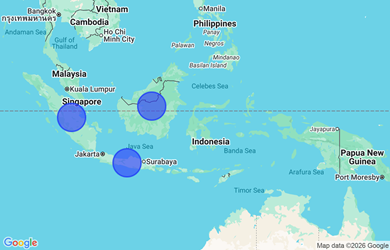
Kalimantan
Solar PV Generation Potential in Indonesia (TWh/year): 1. West Kalimantan (2,948) 2. Central Kalimantan (1,877) 3. East Kalimantan (2,096) 4. Riau (1,557) 5. North Sumatra (1,509) 6. South Sumatra (1,495) (37)
Java
Although solar-rooftop can be set up across the country for efficient energy generation, Jakarta, West Java, and East Java have the highest market potential for Solar Rooftop (18)
Sumatra
Operations of Xurya area spread across Jakarta, Banten, West Java, East Java, Central Java, Lampung, South and North Sumatera, and South Sulawesi. (22)
Sector Sources
1) Republic of Indonesia. 2019. Roadmap of SDGs Indonesia Towards 2030. https://www.unicef.org/indonesia/media/1626/file/Roadmap%20of%20SDGs.pdf.
2) Ministry of Energy and Mineral Resources of the Republic of Indonesia. 2021. Press Release: Indonesia Needs Concrete and Planned Efforts to Meet the 23% Renewables Target by 2025, Says Energy Minister. https://www.esdm.go.id/en/media-center/news-archives/indonesia-needs-concrete-and-planned-efforts-to-meet-the-23-renewables-target-by-2025-says-energy-minister
3) Republic of Indonesia. 2021. Updated Nationally Determined Contribution. https://www4.unfccc.int/sites/ndcstaging/PublishedDocuments/Indonesia%20First/Updated%20NDC%20Indonesia%202021%20-%20corrected%20version.pdf.
4) Republic of Indonesia. 2021. Presidential Regulation (Perpres) No.18/2020 concerning the 2020-2024 National Medium-Term Development Plan. https://jdih.setkab.go.id/PUUdoc/176020/Perpres_Nomor_18_Tahun_2020.PDF.
5) Republic of Indonesia. 2020. Indonesia's 2020-2024 National Medium-Term Development Plan (RPJMN). https://perpustakaan.bappenas.go.id/e-library/file_upload/koleksi/migrasi-data-publikasi/file/RP_RKP/Narasi-RPJMN-2020-2024-versi-Bahasa-Inggris.pdf.
6) Safrina, Rika. ASEAN Centre for Energy, 2021. COP26: ASEAN’s Commitment in The Energy Sector. https://aseanenergy.org/cop26-aseans-commitment-in-the-energy-sector-economy/.
7) Aldila, Nindya. Bisnis.com, 2021. Wapres Ma'ruf Soroti Ketimpangan Akses Energi Bagi Rakyat Miskin. https://ekonomi.bisnis.com/read/20210201/44/1350834/wapres-maruf-soroti-ketimpangan-akses-energi-bagi-rakyat-miskin)
8) Misna, Andriah. ASEAN Climate Change and Energy Project (ACCEPT), 2021. Indonesia – Perspective of Women towards Inclusive Energy Transition in ASEAN. https://accept.aseanenergy.org/indonesia-perspective-of-women-towards-inclusive-energy-transition-in-asean/#:~:text=There%20is%20an%20increase%20in,2011%20to%2027.5%25%20in%202021.
9) State Electricity Company (PT. PLN). 2021. Electricity Supply Business Plan (RUPTL) 2021-2030. https://web.pln.co.id/statics/uploads/2021/10/ruptl-2021-2030.pdf.
10) Asian Development Bank (ADB). 2020. Indonesia Energy Sector Assessment, Strategy, and Road Map Update 2020. https://www.adb.org/sites/default/files/institutional-document/666741/indonesia-energy-asr-update.pdf.
11) Shofa, Jayanty. JakartaGlobe, 2021. PLN to Gradually Retire Coal-Fired Power Plants. https://jakartaglobe.id/business/pln-to-gradually-retire-coalfired-power-plants
12) Sekretariat Nasional SDGs. 2019. Indonesia's SDG National Action Plans (RAN) SDGs 2021-2024.
13) Statistics Indonesia (BPS). 2018-2020. Electricity Consumption per Capita (MWH/Capita). https://www.bps.go.id/indikator/indikator/view_data/0000/data/1156/sdgs_7/1
IOA Sources
14) East Ventures. 2022. Xurya receives US$21.5 million series A funding from investors led by East Ventures and Saratoga. https://east.vc/east-ventures/xurya-seriesa-funding-led-by-east-ventures-and-saratoga/
15) U.K. Foreign & Commonwealth Office of the British Embassy Jakarta. Indonesia Renewable Energy Business Opportunities. https://www.the-eic.com/portals/0/Website/Publications/Indonesia-Business-Opportunities-Study.pdf
16) Republic of Indonesia. 2014. Government Regulation (PP) No. 79/2014 concerning Indonesia’s National Energy Plan. https://jdih.esdm.go.id/peraturan/PP%20No.%2079%20Thn%202014.pdf
17) Silalahi, David. et al. Energies, 2021. Indonesia’s Vast Solar Energy Potential. https://doi.org/10.3390/en14175424
18) Cindy, Massita Ayu and Fitriyanti, Vivi. The Diplomat, 2021. A Turning Point for Renewable Energy in Indonesia? https://thediplomat.com/2021/10/a-turning-point-for-renewable-energy-in-indonesia/
19) Saputra, Gandabhaskara. Institute for Essential Services Reform (IESR), 2019. Harnessing Indonesia’s Solar Potential: Yellow is The New Black. https://iesr.or.id/harnessing-indonesias-solar-potential-yellow-is-the-new-black
20) Australian Department of Foreign Affairs and Trade (DFAT). 2021. A Blueprint for Trade and Investment with Indonesia. https://www.dfat.gov.au/sites/default/files/blueprint-trade-investment-indonesia.pdf
21) BloombergNEF. 2021. Indonesian Solar Market Poised for Unprecedented Growth, Holds Key to Decarbonizing Energy Sector. https://about.bnef.com/blog/indonesian-solar-market-poised-for-unprecedented-growth-holds-key-to-decarbonizing-energy-sector/
22) Digital News Asia. 2022. Indonesia’s Xurya Receives US$21.5 mil Series A led by East Ventures and Saratoga. https://www.digitalnewsasia.com/startups/indonesias-xurya-receives-us215-mil-series-led-east-ventures-and-saratoga
23) Vena Energy. 2021. Vena Energy Combined Financials - 1H 2020 (Financial Report). https://www.venaenergy.com/wp/wp-content/uploads/2021/09/Vena-Energy_1H-2020-Financial-Report.pdf
24) Ministry of Industry of the Republic of Indonesia. 2017. Minister Regulation No.4/2017 concerning local-content requirements (TKDN) for solar panels. http://jdih.kemenperin.go.id/site/baca_peraturan/2286
25) Institute for Essential Services Reform (IESR). 2021. Beyond 207 Gigawatts: Unleashing Indonesia’s Solar Potential. https://iesr.or.id/wp-content/uploads/2021/03/Unleashing-Indonesias-Solar-Potential-Technical-Note-FINAL1.pdf
26) Republic of Indonesia. 2021. Voluntary National Review: Annexes. https://sdgs.bappenas.go.id/laporan-voluntary-national-review-vnr-indonesia-2021/
27) Ministry of Investment/BKPM of the Republic of Indonesia. 2021. Harnessing renewable energy investment sector in Indonesia. https://www.bkpm.go.id/en/publication/detail/news/harnessing-renewable-energy-investment-sector-in-indonesia
28) Ministry of Energy and Mineral Resources of the Republic of Indonesia. 2020. The Ministry of Energy and Mineral Resources 2020-2024 Strategic Plans. https://www.esdm.go.id/assets/media/content/content-rencana-strategis-kesdm-2020-2024.pdf
29) Republic of Indonesia. 2007. Law No.30/2007 concerning Energy. https://jdih.esdm.go.id/peraturan/uu-30-2007.pdf
30) Republic of Indonesia. 2014. Government Regulation (PP) No. 79/2014 concerning Indonesia’s National Energy Plan. https://jdih.esdm.go.id/peraturan/PP%20No.%2079%20Thn%202014.pdf
31) Republic of Indonesia. 2017. Presidential Regulation (Perpres) No. 22/2017 concerning National Energy General Plans (RUEN). https://jdih.esdm.go.id/storage/document/Perpres%2022%20Tahun%202017.pdf
32) Ministry of Energy and Mineral Resources (MEMR) of the Republic of Indonesia. 2020. MEMR Regulation No.4/2020 concerning Risk-Based Business Licensing Services and Investment Facilities. https://jdih.esdm.go.id/storage/document/Permen%20ESDM%20Nomor%204%20Tahun%202020.pdf
33) Indonesia Investment Coordinating Board (BKPM). 2021. BKPM Regulation No.4/2021. https://jdih-storage.bkpm.go.id/jdih/userfiles/documents/2021/10/2021PerBKPM004.pdf
34) Indonesia Investment Coordinating Board (BKPM). 2020. BKPM Regulation No.5/2020, revoking BKPM Regulation No.6/2018, concerning Guidelines of Entity Income Tax Incentives in Certain Industries and/or Regions. https://peraturan.bpk.go.id/Home/Details/169073/peraturan-bkpm-no-5-tahun-2020
35) Ministry of Finance (MoF) of the Republic of Indonesia. 2015. MoF Regulation No.66/2015. https://jdih.kemenkeu.go.id/in/dokumen/peraturan/33b4ea80-8c90-4220-9f84-5696f0fd08df
36) Ministry of Finance (MoF) of the Republic of Indonesia. 2020. MoF Regulation No.130/2020, revoking MoF Regulation No.150/2018, revoking MoF Regulation No.35/2018; concerning the Granting of Corporate Income Tax Facilities. https://jdih.kemenkeu.go.id/in/dokumen/peraturan/33b4ea80-8c90-4220-9f84-5696f0fd08df
37) Institute for Essential Services Reform (IESR). 2021. Beyond 207 Gigawatts: Unleashing Indonesia’s Solar Potential. https://iesr.or.id/wp-content/uploads/2021/03/Unleashing-Indonesias-Solar-Potential-Technical-Note-FINAL1.pdf
38) Cindy, Massita Ayu and Fitriyanti, Vivi. The Diplomat, 2021. A Turning Point for Renewable Energy in Indonesia? https://thediplomat.com/2021/10/a-turning-point-for-renewable-energy-in-indonesia/
39) Digital News Asia. 2022. Indonesia’s Xurya Receives US$21.5 mil Series A led by East Ventures and Saratoga. https://www.digitalnewsasia.com/startups/indonesias-xurya-receives-us215-mil-series-led-east-ventures-and-saratoga
40) Ministry of Finance (MoF) of the Republic of Indonesia. 2010. MoF Regulation No.21/2010 concerning the Granting of Tax and Customs Facilities for Activities Utilizing Renewable Energy. https://jdih.kemenkeu.go.id/in/dokumen/peraturan/2d42d4e0-eb7c-4f26-8473-e9e40e7cef11