
Explore the country and target locations of the investment opportunity.
Country
Vietnam
Region
- Northern Key Economic Zone
- Eastern South Region
- Central Key Economic Zone
Situate the investment opportunity within sustainability focused sector, subsector and industry classifications.
Sector
Education
Development needs
Vietnam experiences a shortage of skilled labor, with 33.8% of enterprises facing difficulty in recruiting professionals or technically qualified workers, locally (1, 12). This gap is further exacerbated by low enrollment in higher education at 30%, compared with 50% in China and Malaysia (6), along with the disparity in access to education across income groups. (7)
Policy priority
Vietnam service sector development strategy (Decision 531/QD-TTg-2021) focuses on enhancement of education quality, technology application, human resource development in the technical area, technology, business management, and social management, and institution improvement for the education sector. (8)
Gender inequalities and marginalization issues
Untrained female workers receive lower wages (about USD 230/month) than trained workers (about USD 280/month); lack of skills, especially digital skills among female migrants in cities, results in marginalization of such workers in the job arena due to increasing automation in various industries. (9)
Investment opportunities
Vietnam's government expenditure on education has been 5 – 6% of GDP in the last 10 years (16); By adding household contribution to education, total expenditure towards education would reach ~8%, equivalent to more than USD 20 billion (17)
Key bottlenecks
Access to significantly large land banks and high capital expenditure required for businesses using a brick-and-mortar institutional structure can prolong the set-up time; the pool of high-quality talents for the sector is also limited and cannot be filled up quickly.
Sub Sector
Education Technology
Development need
Education Technology (EdTech) in Vietnam is in a nascent stage, and is currently, not a significant contributor to tackling the issue of Vietnam's untrained workforce which accounts for about 74% of the 51 m labor force (1). However, given a high smart phone penetration rate, EdTech can potentially reach out to a large population that needs vocational training.
Policy priority
Directive 24/CT-TTg - Digital education is encouraged to improve education quality, and provide access to education for students from different regions and at different times (13). The policy also offers support for the development of skilled human resources, especially in digitalization & international integration (10).
Gender inequalities and marginalization issues
Currently, more than 70% of rural female workers in Vietnam do not have access to vocational training due to limited educational qualifications and occupational skills, thereby limiting their access to gainful and quality employment opportunities. (14)
Investment opportunities
Vietnam's Edtech market is potentially worth USD 3 billion in 2021, up from about USD 2 billion in 2019; the rise of online education, further induced by COVID-19, has the potential to prepare the country's workforce for an increasingly digital and globalized market. (15)
Key bottlenecks
The relevant education regulations are designed specifically for brick-and-mortar class format, not for the practical processes of EdTech which is delivered online.
Industry
Educational Technology
Discover the investment opportunity and its corresponding business model.
Investment Opportunity Area
Online vocational skill training
Business Model
Investment in B2C education technology (EdTech) to provide online vocational training for those who want skill training or upskill. The training may be supplemented by offline training in selected areas (Online Merge Offline (OMO).
Manabie: a new tech platform providing formal education services in Vietnam, focusing on building high-quality educational content both online and offline; 350.000 students downloaded the app (3). It received USD 4.8 m investment from Do Venture, F99, and Palexy.
Hocmai: offers an e-learning app with 4 million fee-based registered users (3). Hocmai won a silver medal for digital content in the 2019 ASEAN ICT Awards 2019 contest. The business secured investment from Galaxy in 2020; the value of the deal is not disclosed.
Learn about the investment opportunity’s business metrics and market risks.
Market Size and Environment
Market Size (USD)
< USD 50 million
CAGR
Varied by the products. High CAGR is reported to be 44% (5)
Critical IOA Unit
2m students registered for vocational training annually. Less than 30% of workers are trained (2)
Investment in EdTech in Vietnam is strong: USD 50 million in 2019. Various venture funds and angels are active in the market, e.g Forge Ventures, Venturra Discovery, iSeed (2)
The average share of expenses for education in Vietnam households' budget is estimated to be 30% (18)
Government supports education through various initiatives, including vocational training - Vietnam's annual expenditure on education is approximately 20% of total national budget, equivalent to 5% of GDP (11)
Indicative Return
ROI
> 25%
Several venture funds in Vietnam have invested in EdTech sector, generating average ROE of about 20 - 30%.
Investment Timeframe
Timeframe
Medium Term (5–10 years)
Varied by product and target segment. Current investment by venture funds suggests < 5 years. It usually takes time for players to attract a sufficient number of students to their platform.
Ticket Size
Average Ticket Size (USD)
USD 1 million - USD 10 million
Market Risks & Scale Obstacles
The major challenge for education startups is to integrate new technologies into the learning practice and exploit the needs of schools, teachers, and students to create better remote online learning experiences, and in a short duration of time.
Business - Supply Chain Constraints
Various issues: Learners are distracted, teachers are not familiar with online teaching practice, and the Edtech platform may not be well designed to address key practical issues.
Read about impact metrics and social and environmental risks of the investment opportunity.
Sustainable Development Need
Shortage of skilled labor can be resolved using EdTech platforms to ensure sustainable economic development. Currently, 80% of electronic companies face difficulty in recruiting highly skilled labor (23). The same issue persists in ICT (22), logistics, and many other sectors.
COVID-19, as well as the development of 4.0 version of industrial revolution has necessitated the need for development of e-learning applications for training solutions.
Gender & Marginalisation
More than 70% of rural female workers in Vietnam are not able to access vocational training (14). This is generally perceived as being due to both accessibility and affordability.
Expected Development Outcome
Improve access to the latest, state-of-the-art infrastructure and facilities for quality vocational training for the population as a whole, hence improving businesses' performance, increasing income for the people, and reducing regional disparities and marginalization issues.
Gender & Marginalisation
Enable women burdened with household work and people in rural/semi-rural areas to gain from opportunities for technical & vocational training for upskilling / skilling.
Primary SDGs addressed

4 - Quality Education
4.3.1 Participation rate of youth and adults in formal and non-formal education and training in the previous 12 months, by sex
Current Value
Rate of trained laborers who obtained certificates and diplomas in Vietnam: 26% in 2021 (25)
Target Value
The rate of trained workers will increase to 70-75%, of which the rate of those who obtained certificates and diplomas will reach 30% (by the end of the term 2021-2025) to 40% by 2030 (26).

8 - Decent Work and Economic Growth
8.3.1 Proportion of informal employment in total employment, by sector and sex
Current Value
55% in 2019, but increased by 1.3% by the end of Sep 2020 to 56.3% (35)
Secondary SDGs addressed
9 - Industry, Innovation and Infrastructure
Directly impacted stakeholders
People
Population graduated from schools or those that want to upgrade skills, learn new skills, to keep up with demand in the workplace.
Gender inequality and/or marginalization
Reduced regional disparities as women/ marginalized groups, especially in remote areas, benefit from improved access to standardized quality vocational training.
Planet
Usage of digital platforms will result in reduced usage of paper resulting in the protection of the environment; Reduce environmental burden as companies can leverage technology.
Corporates
Vocational training businesses benefit from easy-to-use and better management systems.
Improved social security resulted from lower unemployment.
Indirectly impacted stakeholders
People
Improved quality of life with increased income, globally competitive workforce
Planet
Technology-based solutions would result in a lesser requirement for commuting, thereby reducing the level of vehicular pollution
Corporates
Better quality of workforce helps in generating better results; industrial businesses will improve performance as a result of having skilled labor available in the market as demand.
Public sector
More revenue income, and social welfare budget due to increased revenue from businesses.
Outcome Risks
Revenue may not be sufficient to justify the model if the products are not designed to tap into market demand.
Lack of digital devices at the learners' side will undermine the coverage of the model.
Lack of linkage to industries or absence of placement assistance may restrict the learners in job seeking after graduation, leading to reduced interest in the training courses.
Gender inequality and/or marginalization risk: traditional culture and marginalization may limit women's/ marginalized groups' access to the online training service.
Impact Risks
Unaffordable costs or poor digital connections may undermine the accessibility of such courses for low-income or remote groups.
Poor understanding of key skills can hamper the ability of educators to equip the next-generation workforce with the required skill-set.
Gender inequality and/or marginalization risk: Disparities (in quality of education, workforce, and salaries) may arise if the model isn't efficiently managed by personnel (who lack digital skills).
Impact Classification
C—Contribute to Solutions
What
Investment in Edtech solutions to provide online access to a wide range of vocational/ soft skill training courses
Who
Underserved; the population as a whole, especially those living in rural or remote areas, and the communities of businesses seeking skilled labors
Risk
While the model has been proven to work in reality, access to the service may be undermined by the limited income of some groups and unreliable internet connection.
Contribution
The GoV's budget for education, training, and vocational training for the period 2012-2019 is estimated at USD 7,1 billion (19)
How Much
Vietnam's untrained workforce that accounts for about 74% of the 51 m labor force will have better opportunities for skilling and upskilling (1).
Impact Thesis
This IOA provides opportunities to access vocational training, and acquire jobs for a large population, including women and those who are living in rural/ remote areas.
Explore policy, regulatory and financial factors relevant for the investment opportunity.
Policy Environment
GoV, 2239/QĐ-TTg: Vocational education development strategy for the period of 2021 - 2030, with a vision to 2045. Key objective: Rapidly develop vocational education to meet the diverse needs of the labor market (31)
GoV, Directive No. 24/CT-TTg of the Prime Minister: Encourage businesses to set up vocational education institutions; facilitate access to credit by vocational education institutions (4)
GoV, Directive No. 24/CT-TTg of the Prime Minister: promote the development of skilled human resources, especially highly skilled human resources in order to raise the level of Vietnamese labor skills (4)
Financial Environment
GoV, Circular 219/2013/TT-BTC: Preferential value-added tax (0%) for vocational training (33)
GoV, Decree 69/2008/NĐ-CP: encourage the social mobilization of resources for investment in education, vocational training, health, culture, sports, and environment. Various incentives: access to land, tax exemption, and access to a loan at a concessional lending rate (34)
Regulatory Environment
Law on Vocational Training, 74/2014/QH13: regulations on the vocational education system; organization and operation of vocational education institutions; rights and obligations of organizations and individuals participating in vocational education activities (32)
Education law: Relevant regulations are for traditional training (in-class) (29); adjustments are being made to accommodate EdTech. Registration should cover educational & technology activities
GoV, Decree 143/2016/NĐ-CP: Regulations on investment and operation conditions in the field of vocational education and training (28)
GoV, Circular 09/2021/TT-BGDDT: provides information on specific requirements for the management and organization of online education. This covers general education institutions and continuing education institutions (30)
Discover examples of public and private stakeholders active in this investment opportunity that were identified through secondary research and consultations.
Private Sector
A number of Edtech businesses exist in the market(27): Broad Online Learning Platforms (Kyna.vn, Unica, Edumall, Brands Việt Nam, Wikilady, Adabook, Testbank, Alada, etc.); Tech Learning (Code4Startup, CoderSchool, MClass, etc.); Enterprise Learning (Nexedu, OMT, DES, etc.);
Government
Government: Ministry of Education, Directorate of Vocational Education and Training, Ministry of Labor Invalids and Social Affairs, (MOLISA), provincial governments
Multilaterals
Multilaterals: European Union (EU, Development Programme (UNDP), Asian Development Bank (ADB) World Bank (WB), United Nations International Children's Emergency Fund (UNICEF).
Non-Profit
Non-Profit: Vietnam Association for Vocational Education and Training and Social Wok (VAVET SW), Vietnam Association for Education Equipment (VAEE), Association of Vietnam Universities and Colleges (AVU&C), Global Association of Economics Education (GAEE)
See what country regions are most suitable for the investment opportunity. All references to Kosovo shall be understood to be in the context of the Security Council Resolution 1244 (1999)
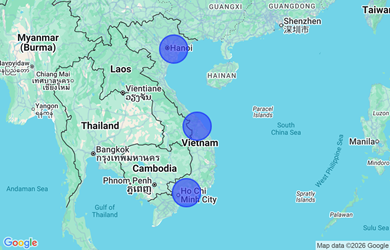
Northern Key Economic Zone
Online models - location does not matter since the learners across regions may join the EdTech platforms. If the investment is an on & off-line model, a physical presence may be needed in the targeted location. It can start in Hanoi, Ho Chi Minh, and Danang, and then roll out to rural areas.
Eastern South Region
Online models - location does not matter since the learners across regions may join the EdTech platforms. If the investment is an on & off-line model, a physical presence may be needed in the targeted location. It can start in Hanoi, Ho Chi Minh, and Danang, and then roll out to rural areas.
Central Key Economic Zone
Online models - location does not matter since the learners across regions may join the EdTech platforms. If the investment is an on & off-line model, a physical presence maybe needed in the targeted location. It can start in Hanoi, Ho Chi Minh, and Danang, and then roll out to rural areas.
SECTOR SOURCES
1) Khanh, N. (2021, Oct 6). Nong Nghiep Viet Nam. Retrieved from Kinh Te https://nongnghiep.vn/nang-cao-ky-nang-nguon-nhan-luc-nham-khoi-phuc-phat-trien-thi-truong-lao-dong-d304449.html
6) International Finance Corporation. (2021, Sep). Creating Markets in Vietnam: Country Private Sector Diagnostic. Retrieved from https://www.ifc.org/wps/wcm/connect/publications_ext_content/ifc_external_publication_site/publications_listing_page/cpsd-vietnam
7) Vietnam Statistic Office. (2021, Sep 16). Chi tiêu cho giáo dục, đào tạo của các hộ gia đình ở việt nam những năm gần đây. Retrieved from https://www.gso.gov.vn/du-lieu-va-so-lieu-thong-ke/2021/09/chi-tieu-cho-giao-duc-dao-tao-cua-cac-ho-gia-dinh-o-viet-nam-nhung-nam-gan-day/ 8) Government of Vietnam. (2021, Apr 1). Quyết định Số: 531/QĐ-TTg phê duyệt chiến lược tổng thể phát triển khu vực dịch vụ của việt nam thời kỳ 2021 - 2030, tầm nhìn đến năm 2050. Retrieved from https://thuvienphapluat.vn/van-ban/Thuong-mai/Quyet-dinh-531-QD-TTg-2021-phe-duyet-Chien-luoc-phat-trien-khu-vuc-dich-vu-Viet-Nam-469614.aspx
9) Ha, G. (2018, Oct 25). Đào tạo nghề nghiệp cho lao động nữ di cư: Thực trạng và giải pháp. Retrieved from http://laodongxahoi.net/dao-tao-nghe-nghiep-cho-lao-dong-nu-di-cu-thuc-trang-va-giai-phap-1310978.html
10) Government of Vietnam. (2020, May 28). Chỉ thị 24/CT-TTg: Đẩy mạnh phát triển nhân lực có kỹ năng nghề góp phần nâng cao năng suất lao động và cạnh tranh quốc gia trong tình hình mới. Retrieved from https://tulieuvankien.dangcongsan.vn/Uploads/2020/6/7/4/CT-24.signed.pdf 12) Dang, A. T., Nguyen, T. T., & Phan, D. H. (2021, Mar 22). Phát triển chất lượng nguồn nhân lực các doanh nghiệp FDI trong giai đoạn cách mạng công nghiệp 4.0. Retrieved from https://khcncongthuong.vn/tin-tuc/t9473/phat-trien-chat-luong-nguon-nhan-luc-cac-doanh-nghiep-fdi-trong-giai-doan-cach-mang-cong-nghiep-4-0.html
13) Government of Vietnam. (2020). Directive-24-CT-TTg-2020: Promoting skilled work force development. Retrieved from https://thuvienphapluat.vn/van-ban/EN/Lao-dong-Tien-luong/Directive-24-CT-TTg-2020-promoting-skilled-workforce-development-to-improvement-of-productivity/455491/tieng-anh.aspx
14) MOLISA. (2016, Aug 16). Đổi mới đào tạo nghề cho phụ nữ nông thôn. Retrieved from http://www.molisa.gov.vn/Pages/tintuc/chitiet.aspx?tintucID=25573
15) ONISHI , T., & OSADA, M. (2021, Dec 18). Vietnam edtech market soars to $3bn on remote learning boom. Retrieved from https://asia.nikkei.com/Business/Education/Vietnam-edtech-market-soars-to-3bn-on-remote-learning-boom
16) Thanh, H., & Duy, P. (2022, Aug 8). Việt Nam dành 18% tổng chi ngân sách cho giáo dục. Retrieved from https://vnexpress.net/viet-nam-danh-18-tong-chi-ngan-sach-cho-giao-duc-4497087.html
17) Vietnam Statistic Office. (2021, Sep 16). Chi tiêu cho giáo dục, đào tạo của các hộ gia đình ở việt nam những năm gần đây. Retrieved from https://www.gso.gov.vn/du-lieu-va-so-lieu-thong-ke/2021/09/chi-tieu-cho-giao-duc-dao-tao-cua-cac-ho-gia-dinh-o-viet-nam-nhung-nam-gan-day/
IOA SOURCES
2) General statistic office. (2019, Dec 19). Thông cáo báo chí kết quả tổng điều tra dân số và nhà ở năm 2019. Retrieved from https://www.gso.gov.vn/su-kien/2019/12/thong-cao-bao-chi-ket-qua-tong-dieu-tra-dan-so-va-nha-o-nam-2019/#:~:text=M%E1%BB%99t%20s%E1%BB%91%20ch%E1%BB%89%20ti%C3%AAu%20ch%C3%ADnh,%2C%20chi%E1%BA%BFm%2050%2C2%25.
3) Hocmai. (n.d.). Retrieved from www.hocmai.vn
3) Manabie. (n.d.). Retrieved from www.manabie.vn
3) Phong, V. (2021, Sep). Startup edtech rầm rộ gọi vốn. Retrieved from https://startup.vnexpress.net/tin-tuc/xu-huong/startup-edtech-ram-ro-goi-von-4359369.html
3) Thanh, D. (2021, Mar 2). Startup giáo dục Manabie gọi vốn thành công 3 triệu USD. Retrieved from https://startup.vnexpress.net/tin-tuc/hanh-trinh-khoi-nghiep/startup-giao-duc-manabie-goi-von-thanh-cong-3-trieu-usd-4241898.html
4) Government of Vietnam. (2020). Directive-24-CT-TTg-2020: Promoting skilled work force development. Retrieved from https://thuvienphapluat.vn/van-ban/EN/Lao-dong-Tien-luong/Directive-24-CT-TTg-2020-promoting-skilled-workforce-development-to-improvement-of-productivity/455491/tieng-anh.aspx
5) TopDev. (n.d.). Dịch vụ Thị trường Edtech Landscape 2020. Retrieved from https://topdev.vn/blog/dich-vu-thi-truong-edtech-landscape-2020/ 11) Bui, C. T. (2020, Sep 16). Chú trọng đầu tư cho Giáo dục đào tạo. Retrieved from http://consosukien.vn/chu-trong-dau-tu-cho-giao-duc-dao-tao.htm
17) General Statistic Office. (2021, Sep 1). Chi tiêu cho giáo dục, đào tạo của các hộ gia đình ở việt nam những năm gần đây. Retrieved from https://www.gso.gov.vn/du-lieu-va-so-lieu-thong-ke/2021/09/chi-tieu-cho-giao-duc-dao-tao-cua-cac-ho-gia-dinh-o-viet-nam-nhung-nam-gan-day/ 18) Nguyen, H. T. (2016, May 23). Chi tiêu cho giáo dục trong các hộ gia đình ở Việt Nam năm 2015. Retrieved from http://ncif.gov.vn/pages/newsdetail.aspx?newid=18779
19) Nguyen, T. T. (2020, Dec 3). Nâng cao hiệu quả sử dụng nguồn lực từ ngân sách nhà nước cho giáo dục nghề nghiệp. Retrieved from https://tapchitaichinh.vn/co-che-chinh-sach/nang-cao-hieu-qua-su-dung-nguon-luc-tu-ngan-sach-nha-nuoc-cho-giao-duc-nghe-nghiep-330287.html
21) Tech Collective. (2019, Dec 3). Vietnam’s emerging edtech startups. Retrieved from https://techcollectivesea.com/2019/12/03/vietnams-emerging-edtech-startups/
22) Vietnam News. (2021, Aug 24). Nhu cầu nhân lực ngành công nghệ thông tin vẫn tăng cao. Retrieved from https://baotintuc.vn/xa-hoi/nhu-cau-nhan-luc-nganh-cong-nghe-thong-tin-van-tang-cao-20210824092019818.htm
23) Phuong, T. (2021, Sep 24). Thiếu hụt nặng nề lao động tay nghề cao trong ngành sản xuất điện tử. Retrieved from https://bnews.vn/thieu-hut-nang-ne-lao-dong-tay-nghe-cao-trong-nganh-san-xuat-dien-tu/213982.html
24) Tri Minh Law . (n.d.). Thủ tục thành lập trung tâm dạy nghề năm 2022. Retrieved from https://luattriminh.vn/giay-chung-nhan-dang-ky-hoat-dong-day-nghe.html
25) Lai, C. (2021, Oct 5). Tỷ lệ lao động đã qua đào tạo ở Việt Nam chỉ đạt 26,1%. Retrieved from https://giaoduc.net.vn/giao-duc-24h/ty-le-lao-dong-da-qua-dao-tao-o-viet-nam-chi-dat-26-1-post221505.gd
26) Vietnam General Confederation of Labor. (2021, Sep 29). Nâng tầm kỹ năng lao động Việt Nam. Retrieved from http://www.congdoan.vn/tin-tuc/doi-song-cong-nhan-503/nang-tam-ky-nang-lao-dong-viet-nam-596999.tld
27) Vo, P., Tran, D., & Nguyen, P. (2021, June 16). EdTech in Vietnam: Sector regulatory analysis. Retrieved from https://vietnam.acclime.com/news-insights/edtech-in-vietnam-a-sector-regulatory-analysis/
28) Government of Vietnam. (2016, Oct 14). Nghị định 143/2016/NĐ-CP Quy định điều kiện đầu tư và hoạt động trong lĩnh vực giáo dục nghề nghiệp. Retrieved from https://thuvienphapluat.vn/van-ban/Dau-tu/Nghi-dinh-143-2016-ND-CP-dieu-kien-dau-tu-hoat-dong-trong-linh-vuc-giao-duc-nghe-nghiep-326965.aspx
29) Vietnam National Assembly. (2019, Jun 14). Luật giáo dục. Retrieved from https://thuvienphapluat.vn/van-ban/Giao-duc/Luat-giao-duc-2019-367665.aspx
30) Ministry of Education. (2021, Mar 30). Stipulation 09_2021_TT_BGDDT . Retrieved from https://moet.gov.vn/content/vanban/Lists/VBPQ/Attachments/1396/09_2021_TT_BGDDT-TH%C3%94NG%20T%C6%AF%20D%E1%BA%A0Y%20H%E1%BB%8CC%20TR%E1%BB%B0C%20TUY%E1%BA%BEN.pdf
31) Government of Vietnam. (2021, Dec 30). Phê duyệt chiến lược phát triển giáo dục nghề nghiệp giai đoạn 2021 - 2030, tầm nhìn đến năm 2045. Retrieved from https://thuvienphapluat.vn/van-ban/Lao-dong-Tien-luong/Quyet-dinh-2239-QD-TTg-2021-phe-duyet-Chien-luoc-phat-trien-giao-duc-nghe-nghiep-499389.aspxx
32) Vietnam National Assembly. (2014, Nov 27). Luật Giáo dục nghề nghiệp. Retrieved from hhttps://thuvienphapluat.vn/van-ban/Lao-dong-Tien-luong/Luat-Giao-duc-nghe-nghiep-2014-259733.aspx
33) Ministry of Finance. (2013, Dec 31). Hướng dẫn thi hành luật thuế giá trị gia tăng và nghị định số 209/2013/nđ-cp ngày 18/12/2013 của chính phủ quy định chi tiết và hướng dẫn thi hành một số điều luật thuế giá trị gia tăng. Retrieved from https://thuvienphapluat.vn/van-ban/Thue-Phi-Le-Phi/Thong-tu-219-2013-TT-BTC-huong-dan-Luat-thue-gia-tri-gia-tang-va-Nghi-dinh-209-2013-ND-CP-220761.aspx
34) Government of Vietnam. (2008, May 30). Nghị định về Chính sách khuyến khích xã hội hóa đối với các hoạt động trong lĩnh vực giáo dục, dạy nghề, y tế, văn hóa, thể thao, môi trường. Retrieved from https://vanban.chinhphu.vn/default.aspx?pageid=27160&docid=73157
35) UNDP. (2021). Vietnam National Report on SDGs Implementation 2020. Retrieved from https://www.undp.org/sites/g/files/zskgke326/files/migration/vn/Bao-cao-QG-SDG_VN.pdf