
Explore the country and target locations of the investment opportunity.
Country
Cambodia
Region
- Kandal
- Pursat
- Phnom Penh
Situate the investment opportunity within sustainability focused sector, subsector and industry classifications.
Sector
Food and Beverage
Agriculture sector represented 32% of Cambodia's GDP in 2020.(1) However, it suffers from certain inefficiencies, including a reliance on subsistence agriculture and lack of mechanization, value-addition, standards and logistics. This also impacts Cambodia’s performance on SDG 2, relating to food security in RGC's Sustainable Development Report (ranked 67th). (2)
National Strategic Development Plan, 2019–2023 includes targets for enhancing the infrastructure for agricultural research, supporting strengthening agricultural cooperatives and developing agribusiness networks, as well as pre/postharvest technology development. One goal is to increase export of processed agricultural products from 10% to 12 % of all exports by 2025. (3)
Women now represent 74% of the agricultural workforce [33.25% females (% of female employment) employed in agriculture in 2020 (4)] and produce 80% of Cambodia’s food. Even though, women face numerous challenges, including poor access to land (women own ~15.4% of the recorded agricultural land area) and credit, their participation rate in agriculture is falling more slowly than men’s.
Men are usually involved in land preparation and maintenance activities, while women manage pre- and post-harvest activities (prepare and plant seeds, maintain seed beds, harvest and transport crops, and implement low-technology pest control measures by planting repellent grasses).
Women are estimated to receive only ~10% of all agricultural extension services, and female-headed households, on average, have less land and less access to farm equipment, tools, and communications services. (5)
Despite 54% of population engaged in this sector, agriculture represents only 32% of total GDP in 2020 (1) The agriculture sector is dominated by small landholders and MSMEs, that are highly impacted by economic recession, and would take longer to overcome the economic impacts of Covid-19.
Covid-19 has impacted Cambodia’s food security (which showed signs of improvement in recent years with real income growth and volume increases in rice and other crop production), primarily since the consumers are unable to afford sufficient and diverse food. (6)
Diet quality of pregnant women and children under-5 remains inadequate and incidence of obesity, especially among women of child-bearing age, has increased. Stunting is prevalent in households with poor sanitation. Children in rural areas are more likely to be stunted than children in urban areas. (6)
Poorest households, including landless, female-headed, with disabled family members, or households of ethnic minorities and/or living in the most remote and marginalized areas, suffer the most when localized or seasonal food deficits occur. (6)
~77% of rural households rely on agriculture, fisheries, and forestry for their livelihood. (7) In 2020, agriculture sector contributed 32% towards Cambodia's gross domestic product (GDP). (1)
Fragmented smallholders farmers, low productivity and inefficient logistics, are some of the key challenges in Agro-food sector. Infrastructure and services for processing and exporting food products are inadequate, resulting in maximum food-processing outsourced to neighboring countries.
Sub Sector
Food and Beverage Retail
Exports from Cambodia [Agricultural exports were ~USD 1,118 mn in 2019 (8)] slowed down due to their lack of adequacy to international standards, resulting from an inefficient supply chain. Inefficient logistic services (limited cold supply chain solution) leads to agricultural waste at various stages of the supply chain. 51.9% Municipal Solid Waste (MSW) is from food waste. (9)
Rectangular Strategy Phase IV
Recovery plan focuses mainly on boosting agricultural productivity growth, strengthening competitiveness in terms of both costs and quality, modernizing supporting infrastructure in the supply chain of agricultural products, promoting processing of agricultural products, promoting seed industry and maximizing the benefits of free trade agreement. (10)
Food security and agri-food supply chain have been adversely impacted due to border closures and trade restrictions imposed for limiting the spread of Covid-19.
Accessibility to food sources has also been limited due to job losses, income reductions, food price increases and local food availability, rendering the already vulnerable communities (especially low and middle-income households) in a precarious position. (6)
140,000 cbm of capacity must be added to Cambodia’s existing cold storage volume to meet its supply chain needs by 2030. (11)
Agriculture exports are linked to quality of products and compliance to international standards. Very few companies have the capacity to ensure that they meet international standards, while there is a lack of third party actors providing adequate logistics services that could help them to do so.
Industry
Agricultural Products
Discover the investment opportunity and its corresponding business model.
Investment Opportunity Area
Logistics Services To Promote Cambodian Exports
Includes Cold Chain, Storage, Transport and other Ancillary Services
Business Model
Invest in B2B businesses or facilities engaged in building efficient logistic services and support infrastructure
Khmer Cold Chain Co. Ltd. (KCC), founded in 2020, is a project company of InfraCo Asia Development Pte Ltd (InfraCo Asia) (primary shareholder). It provides temperature controlled logistics, delivering international quality services to Cambodian and regional farmers, agribusiness, food processers, pharmaceutical companies, food retailers and hotels, restaurants and food-caterers.
In 2021, KCC partnered with Phnom Penh Autonomous Port (PPAP) to build a cross-docking facility with controlled temperature conditions (large-scale cold storage warehouse and distribution center) in eastern Kandal province’s Kien Svay district. (11)
Auskhmer Import Export Co., Ltd. (AIEC), founded in 2001, imports and distributes food products and beverages, and provides import/export brokerage services, which include sourcing/importing, stocking/warehousing, order generation, merchandising and promotion execution, distribution and delivery. In 2016, Worldbridge International (Cambodia) Ltd acquired 55% stake in AIEC. (12)
Learn about the investment opportunity’s business metrics and market risks.
Market Size and Environment
Market Size (USD)
USD 100 million - USD 1 billion
Critical IOA Unit
Additional cold storage capacity required by 2030: 140,000 cbm to cater to growing demand (11)
140,000 cubic meters (cbm) of capacity must be added to Cambodia’s existing cold storage volume to meet its supply chain needs by 2030. KCC's new installations will supply 36,205 cbm, filling >25% of the current gap to meet the increasing market demand. (11)
In the case of fruit exports, minimum ~USD 500 mn are required to reach the quota of mango export to China as part of the Cambodia-China Trade Agreement.
In 2022, United States Agency for International Development (USAID) partnered with KCC and Amru Rice (Cambodia) Co. Ltd., to invest USD 2 mn in cold chain infrastructure and storage capacity for agricultural products and logistics purposes in Cambodia. (13)
Indicative Return
IRR
15% - 20%
As per expert consultations, capital expenditure (CAPEX) for 1cbm is ~USD 200.
Meat demand is expected to increase to 300,000 tons annually by 2030. However, only ~20% of this national demand is presently met through formal domestic supply chains (i.e., from a slaughterhouse) due to insufficient cold-storage facilities. (5)
Agriculture contributes ~15% to Cambodia's total trade costs (comprising transportation and travel expenses) for efficient good flow. (14)
Investment Timeframe
Timeframe
Medium Term (5–10 years)
Logistic services offers a wide range, but expected investment timeframes are mostly within the 5-10 year range.
Ticket Size
Average Ticket Size (USD)
USD 1 million - USD 10 million
Market Risks & Scale Obstacles
Business - Supply Chain Constraints
Most agri-commodities are currently exported through informal channels, under few regulations. Formal export channels require a level of sophistication, aligned with international standards, which the Cambodian market lacks primarily as an outcome of an inefficient supply chain.
Capital - Requires Subsidy
This area is capital intensive as substantial amount of investment is required for setting up logistic services (storage, cold chain, transportation). As per experts, a hot water treatment facility can cost ~USD 10 mn. As the products are perishable, cost of spoilage is also borne by the operators.
Most producers store food with traditional methods, leading to food losses. Not only would they require financial assistance to use the services, they may also need capacity building efforts to understand the link between their losses from spoilage and the cost of cold storage.
Read about impact metrics and social and environmental risks of the investment opportunity.
Sustainable Development Need
As Cambodia modernizes, it requires an efficient supply chain to set stage for economic growth, allowing the country to respond to potential crises, such as food shortages and to address regional disparities in people's access to goods and services. (11)
Cold storage can help increase operational efficiency for distribution of goods, provide temperature-controlled logistics (TCL) services, and serve Cambodian/regional farmers in reducing early post-harvest losses by ~50% (15).(11)
Efficient supply chain management is required for ensuring that goods flow in a free and timely manner, promoting more vibrant trade interactions. If agriculture value chain lack traceability, it disallows meeting standards and certifications needed for premium local and export markets. (14)
Gender & Marginalisation
Developing a secure, temperature-controlled supply chain (cold storage) and logistics capabilities for agriculture will help address market system barriers to import-export opportunities, focusing on improving market access for smallholder farmers, including women- and youth-owned businesses. (16)
Export of products through informal channels involves a lower cost than through formal channels. Affordable and accessible logistics solutions can potentially help smallholder farmers use such services with significant economic gains for them and their families.
Efficient logistics can contribute to uplifting farmers' livelihood. As most food products are exported raw to countries like Vietnam and Thailand, which in-turn process and further export the products, Cambodian farmers end up earning a much lower income.
Expected Development Outcome
Advance the country's economic competitiveness and inclusiveness by addressing gaps in the agricultural sector's supply chain (16) and tackle market system barriers that hamper import and export opportunities. (13)
Increase the traceability of agriculture value chains, and ensure efficient market linkages and organised distribution channels, to help reduce risk of mismatch between demand and supply, especially for fresh food, decrease post-harvest losses and support smallholder farmers raise their income levels.
Support local food systems with shorter, fairer and cleaner supply chains to address local priorities. (17)
Gender & Marginalisation
Provide equal opportunity to marginalized, smallholder farmers to obtain access to national and international markets, and operate with improved productivity and profitability.
Ensure improved job opportunities for all, without any gender disparities. Construction of cold-storage facilities aligned with this investment opportunity area have created ~150 local jobs, and ~100 more long-term positions when the facility becomes operational. (12)
Expand Cambodia's economic development to allow rural households that suffer food insecurity to easily access formal markets within Cambodia and beyond. (16)
Primary SDGs addressed
2 - Zero Hunger
2.3.2 Average income of small-scale food producers, by sex and indigenous status
2.4.1 Proportion of agricultural area under productive and sustainable agriculture
Current Value
The value of agricultural production per unit of labor engaged in agriculture (farming, animal husbandry and fisheries) is USD 1,555 in 2015. (18) The baseline sustainable agricultural land productivity is USD 1,548/ha in 2016. (18)
Target Value
The target value of agricultural production per unit of labor engaged in agriculture (farming, animal husbandry and fisheries) is USD 3,755 by 2030. (18) The target sustainable agricultural land productivity is USD 2,645/ha by 2030. (18)
Secondary SDGs addressed
3 - Good Health and Well-Being
8 - Decent Work and Economic Growth
11 - Sustainable Cities and Communities
Directly impacted stakeholders
People
Small and mid-scale fruit and vegetable producers, cooperatives and storage facility operators benefit with lesser losses due to spoilage.
Gender inequality and/or marginalization
Smallholder farmers benefit from access to international markets including for farms that are operated by women.
Planet
Lower loss of food products owing to spoilage will generate lesser food waste, thereby reducing pollution caused by burning of such waste.
Corporates
Traders, exporters and supermarkets will benefit from improved supply of agricultural produce (fruits, vegetables, cereals) of consistent quality.
Public sector
Enable Cambodia to retain the goods that it needs, and export profit-making merchandise, thereby contributing to growth in national income. (11)
Indirectly impacted stakeholders
People
Population benefits from high quality and affordable agricultural products, and generally from increased economic activities with strengthened supply chains.
Gender inequality and/or marginalization
Rural population benefits increased job opportunities. Construction of similar facilities have been able to create ~150 local jobs, and 100 more long-term positions as the facility becomes operational. (11)
Planet
In the long-run, efficient supply chains help to conserve biodiversity resources, as well as reduce methane/CO2-based waste emissions.
Corporates
Complete spectrum of cold-chain needs of local businesses can be addressed through cold-storage facilities, and inspire others to undertake the development of cold-chain businesses across the country. (11)
Public sector
RGC recognizes logistics services as a key priority for agriculture development, as well as a way for overcoming food shortage. Agriculture sector is also one of the three sectors in the framework of economic recovery plan 2021-2023. (19)
Outcome Risks
In need of higher profits, producers may choose to export their products, then sell it domestically, thereby resulting in a potential reduction of food products in local markets.
Transport of agri-commodities over longer distances (farm to ports or places of consumption) will result in an increase in GHG emissions.
Smallholder farmers may be unable to afford the facilities without added financial support. Unless such support is philanthropic in nature, it may add to their financial burdens.
Farmers in some regions may concentrate their production on one crop, resulting in mono cropping patterns with negative impact on environment including reduced availability of other essential agricultural products.
Gender inequality and/or marginalization risk: Inability of smallholder farmers to afford logistics services may exclude them from the market, thus making the business model exclusive to only large farmers.
Impact Risks
Farmers often borrow money from local middlemen to expand their business and increase yields, which burdens them to sell their harvest at very low prices, resulting in losses.
Export market for agricultural products is potentially large, but is still limited due to limited capacity of companies to access and engage with international markets, in line with expected quality parameters.
Without adequate checks and balances in place, operational efficiency of such business models would be impacted in case of a conflict or unchecked fraudulent activities by existing players (middlemen) in the market.
If the benefits of the model do not expand across Cambodia, it will deepen regional and income disparities in the country.
Gender inequality and/or marginalization risk: If the business models do not evaluate their impact on all actors of the value chain, most of the economic benefits might be reaped by companies themselves, without such benefits passing on to smallholder farmers, including women.
Impact Classification
B—Benefit Stakeholders
What
Improving logistic services to reduce post-harvest losses and ensure a higher rate of food processing, as well as promoting exports.
Who
Various; Small-holder farmers benefit from gaining access to international markets.
Risk
In the absence of regulations and a stakeholder approach for promoting investments, value addition from reduced post-harvest losses and increased export opportunities would fail to benefit farmers.
Contribution
KCC's new installations will supply 36,205 cbm, filling >25% of the current gap in cold storage facilities to meet the increasing market demand. (11)
How Much
KCC's new installations will supply 36,205 cbm, filling >25% of the current gap in cold storage facilities to meet the increasing market demand. (11)
Impact Thesis
Development of logistics to reduce spoilage and enable Cambodia to expand its export income, thereby contributing to growth of economy.
Explore policy, regulatory and financial factors relevant for the investment opportunity.
Policy Environment
Industrial Development Policy 2015-2025: Develop and implement a master plan for transport and logistic system development with the aim of creating integrated and highly effective multimodal transport and logistics system to become key national economic corridors. (20)
Master Plan of ASEAN Connectivity (MPAC) 2025. strengthen AESAN competitiveness through enhanced trade routes and logistics and enhance supply chain efficiency through addressing key chokepoints.(21)
Financial Environment
Investment Law: industries supporting agriculture, manufacturing, environmental management and protection, and biodiversity conservation and the circular economy are eligible to get QIP. (23)
Investment Law: Under article 24, this sector is entitled to investment incentives described under article 26 such as income tax exemption for 3 to 9 years, prepayment tax exemption and minimum tax exemption. (23)
Investment Law: Under article 27, besides the basic incentives above, QIP will receive additional incentives such as VAT exemption for the purchase of locally made inputs, deduction of 150 % from tax base for activities such as research development and innovation. (23)
Regulatory Environment
Royal decree on the establishment of Logistics National Council in 2017 is designed to tackle the high costs of the Kingdom’s logistics sector to promote the efficient flow of exports (22)
Discover examples of public and private stakeholders active in this investment opportunity that were identified through secondary research and consultations.
Private Sector
Corporates: Khmer Cold Chain Co Ltd (KCC) Investors: InfraCo Asia Development Pte. Ltd. (InfraCo Asia)
Government
Ministry of Health, the Ministry of Commerce, the Ministry of Agriculture, Forestry, and Fisheries and the Ministry of Economy and Finance
Multilaterals
World Bank, United Nations Development Programme (UNDP), Food and Agriculture Organization of the United Nations (FAO), ARISE+
Non-Profit
Energy Lab, Cambodian Farmer Federation Association of Agricultural Producers, Global Cold Chain, World Vision
Public-Private Partnership
United States Agency for International Development through partnership with Khmer Cold Chain Company and Amru Rice, Kandal Cold Storage project
See what country regions are most suitable for the investment opportunity. All references to Kosovo shall be understood to be in the context of the Security Council Resolution 1244 (1999)
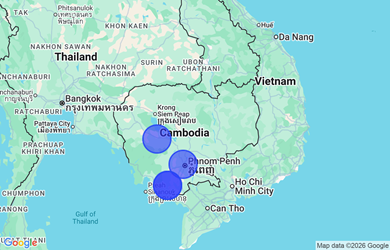
Kandal
Kandal is one of the provinces with the most crops, including rice, maize, sugarcane, soybean, and many varieties of vegetables and fruits. The province has 140,797 hectares devoted to agricultural production. ~101,500 hectares of this is rice production, with yields above the national average. (24)
Kandal
In 2021, KCC partnered with Phnom Penh Autonomous Port (PPAP) to build a cross-docking facility with controlled temperature conditions in eastern Kandal province’s Kien Svay district.(11)
Pursat
Pursat accounts for >4% of Cambodia’s rice crop and is famous for its sweet oranges, apart from grow sugar palm, sweet potato, sesame, beans, mixed vegetables, corn and cassava. (25)
Phnom Penh
Phnom Penh is the best location for Cold storage
Sector Sources
(1) World Bank. (2020). Cambodia in the Time of COVID-19. https://pubdocs.worldbank.org/en/357291590674539831/CEU-Report-May2020-Final.pdf
(2) Royal Government of Cambodia. (2018). Cambodian Sustainable Development Goals (CSDGs) Framework (2016-2030). https://data.opendevelopmentmekong.net/dataset/3aacd312-3b1e-429c-ac1e-33b90949607d/resource/d340c835-e705-40a4-8fb3-66f957670072/download/csdg_framework_2016-2030_english_last_final-1.pdf
(3) World Food Programme. (2019). Cambodia Country Strategic Plan (2019-2023). https://docs.wfp.org/api/documents/WFP-0000112436/download/?_ga=2.241923010.1595998384.1580922941-1577799135.1580922941
(4) Trading Economics. (2022). Cambodia--Employees, Agriculture, Female (% of Female Employment). https://tradingeconomics.com/cambodia/employees-agriculture-female-percent-of-female-employment-wb-data.html#:~:text=Employment%20in%20agriculture%2C%20female%20(%25,compiled%20from%20officially%20recognized%20sources.
(5) Asian Development Bank. (2021). Cambodia Agriculture, Natural Resoures, and Rural Development Sector Assessment, Strategy, and Road Map. Cambodia Agriculture Rural Development Map https://www.adb.org/sites/default/files/publication/718806/cambodia-agriculture-rural-development-road-map.pdf
(6) Asian Development Bank. (2021). Cambodia Agriculture, Natural Resoures, and Rural Development Sector Assessment, Strategy, and Road Map. Cambodia Agriculture Rural Development Map https://www.adb.org/sites/default/files/publication/718806/cambodia-agriculture-rural-development-road-map.pdf
(7) USAID. (2022). Agriculture and Food Security. https://www.usaid.gov/cambodia/agriculture-and-food-security
(8) Nguyen, M. (2021). Cambodia Exporter Guide. https://apps.fas.usda.gov/newgainapi/api/Report/DownloadReportByFileName?fileName=Cambodia%20Exporter%20Guide_Ho%20Chi%20Minh%20City_Cambodia_05-03-2021.pdf
(9) Chinda, T. & Thay, S. (2022). Long-term Food Waste Management in Phnom Penh Utilizing a System Dynamics Modeling Approach. https://www.eeer.org/upload/eer-2020-603.pdf
(10) Royal Government of Cambodia. (2018). Rectangular Strategy for Growth, Employment, Equity and Efficiency: Building the Foundation toward Realizing the Cambodia Vision 2050 Phase IV. http://cnv.org.kh/wp-content/uploads/2012/10/Rectangular-Strategy-Phase-IV-of-the-Royal-Government-of-Cambodia-of-the-Sixth-Legislature-of-the-National-Assembly-2018-2023.pdf
(11) May, K. (2021). Cold Storage Logistics Centre Set for Kandal. The Phnom Penh Post. https://www.phnompenhpost.com/business/cold-storage-logistics-centre-set-kandal
IOA Sources
(12) Kotoski, K. (2016). Logistics Firm Takes Shape. The Phnom Penh Post. https://www.phnompenhpost.com/business/logistics-firm-takes-shape
(13) Fresh Plaza. (2022). Cambodia Cold Chian Infrastructure to Get $2 Million Boost. https://www.freshplaza.com/article/9404006/cambodian-cold-chain-infrastructure-to-get-2-million-boost/
(14) Thou, V. (2021). Supply Chain Woes Stunt Economy. The Phnom Penh Post. https://www.phnompenhpost.com/business/supply-chain-woes-stunt-economy
(15) Shell Foundation. (2019). The 'Cold Chain' Opportunity: Reducing Posthavest Losses and Increasing Market Access for Rural Farmers. https://shellfoundation.org/feature_posts/the-cold-chain-opportunity/
(16) USAID. (2022). USAID Announces Partnership to Propel Economic Growth in Cambodia. https://www.usaid.gov/cambodia/press-releases/feb-22-2022-usaid-announces-partnerships-propel-economic-growth
(17) Firn, M. (2021) Investment in Food Startup Azaylla to Source More Local Produce. Khmer Times. https://www.khmertimeskh.com/50945155/investment-in-food-startup-azaylla-to-source-more-local-produce/
(18) Royal Government of Cambodia. (2018). Cambodian Sustainable Development Goals (CSDGs) Framework (2016-2030). https://data.opendevelopmentmekong.net/dataset/3aacd312-3b1e-429c-ac1e-33b90949607d/resource/d340c835-e705-40a4-8fb3-66f957670072/download/csdg_framework_2016-2030_english_last_final-1.pdf
(19) Ministry of Agriculture, Forestry and Fisheries. (2020). Agricultural Sector Master Plan 2030. Agricultural Sector Master Plan 2030 https://web.maff.gov.kh/documents/gQMqjQBOBX?lang=en
(20) Royal Government of Cambodia. (2015). Industrial Development Policy 2015-2025. https://cdc.gov.kh/industrial-development-policy/
(21) ASEAN. (2017). Master Plan on ASEAN Connectivity 2025. https://asean.org/wp-content/uploads/2018/01/47.-December-2017-MPAC2025-2nd-Reprint-.pdf
(22) Food and Agriculture Organization. (2003). Sub-Decree No. 47 on Food Hygience for Humans. https://www.informea.org/en/legislation/sub-decree-no-47-food-hygiene-humans
(23) Council for the Development of Cambodia. (2021). Law on Investment. https://www.cambodiainvestment.gov.kh/en/law-on-investment-2021.html
(24) USAID. (2008). Kandal province investment profile. https://pdf.usaid.gov/pdf_docs/PA00HV46.pdf
(25) USAID. (2010). Pursat province investment profile. https://pdf.usaid.gov/pdf_docs/PA00HV4B.pdf