
Explore the country and target locations of the investment opportunity.
Country
Indonesia
Region
- Java
- Kalimantan
- Sulawesi
Situate the investment opportunity within sustainability focused sector, subsector and industry classifications.
Sector
Food and Beverage
Development need
In 2020, Indonesia ranked 65/113 in Global Food Security Index indicating high food insecurity and poor nutrition (1) which results in malnutrition, stunting and wasting.(2) Agriculture provides high employment, but low average income for farmers. Extreme weather negatively impacts productivity, increasing import dependence (1.8 mn ton rice was imported in 2018). (3)
Policy
Medium-Term National Development Plan (RPJMN) 2020-2024 states the policy directions for managing economic resources (including increasing the availability, access and quality of food consumption through development of biofortified rice seeds) and to address the issue of undernourishment, food insecurity experience scale and % of paddy fields defined as sustainable. (4)
Gender inequalities and marginalization issues
Households in eastern regions experience higher food insecurity than those in western regions. In 2017, households in NTT were at the most risk (31.8%) while those in Bangka Belitung possessed the lowest risk (3.8%). (1)
Indonesian youth experiences low micronutrient nutrition- 12% male and 23% female adolescents experience anemia, which mostly caused by iron-deficiency. (5) ~40% smallholder farmers in Indonesia are women. Their role often goes unnoticed, particularly by private sector companies who fail to recognize their decision-making power and potential impact on the bottom line. (6)
Investment opportunities
Population, income and change in food preferences impact food demand. Demand grew by 105% for wheat and 61% for vegetables (2000-2015). With an expected growth in population of 10%, GDP and per capita GDP at 140% and 79%, respectively (Between 2015 to 2030), food demand is expected to show a sharp growth over the next 30 years. (3)
Key bottlenecks
Inadequate logistics (distribution channels) and supply-chain management, low productivity of key crops, poor infrastructure and national food reserves, and climate change, adversely impact the achievement of food security and nutrition targets. (1)
Sub Sector
Food and Agriculture
Development need
Food insecurity, nutritional adequacy and income disparities remain prevalent issues in Indonesia, where children from poorer families are ~2x as likely to suffer from stunting compared to their counterparts. (1) Majority farmers own scarce lands (0.6 hectares), are at a high risk of poverty and lack access to modern farming technology. (7)
Policy priority
National Medium-Term Development Planning 2020-24 states policy directions to improve food security and consumption quality by maintaining sustainable agricultural systems adaptive to climate change, promoting farmer regeneration, as well as increasing sustainable agriproduction techniques, where private sectors are invited to participate. (4)
Gender inequalities and marginalization issues
In 2018, 24% of 25.4 mn farmers were women (most are farm laborers). (8) Low-income families still experience malnutrition. 48% children under five from the poorest quintile of the population were stunted compared to 29% of those from the richest quintile. (1)
Women farmers, who comprise 49% of agricultural households (2018), have limited access to adequate agricultural training and information, as well as participation in decision-making or implementation of food policies. Such access is largely determined by land ownership, which is usually dominated by men of the household. (9)
Marginal smallholder farmers are also vulnerable to food insecurities during extreme weathers (such as dry seasons), where their income suffers due to low labor demand and production. (10)
Investment opportunities
High value crops (such as fruits and vegetables) grew substantiallly from 2000 to 2015 at 117.9% and 61.3%, and annual growth rates of 4.32% and 3.75%, respectively. With expected growth in population (10%) and per capita GDP (79%), demand for said commodities is likely to rise over the next 30 years. (3)
Key bottlenecks
Low adoption of agricultural technology and innovation due to low R&D expenditure, coupled with high infrastructure or technological costs, is a key barrier towards achieving increased productivity and competitiveness in the sector. (4)
Industry
Agricultural Products
Discover the investment opportunity and its corresponding business model.
Investment Opportunity Area
Input-side Digital Platforms for Farmers
Offering effective farming advice, input solutions (processing, monitoring, etc.), financing and logistics support
Business Model
Invest in B2C AgriTech models engaged in offering logistics support for agriculture inputs (seeds, nutrition and pest control) to ensure timely supply and enable quality produce and mechanization or productivity increasing tools (both, on sale or on lease) in line with modern technology.
Other services may include advisory on specialized value chains (high value produce like Exotic Fruits and Vegetables, Tea and Coffee), financial assistance (in the form of working capital loans and insurance) to eliminate losses due to delays in production. Examples of some companies active in this space are:
Tunas Farm, founded in 2020, operates as an indoor vertical farming facility to produce veggies in Tangerang and sells its products online. It raised USD 1 mn from Gayo Capital in a seed funding round.
PT East West Seed Indonesia, founded in 1990, (joint venture between East West Seed and Enza Zaden) produces and markets vegetable seeds (under the brand CAP PANAH MERAH) for smallholder farmers and offers extension/training services to increase their yields/income. With Business Call to Action (2016), it integrates 17,775 seed growers into its value chain and impart knowledge to 125,000 farmers.
PT. Crowde Membangun Bangsa, founded in 2015, operates a peer to peer (P2P) lending platform for farmers. It educates farmers on technology and financial management, and provides equipment like tools, seeds, fertilizers, and pesticides. In 2021, it raised USD 9 mn (Series B) from Monk's Hill Ventures, Mandiri Capital and PT. Great Giant Pineapple Co, at a post-money valuation of USD 32 mn.
Habibi Garden, founded in 2018, is an AgriTech company that focuses on leveraging Internet-of-things (IoT) on farming operations. Habibi Garden creates precision agriculture devices for farmers that process environmental and local data and optimize fertilizer and water schedules to optimize crop yields. In 2018, it raised an undisclosed amount in seed funding from Brinc. (12)
Learn about the investment opportunity’s business metrics and market risks.
Market Size and Environment
Market Size (USD)
> USD 1 billion
CAGR
Indonesia's market is growing at ~12.93% per quarter (QoQ) (13)
Critical IOA Unit
Employed labor : ~40.5 mn (14) 33.4 mn farmers (13) 93% are smallholder farmers (15)
In 2022, the real gross domestic product growth of the agriculture sector was at 2.8%, and its exports are also expected to contract in the coming years. (16)
In 2020, AgriTech startups raised more than USD 165 mn across 26 deals. (15)
In 2018, Crowde's default rate was 1.2%; >20,000 lenders; lenders' minimum investment - USD 0.7 at 12-30% interest rate. It aimed at reaching USD 10 mn of loans and increasing investor interests to 12x. (17)
Indicative Return
GPM
Crowde reported a profit of USD 183,000 and a revenue of USD 438,000 in 2020. (18)
PT East West Seed Indonesia's reported revenue is ~ USD 6 mn. (19) In 2018, it released 50 tons from the total of 710 tons of kangkong seeds that were exported, thereby increasing the income of 12,500 seed growers, who in turn employ 62,500 pollinators. (20)
Private Equity firms target 20-25% IRRs on their investment. Returns depend on stage of investment and the valuation at the time of exit. Example: Seed fund investors will earn a better return if they hold their investment, than the investors who enter at a later stage.
Investment Timeframe
Timeframe
Medium Term (5–10 years)
The sector is still at a nascent stage and requires more development in terms of simplified regulations to promote more capital flow and expand business operations in an economical way to enable players to break-even.
AgriTech players spend resources on educating the farmers on improved methods of farming and technology usage. Thus, such models will take minimum 5 years to break-even.
Crowde was founded in 2015 and reported a profit of USD 183,000 in 2020. (18)
Ticket Size
Average Ticket Size (USD)
USD 1 million - USD 10 million
Market Risks & Scale Obstacles
Business - Supply Chain Constraints
AgriTech enterprises are facing challenges scaling up because of: (15) - data fragmentation in accessing high-quality real-time analytics; - harvesting of crops takes time; thus, working capital is required sporadically (21); and - market access is an issue due to fragmented island landscape
Business - Supply Chain Constraints
Infrastructure, crop cultivation, and logistics and distribution are challenges for the agriculture sector. Different regions produce different crops depending on local conditions, and these need to be distributed domestically, which is a challenge given that Indonesia is a large archipelago. (21)
Business - Supply Chain Constraints
Farmers are mostly smallholders. This poses both a challenge in terms of yield consistency as it is difficult to achieve economies of scale from fragmented land-holdings (21)
Read about impact metrics and social and environmental risks of the investment opportunity.
Sustainable Development Need
Majority of farmers are not educated beyond primary school, are >45 years old, and lack technical /digital knowledge. They do not have the technical knowledge to keep up with agricultural mechanization and trends, resulting in low productivity. (15)
~2.29 mn people work in the horticulture sector, and most are smallholder farmers who lack knowledge of adequacy/type of seeds or knowledge about how / when to plant. Thus, without adequate advisory, smallholder farmers cannot participate and break the cycle of poverty. (23)
Digital agriculture solutions have the potential to: (15) > improve millions of farmers’ livelihoods by reducing production cost and increase in farm income (23); > improve economic growth in rural communities; and > significantly transform Indonesia’s agricultural sector.
Gender & Marginalisation
9/10 farmers are impoverished smallholder farmers and fisherfolk who live in rural areas and lack access to education, financing and basic infrastructure (potable water, electricity and sanitation). (14) Such conditions impact the productivity of these farmers and the quality of their produce.
Applying new technologies to farming can help Indonesia achieve its goal of growing non-oil and gas exports (including food) by up to 12.23% by 2024 and keep its trade balance in check. (14)
Promote women empowerment by inclusion of women in decision making roles. In palm oil supply chain, women's roles are reserved for secondary, non-essential tasks such as maintenance. Women lack access to collateral for loans, resources and inputs. (24)
Expected Development Outcome
As per expert consultations, promotion of sustainable farming practices can help in increasing productivity (quality, quantity), creating jobs (agents, takers, farmers, workers), increasing farmers' income (financial support) and promoting financial education of farmers.
Ensure efficient and equitable farming practices to pave the way for sustainable agriculture, benefitting the farmers, resources and communities which would help in creating a strong agriculture sector and support Indonesia’s food security and economic growth. (14)
Create an ecosystem which would be beneficial for all, including farmers, support-agents and final consumers. In 2019, Crowde reported an average income increase of 5% among its farmers for one cultivation cycle, after having received wider access to capital through its lending platform. (25)
Gender & Marginalisation
Promote women empowerment by educating rural women that participate in agriculture through incubation and training programs. Example: Proportion of women who partnered with Crowde increased from 7% in 2019-2020 to 20% in 2020 women through socialization programs adopted by the company.
Technology can help smallholder farmers and fisherfolk produce efficiently and earn enough to breakout of poverty, thereby encouraging more people to farming and fishing, increasing Indonesia’s agricultural and seafood output for domestic consumption and export. (14)
Uplift the status of women (24% of 25.4 mn farmers in 2018). (8) Women in developing countries are engaged in labor-intensive activities, work smaller lands areas, produce less profitable crops, and suffer from persistent gender gap in earnings due to such differences. (26)
Primary SDGs addressed
2 - Zero Hunger
2.3.1 Volume of production per labour unit by classes of farming/pastoral/forestry enterprise size
2.3.2 Average income of small-scale food producers, by sex and indigenous status
2.4.1 Proportion of agricultural area under productive and sustainable agriculture
2.a.1 The agriculture orientation index for government expenditures
2.c.1 Indicator of food price anomalies
Current Value
West Java - 43.58 East Java - 28.52 West Nusa Tenggara - 20.15 Average value of 3 provinces - 36.30 (27)
West Java - 683.37 East Java - 573.83 West Nusa Tenggara - 466.73 Average value of 3 provinces - 641.87 (27)
West Java - 13.52 East Java - 8.33 West Nusa Tenggara - 1.57 Average value of 3 provinces - 1.28 (27)
Not available as on January-2022
2019 - 0.21 2020 - 0.43 (27)
Target Value
Not available as on January-2022
Not available as on January-2022
Not available as on January-2022
Not available as on January-2022
Not available as on January-2022
Secondary SDGs addressed

3 - Good Health and Well-Being
10 - Reduced Inequalities
12 - Responsible Consumption and Production
Directly impacted stakeholders
People
Farmers benefit from increased income generated from adoption of modern agri-tech methods.
Gender inequality and/or marginalization
Women farmers benefit with improved livelihoods from equal opportunities and recognition of their decision making ability. Rural communities with high dependence on agriculture benefit overall with boost in local economy.
Planet
Climate-smart agriculture technology encourage less resource-intensive practices. Automated-based production methods (such as, to control greenhouses automatically and remotely) help decrease carbon footprint/emissions. Soil sensor technology helps in reducing soil degradation. (28)
Public sector
Government benefits from increased agricultural productivity, leading to an expected increase in GDP growth in agriculture, from 3.5% in 2019 baseline, to 4.1% in 2024. Benefits of improved livelihoods and income for smallholder farmers, contribute to poverty alleviation. (4)
Indirectly impacted stakeholders
People
Population benefits from improved agriculture productivity which ensures quality produce for achieving food security and nutritional targets of Indonesia.
Gender inequality and/or marginalization
Population benefits from equitable distribution of resources through upliftment of local communities / industries.
Planet
Reduced carbon footprint and/or environmental degradation from efficient agriculture technologies, in turn contribute to overall biodiversity and natural resources conservation.
Corporates
Wholesalers and retailers benefit from procuring better quality produce at fair prices
Public sector
With an allocated State Budget (APBN) of USD 14 bn towards farming cooperatives and commodities under the RPJMN 2020-24, the scaling of private business models will lower the government's financial burden on investing in farmer-support initiatives.(4)
Outcome Risks
Efficiency of operations would be impacted in case fraudulent activities by existing players (middlemen and other actors) in the value chain who limit limit passing on of benefits to the farmers.
Farmers in some regions may concentrate their production on the same product, resulting in excess supply of one crop and scarcity of others.
Risks associated with lending for agriculture is high due to the financial vulnerability of borrowers. The lenders (in P2P or crowdfunding) should be comfortable with their risk appetite.
In the P2P lending market, scams and other unscrupulous practices remain a key concern. Thus, stronger regulations and enforcement is required. (14)
Gender inequality and/or marginalization risk: Absence of sufficient regulations may lead to exploitation of farmers. Absence of gender centric project design may marginalize women further.
Impact Risks
Unavailability of formal modes of lending for farmers (due to higher level of scrutiny and documents required) can limit their working capital flow required for timely cultivation of crops.
93% farmers are impoverished smallholders, and may not be able to afford the service offered by digital platforms without low-interest based financial assistance with suitable tenures. (15)
Gender inequality and/or marginalization risk: Lack of initiative to uplift the agriculture sector will deepen the regional and income disparities in the country.
Impact Classification
C—Contribute to Solutions
What
Tech-enabled solutions to serve farm input, advisory and financial needs of specifically smallholder farmers.
Who
Underserved; Farmers benefit from improved productivity, resulting in increase in their income
Risk
Most farmers belong to the low-income bracket and may not be able to afford the services offered by the input-side digital platforms. Failure of crop may lead to default in repayment of loans.
Contribution
In 2018, PT East West Seed Indonesia released 50 tons of kangkong seeds that were exported, increasing the income of 12,500 seed growers, who employ 62,500 pollinators. (20)
How Much
Agriculture employs 1/3 of total workforce in Indonesia or ~40.5 mn people. (14) Out of 33.4 mn farmers, (13), 93% are smallholder farmers. (15)
Impact Thesis
Support farmers by providing farm input, information and financial services to improve productivity and induce climate resilient farming practices.
Explore policy, regulatory and financial factors relevant for the investment opportunity.
Policy Environment
Regulation No.17/2015 on Food Security and Nutrition includes: Food Reserves of Government and Regional Government; Food Diversification and Community Nutrition Improvement; Food Crisis Preparedness and Response; Food Distribution, Food Trade, and Food Aid and Supervision. (29)
Ministry of Agriculture Regulation No.6/2012 on Guidance for Agriculture Research & Development Cooperation aims to increase the capacity of agricultural research resources, and accelerate the use of technology. (30)
It covers areas of domestic and foreign cooperation that include acceleration of agricultural technology innovations and use of science-based technology, improvement of services to parties in need, and invitation of participation of cooperation partners for agricultural R&D. (30)
Presidential Regulation no.154/2014 on the Agricultural, Fishery, and Forestry Institutional Extension concerns with learning and development processes of assisting businesses in accessing market information, technology, capital and other resources. (31)
It invites private sector participation in the implementation of and increasing the capacity of extension services for said beneficiaries to improve productivity, business efficiencies, income and welfare, and increase awareness to preserve environmental life and functions. (31)
Financial Environment
Financial incentives: MoF Regulation No.66/2013 stipulates the Seed Subsidy as the difference between Seed Price (HB) [all costs incurred during the production to the selling process] and the Highest Retail Price (HET) [highest price of seeds purchased by farmers at the farmer group level]. (37)
Fiscal incentives: Under Regulation No.25/2014, provisions of Facilities and Incentives are prioritized to Horticultural Business that are micro and small-scale, environmentally-safe, develop high-value commodities, organic cultivation businesses and/or are engaged in R&D. (38)
Fiscal incentives: Facilities include ease of licensing; land use; guarantees; access to capital; marketing; and/or ease of cooperation/partnership. Ministry of Trade Regulation No.57/2017 aims to maintain stability in prices by setting rice ceiling price (maximum price) and affordability. (33)
Regulatory Environment
Ministry of Agriculture Regulation No.3/2021 facilitates the Implementation of Smallholder Business Credits (KUR); providing KUR at certain rates to expand access to financing, boost competitiveness of micro and small agricultural businesses, and encourage economic growth. (32)
Ministry of Trade Regulation No.57/2017 concerning the stipulation of rice ceiling prices (maximum prices) aims to maintain stability of rice prices and affordability of rice for consumers. (33)
Ministry of Agriculture Regulation No.40/2015 establishes the need for the Facilitation of Agricultural Insurance where the majority of agricultural businesses consist of smallholder farmers who are financially unable to sustain their businesses independently. (34)
Ministry of Agriculture Regulation No.15/2021 regulates Business Activity Standard and Product Standard in the Implementation of Risk Based-Business Licensing for Agriculture Sector. (35)
Minister of Agriculture Regulation No. 41/2021 on Allocation and Highest Retail Price of Subsidized Fertilizer in Agriculture Sector regulates that subsidized fertilizer is intended for farmers or farmers who have joined farmer groups, not for companies. (36)
Discover examples of public and private stakeholders active in this investment opportunity that were identified through secondary research and consultations.
Private Sector
Corporates: Tunas Farm, PT East West Seed, Habibi Garden, PT. Crowde, Habibi Garden Investors: Gayo Capital, Brinc, Monk-Hill Capital, Mandiri Capital Indonesia
Government
Ministry of Agriculture, Ministry of Public Works and Housing, Ministry of Environment and Forestry, Ministry of Trade, Ministry of Finance
Multilaterals
United Nations Development Programme (UNDP), World Health Organization (WHO), Asian Development Bank (ADB), World Bank (WB), United Nations Children's Fund (UNICEF), The Food and Agriculture Organization (FAO)
Non-Profit
Farmers Association Indonesia (HKTI), Asosiasi Produsen Pupuk Indonesia, IDH (Sustainable Trade Initiative), Asosiasi Agribisnis Indonesia (AAI), Aliansi Petani Indonesia (API)
Public-Private Partnership
Partnership for Indonesia Sustainable Agriculture (PISAgro), Australia-Indonesia Partnership for Promoting Rural Incomes through Support for Markets in Agriculture (PRISMA)
See what country regions are most suitable for the investment opportunity. All references to Kosovo shall be understood to be in the context of the Security Council Resolution 1244 (1999)
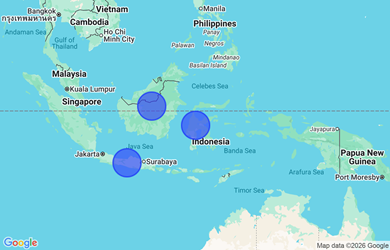
Rural
Java
Jawa Barat, Lampung Jawa, Luar Jawa, Sulawesi and Kalimantan for operations and markets. Operators will have to set-up their collection and delivery centers close to the rural areas, i.e. at close proximity to the farmers. Location will depend on the crop that the operator wishes to obtain from the farmer.
Rural
Kalimantan
Rural
Sulawesi
Sector Sources
1) Republic of Indonesia. 2019. Roadmap of SDGs Indonesia Towards 2030. https://www.unicef.org/indonesia/media/1626/file/Roadmap%20of%20SDGs.pdf.
2) Hadyan, Rezha. Bisnis.com, 2021. Indeks Ketahanan Pangan Global 2020: Posisi Indonesia Turun ke-65. https://ekonomi.bisnis.com/read/20210313/12/1367047/indeks-ketahanan-pangan-global-2020-posisi-indonesia-turun-ke-65
3) Asian Development Bank (ADB). 2019. Policies to Support Investment Requirements of Indonesia’s Food and Agriculture Development during 2020-2045. https://www.adb.org/sites/default/files/publication/534336/indonesia-food-agri-development-2020-2045.pdf
4) Republic of Indonesia. 2020. Indonesia's 2020-2024 National Medium-Term Development Plan (RPJMN). https://perpustakaan.bappenas.go.id/e-library/file_upload/koleksi/migrasi-data-publikasi/file/RP_RKP/Narasi-RPJMN-2020-2024-versi-Bahasa-Inggris.pdf.
5) Rokom. Sehat Negeriku, 2018. Kenali Masalah Gizi yang Ancam Remaja Indonesia. https://sehatnegeriku.kemkes.go.id/baca/rilis-media/20180515/4025903/kenali-masalah-gizi-ancam-remaja-indonesia/
6) Palladium. 2020. Women in Indonesia are Farmers and Decision Makers: What Businesses Need to Know. https://thepalladiumgroup.com/news/Women-in-Indonesia-are-Farmers-and-Decision-Makers-What-Businesses-Need-to-Know
7) Republic of Indonesia. 2021. Voluntary National Review. https://sdgs.bappenas.go.id/laporan-voluntary-national-review-vnr-indonesia-2021/
8) Indonesian Centre for Agricultural Socio-economic and Policy Studies of the Ministry of Agriculture. 2021. The Role of Women Farmers During Covid-19 Pandemic. https://pse.litbang.pertanian.go.id/ind/index.php/covid-19/berita-covid19/675-peran-petani-perempuan-pada-masa-pandemi-covid-19#!/ccomment
9) The ASEAN Post. 2020. Empowering Indonesia’s Women Farmers. https://theaseanpost.com/article/empowering-indonesias-women-farmers
10) Australian Centre for International Agricultural Research. 2020. COVID-19 and food systems in Indonesia. https://www.aciar.gov.au/publication/covid-19-and-food-systems-indo-pacific/4-covid-19-and-food-systems-indonesia
11) IBCSD and FAO. 2020. Investment Opportunities of the Private Sector on the Sustainable Food System in Indonesia. https://researchinstitute.penabulufoundation.org/wp-content/uploads/2020/01/20200106_Investment-Opportunities-of-The-Private-Sector-on-The-Sustainable-Food-System-in-Indonesia.pdf
IOA Sources
12) Tracxn. 2022. Companies: Habibi Garden. https://tracxn.com/d/companies/habibigarden.com
13) DailySocial. 2021. Eden Farm Umumkan Pendanaan Seri A 271 Miliar Rupiah Dipimpin AppWorks dan AC Ventures. https://dailysocial.id/post/pendanaan-seri-a-agritech-eden-farm
14) CompassList. 2020. Indonesia Agritech Report 2020: Startups, Investors and Outlook. https://www.compasslist.com/reports/indonesia_agritech_report_2020
15) Goh, Lesley and Wu, Kelsey. World Bank Blogs, 2021. Investing in data and innovation ecosystem to transform Indonesia’s agriculture. https://blogs.worldbank.org/eastasiapacific/investing-data-and-innovation-ecosystem-transform-indonesias-agriculture
16) Statista. Real GDP Growth of the Agriculture Sector in Indonesia 2014-2019, with Forecasts for 2020-2022. https://www.statista.com/statistics/710164/indonesia-real-gdp-growth-of-the-agriculture-sector/#:~:text=In%202022%2C%20it%20was%20forecast,contract%20in%20the%20next%20years.
17) KPMG. 2018. The Fintech Edge: Peer-to-Peer Lending. https://assets.kpmg/content/dam/kpmg/id/pdf/2018/11/id-the-fintech-edge-p2p-lending.pdf
18) CBinsights. Company: Crowde. https://www.cbinsights.com/company/crowde
19) Rocketreach.co. PT East West Seed Indonesia Information. https://rocketreach.co/pt-east-west-seed-indonesia-profile_b5cefd11f42e0994
20) Hortidaily. 2018. Increasing the income of 12,500 seed growers all over in Indonesia. https://www.hortidaily.com/article/6040139/increasing-the-income-of-12-500-seed-growers-all-over-in-indonesia/
21) AgFunder. 2020. ASEAN Agrifoodtech Investment Report 2020. https://research.agfunder.com/2020/2020-asean-agrifoodtech-investment-report-final.pdf
22) Ministry of Agriculture (Kementan) of the Republic of Indonesia. 2020. Ministry of Agriculture 2020-2024 Strategic Plans. https://balitklimat.litbang.pertanian.go.id/wp-content/uploads/2020/05/Draft-Renstra-2020-2024-Final_3.pdf
23) Business Call to Action. Member - PT East West Seed Indonesia (EWINDO). https://www.businesscalltoaction.org/member/east-west-seed-indonesia-ewindo
24) United Nations Development Programme (UNDP). New York, 2019. Gender mainstreaming in global agricultural supply chains can accelerate good growth: What works and for whom? https://goodgrowthpartnership.com/wp-content/uploads/Gender-KP-Final-Jan2020.pdf
25) Tech for Impact. 2020. Better finance for farmers: How one fintech startup changed the way it works. https://techforimpact.asia/better-finance-for-farmers-how-one-fintech-startup-changed-the-way-it-works/
26) USAID. 2013. Indonesia: Regional Agricultural Trade Environment (RATE), Assessment Country Summary. https://www.usaid.gov/sites/default/files/documents/1861/Indonesia%20Rate%20Summary.pdf
27) Republic of Indonesia. 2021. Voluntary National Review: Annexes. https://sdgs.bappenas.go.id/laporan-voluntary-national-review-vnr-indonesia-2021/
28) Isnurhadi, Rizqi. Xendit, 2021. How Agritech startups are rejuvenating Indonesia’s agriculture sector. https://www.xendit.co/en/blog/how-agritech-startups-are-rejuvenating-indonesias-agriculture-sector/
29) Republic of Indonesia. 2015. Government Regulation (PP) No.17/2015 concerning Food and Nutrition Security. https://www.ecolex.org/details/legislation/government-regulation-of-the-republic-of-indonesia-no-17-of-2015-concerning-food-and-nutrition-security-lex-faoc169453/
30) Ministry of Agriculture of the Republic of Indonesia. 2012. Minister Regulation No.6/2012 on Guidance for Agriculture Research & Development Cooperation. https://www.fao.org/faolex/results/details/en/c/LEX-FAOC119236
31) Republic of Indonesia. 2014. Presidential Regulation (Perpres) no.154/2014 on the Agricultural, Fishery, and Forestry Institutional Extension. https://jdih.maritim.go.id/cfind/source/files/perpres/2011-2015/perpres_154_2014.pdf
32) Ministry of Agriculture of the Republic of Indonesia. 2021. Minister Regulation No.3/2021 on the Facilitation for the Implementation of Smallholder Business Credits (KUR) in the Agriculture Sector. https://jdih.pertanian.go.id/fp/peraturan/detail/476https://jdih.pertanian.go.id/fp/peraturan/detail/476
33) Ministry of Trade of the Republic of Indonesia. 2017. Minister Regulation No.57/2017 concerning the stipulation of maximum rice prices. http://jdih.kemendag.go.id/backendx/image/regulasi/25010739_Permendag_No._57_Tahun_2017.pdf
34) Ministry of Agriculture of the Republic of Indonesia. 2015. Minister Regulation No.40/2015 concerning Facilitation of Agricultural Insurance. https://bppsdmp-ppid.pertanian.go.id/doc/19/PERATURAN%20KEMENTERIAN%20PERTANIAN/Permentan%2040-2015%20Fasilitas%20Asuransi.doc.pdf
35) Ministry of Agriculture of the Republic of Indonesia. 2021. Minister Regulation No.15/2021 concerning Business Activity Standard and Product Standard in the Implementation of Risk Based-Business Licensing for Agriculture Sector. https://keswan.ditjenpkh.pertanian.go.id/?p=3167#:~:text=Peraturan%20Menteri%20Pertanian%20Nomor%2015,Sektor%20Pertanian%20%7C%20Direktorat%20Kesehatan%20Hewan
36) Ministry of Agriculture of the Republic of Indonesia. 2021. Minister Regulation No. 41/2021 concerning Allocation and Highest Retail Price of Subsidized Fertilizer in Agriculture Sector for Fiscal Year 2021. https://jdih.pertanian.go.id/fp/peraturan/detail/1041https://jdih.pertanian.go.id/fp/peraturan/detail/1041
37) Ministry of Finance of the Republic of Indonesia. 2013. Minister Regulation No.66/2013 concerning procedures for Providing, Disbursing, and Holding Accountability for Seed Subsidy Funds. https://www.fao.org/faolex/results/details/en/c/LEX-FAOC133299
38) Republic of Indonesia. 2014. Government Regulation (PP) No.25/2014 concerning the Granting of Horticultural (vegetables, fruits, herbal medicines) Business Facilities and Incentives. https://www.fao.org/faolex/results/details/en/c/LEX-FAOC169454
39) Crowde. 2021. Melalui Program Radhia Tani, CROWDE Berdayakan Kelompok Wanita Tani. https://blog.crowde.co/radhia-tani-kelompok-wanita-tani/