
Explore the country and target locations of the investment opportunity.
Country
Lao PDR
Region
- Vientiane Capital
- Champasak Province
- Savannakhet Province
- Luang Prabang Province
- Oudomxay Province
Situate the investment opportunity within sustainability focused sector, subsector and industry classifications.
Sector
Health Care
Lao PDR is ranked 135th (out of 195) in the 2019 Global Health Security Index [1]. High maternal and child mortality rates, malnutrition, and communicable diseases [2] are significant challenges. To improve public health outcomes, Lao PDR needs to strengthen healthcare infrastructure, enhance access to quality healthcare services, and invest in capacity building for healthcare professionals [3].
Policy priority
Lao PDR's policy priorities focus on achieving universal healthcare, improving access and quality of services, strengthening healthcare infrastructure, capacity building for healthcare professionals, and expanding health insurance coverage [4]. Additionally, reducing maternal and child mortality rates, addressing communicable diseases, and promoting health literacy.
Gender inequalities and marginalization issues
Women in Lao PDR face disparities in accessing healthcare services. Maternal mortality remains high at 46 per thousand live births[5]. In the healthcare workforce, women make up 38.5% of physicians[5]. These gender gaps are amplified in rural areas, where cultural norms, limited health literacy, and inadequate infrastructure further hinder women’s access to healthcare[6].
Investment opportunities
Lao PDR's healthcare sector presents opportunities in API manufacturing and healthcare retail. Growing demand for pharmaceuticals supports local production, while expanding healthcare retail increases access to essential medicines, particularly in underserved rural areas.
Key bottlenecks
Shortage and maldistribution of health workers, inadequate infrastructure [7]. Health financing is characterized by low government spending, reliance on out-of-pocket expenditure, and dependency on external aid [8]. Efforts to achieve Universal Health Coverage for vulnerable groups face hurdles due to these bottlenecks and the country's diverse, rural population [9].
Sub Sector
Health Care Retail
Development need
Lao PDR's biotechnology and pharmaceuticals subsector is in a nascent stage. The country grapples with a high burden of infectious diseases and a pharmaceutical market that is over 90% import-dependent. Investment in R&D is minimal, indicating a need for strengthening this subsector [10].
Policy priority
Lao PDR's policy objectives align with the need to enhance this subsector. The vision for universal healthcare, improved service quality, and expanded health insurance coverage necessitates a robust pharmaceutical industry [10].
Gender inequalities
Gender disparities are evident in Lao PDR's healthcare sector, with women constituting only 38.5% of physicians. These disparities are more pronounced in rural areas, where cultural norms and limited health literacy exacerbate the challenges women face in accessing healthcare [11].
Investment opportunities
The biotechnology and pharmaceuticals subsector in Lao PDR presents promising investment opportunities. The country's growing demand for pharmaceuticals and the need to reduce import dependency provide a conducive environment for API manufacturing and healthcare retail [12]
Key bottlenecks
Lao PDR's healthcare infrastructure faces significant challenges. The sector's heavy reliance on imports, particularly for pharmaceuticals, and an evolving regulatory framework for pharmaceuticals and medical devices could hinder the growth of the biotechnology and pharmaceuticals subsector [13].
Industry
Biotechnology and Pharmaceuticals
Discover the investment opportunity and its corresponding business model.
Investment Opportunity Area
Generic Drug Production
To reduce imports and meet rising demand for medicines
Business Model
Invest to boost Lao PDR's generic drug production by establishing manufacturing facilities with local partners to produce generic drugs for the domestic market. Illustrative examples of enterprises operating in this space are:
PDC 3 is a state-owned pharmaceutical factory in Lao PDR that produces and distributes high-quality pharmaceutical products to meet the healthcare needs of the people in the country. (14)
Sinopharm Group is a Chinese pharmaceutical company that has established a joint venture with the Lao government to build a pharmaceutical factory in the country. The factory will produce a range of generic drugs for the domestic market and is expected to be completed in 2022. (14)
Zuellig Pharma: Zuellig Pharma is a leading healthcare services provider in Asia that has established a presence in Lao PDR through its subsidiary Zuellig Pharma Laos. The company provides distribution and logistics services for pharmaceuticals, medical devices, and consumer health products in the country. (15)
Learn about the investment opportunity’s business metrics and market risks.
Market Size and Environment
Market Size (USD)
< USD 50 million
CAGR
5% - 10%
Critical IOA Unit
30,546,773 USD of medications were imported in Lao in 2022.
The total value of production for medicine was $13 million in 2021.
Indicative Return
GPM
10% - 15%
Generic drug manufacturers had a 20% profit margin in FY 2016, declining to 12.8% in FY 2019.(18)
Investment Timeframe
Timeframe
Long Term (10+ years)
The high upfront capital expenditure required to establish pharmaceutical manufacturing in Lao PDR will contribute to long term returns.
Ticket Size
Average Ticket Size (USD)
> USD 10 million
Market Risks & Scale Obstacles
Capital - CapEx Intensive
The cost of drug research and development, manufacturing, and marketing is high. There is a significant requirement for investments in equipment, facilities, and personnel that makes it a costly venture. [21]
Market - Highly Regulated
Manufacturing of druges in Lao PDR is primarily overseen by the Food and Drug Department (FDD).To import or export pharmaceuticals, food, or chemical products in Laos, importers must obtain a license from the Food and Drug Control Import Division of the Food and Drug Department (FDD) of the Ministry of Public Health. (22)
Read about impact metrics and social and environmental risks of the investment opportunity.
Sustainable Development Need
23% of Lao PDR's population lives below the national poverty line. Investments in this IOA can address challenges in access to affordable healthcare in Lao PDR where many struggle due to high medical costs and where out of pocket expenditure on medicines is especially high. (23)
Inadequate waste management in rural Lao PDR, with only 10% access to basic services, exacerbates health risks, increasing the demand for effective medical interventions and medicines to manage health risks.
70% of the Lao PDR population lacks adequate healthcare access.(23)
Gender & Marginalisation
Only 13% of women give birth with a skilled birth attendant, and maternal mortality is high at 197 per 100,000 live births. Additionally, only 30% of women use modern contraception. (24)
Ethnic groups such as the Hmong and Khmu face language and cultural barriers when accessing healthcare, leading to inadequate treatment and lower health outcomes.(25)
Expected Development Outcome
Increased availability of affordable medicines will directly contribute to improved health outcomes across the population, especially for those living in poverty or remote areas.
The local production of medicines could play a critical role in addressing the increased demand for healthcare products resulting from health risks.
By localizing drug production, the initiative could reduce dependency on imported medicines, improving access to medicines.
Gender & Marginalisation
Improved distribution of generic medicines will increase adoption of modern contraception.
By implementing gender-sensitive policies, such as ensuring equal pay and promoting diversity and inclusion, investments in this IOA can promote an inclusive workforce in pharmaceutical industry, and improve the work environment for marginalised groups and empower them
Primary SDGs addressed
3 - Good Health and Well-Being
3.8.1 Coverage of essential health services
Current Value
Only 48% of the population has access to essential health services, including immunization, maternal and child health, and treatment for infectious diseases. (26)
Target Value
The government aims to reduce the global maternal mortality ratio to less than 70 per 100,000 live births by 2030. (24)
9 - Industry, Innovation and Infrastructure
9.2.1 Manufacturing value added as a proportion of GDP and per capita
Current Value
The manufacturing value added as a proportion of GDP in Lao PDR was 15.7% in 2020. (27)
Target Value
The government is actively promoting investment in pharmaceutical manufacturing to support UHC by 2025. (26)
Secondary SDGs addressed
1 - No Poverty
5 - Gender Equality
Directly impacted stakeholders
People
Patients and healthcare providers in Lao PDR will benefit from increased access to affordable medicines, particularly those from marginalized communities.
Gender inequality and/or marginalization
Women will benefit from increased access to healthcare/hygiene products.
Planet
Reduced carbon emissions from decreased transportation of pharmaceutical products and proper disposal of expired medicines, reducing environmental impact.
Corporates
Local pharmaceutical manufacturers, distributors, retailers, and foreign pharmaceutical companies operating in the Lao PDR market will benefit from increased product demand.
Public sector
The Lao government, particularly the Ministry of Health, will benefit from increased capacity to provide affordable medicines to the population and reduced healthcare expenditures.
Indirectly impacted stakeholders
People
Indirectly impacted stakeholders include family members and caregivers of patients who can benefit from increased access to affordable medicines, especially women and girls who often bear the burden of caring for sick family members.
Gender inequality and/or marginalization
Better access to healthcare options will empower women through increased productivity.
Planet
Increased local production of generic drugs can reduce environmental impact by reducing carbon emissions associated with transportation and packaging waste.
Corporates
International pharmaceutical companies may be indirectly impacted by reduced demand for their products in the Lao PDR market.
Public sector
Healthcare providers and public health agencies may be indirectly impacted by improved access to affordable medicines, leading to better health outcomes and reduced healthcare costs.
Outcome Risks
There is a risk of increased import dependency on foreign pharmaceutical companies, which could lead to higher prices and reduced access to essential medicines.
There is a risk that some manufacturers may be unable to compete with established providers and may struggle to sustain their operations.
Insufficient investment in research and development leading to limited innovation and lack of access to new treatments.
Local production of generic drugs may be subject to reduced quality control standards, which could lead to substandard medicines being distributed, putting patients' health at risk.
Gender inequality and/or marginalization risk: Women and marginalized communities may face limited access to affordable medicines due to systemic barriers to healthcare and economic opportunities.
Impact Risks
Dependence on imported raw materials leading to increased import costs and supply chain disruptions.
Inadequate quality control leading to substandard or unsafe drugs.
Insufficient investment in research and development leading to limited innovation and lack of access to new treatments.
Overreliance on one industry leads to economic volatility and a lack of diversification.
Gender inequality and/or marginalization risk: Women and marginalized communities may face limited access to affordable medicines due to systemic barriers to healthcare and economic opportunities.
Impact Classification
C—Contribute to Solutions
What
Developing local capacity for generic drug production to address import dependency and meet demand for affordable medicines.
Who
The Lao PDR healthcare system, patients, drug manufacturers, pharmaceutical distributors, and the environment.
Risk
Unintended negative consequences, such as environmental degradation, gender inequality, and marginalization.
Contribution
Lao PDR faces a high dependency on imported medicines, with a growing demand for affordable options. Developing local capacity for generic drug production can address this need.
How Much
Lao PDR imported $30,246,773 USD of medicament in 2022. This IOA will reduce import dependency for medicines.
Impact Thesis
Developing local capacity for generic drug production in Lao PDR is expected to increase access to affordable medicines and reduce import dependency.
Explore policy, regulatory and financial factors relevant for the investment opportunity.
Policy Environment
A Policy Snapshot of Health and Nutrition in Lao PDR - provides a snapshot of government health spending, maternal and child expenditure, health care workers, and the status of nutrition. (28)
Health Sector Reform Strategy and Framework till 2025 - provides a legal and action framework for implementing the Health Sector Reform Strategy with a policy and strategic planning matrix. (29)
Country Programme Document for Lao PDR (2022-2026) - outlines the UNDP's programmatic priorities and strategies for development in the country, including in the health sector. (30)
"Policy on Primary Health Care" - provides an approach to primary health care, its basic components, strategy, and responsibilities at each level. (31)
Public Financial Management in the Health Sector in Lao People's Democratic Republic: Service Delivery Challenges and Opportunities - discusses the challenges in financing the health sector and the low level of government investment. (32)
Lao PDR's Ninth National Socio-Economic Development Plan (NSEDP 2021-2025): Outcome 2: Improved quality of human resources to meet development, research capacity, science and technology needs, and create value-added production and services
Financial Environment
Financial incentives: Investment Promotion Law (2016) offers tax breaks and other incentives to attract foreign investment in targeted sectors, including health sector. (34)
Fiscal incentives: Health Sector Reform Strategy (2013-2025) promotes increased public financing, greater efficiency, and strengthened health insurance systems. (35)
Other incentives: Public-Private Partnership (PPP) Policy encourages private sector participation in infrastructure development, including the health sector, by sharing risks and costs. (36)
Regulatory Environment
Law on Drug and Medical products: This Law determines the principles, rules, and measures relating to the use, management, monitoring, and inspection of drugs and medical products with the aim of ensuring the supply of drugs and medical products of good quality, efficacy, safety with appropriate prices in order to prevent diseases and to provide treatment to all people for their good health, contributing to the national protection and development.
Imported medicine regulations: Regulations on importing medicines to Lao PDR (33)
Regulation on Food, Drug and Medical Product Advertisement Control: Regulations on advertising of food, drugs, and medical products (34)
Banned drug list: List of drugs in Lao PDR which are illegal to manufacture or sell.
Discover examples of public and private stakeholders active in this investment opportunity that were identified through secondary research and consultations.
Government
The Ministry of Health and the Ministry of Industry and Commerce are among the key government agencies responsible for overseeing the sector.
Multilaterals
The World Health Organization (WHO) is a key multilateral actor in the pharmaceutical manufacturing space in Lao PDR.
Non-Profit
Non-profit organizations such as the Clinton Health Access Initiative and the Lao Friends Hospital for Children are among the actors that are directly relevant for the pharmaceutical manufacturing space in Lao PDR.
Public-Private Partnership
PDC3, Sinopharm, CBF Pharma.
See what country regions are most suitable for the investment opportunity. All references to Kosovo shall be understood to be in the context of the Security Council Resolution 1244 (1999)
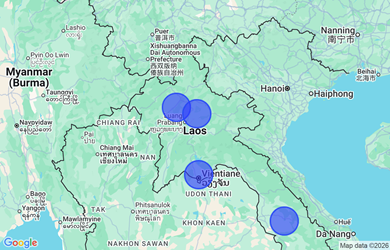
Urban
Vientiane Capital
Established infrastructure and skilled workforce make it a suitable location for pharmaceutical manufacturing—home to key government agencies responsible for regulating the pharmaceutical sector. The investment could create jobs and improve access to quality medicines.
Urban
Champasak Province
Rural province with a large tourism industry and a need for improved access to quality medicines. Investment in pharmaceutical manufacturing could help address this issue while creating jobs and supporting the local supply chain.
Urban
Savannakhet Province
It is the largest province with a strategic location on the border with Vietnam. Savan-Seno Special Economic Zone has attracted investment in several industries. Investment in pharmaceutical manufacturing could create jobs and improve access to quality medicines.
Urban
Luang Prabang Province
Province with a large rural population and a need for improved access to quality medicines. Investment in pharmaceutical manufacturing could help address this issue while contributing to the local economy through job creation and supporting local supply chains.
Oudomxay Province
Capital of Oudomxay province with a large rural population and a need for improved access to quality medicines. Investment in pharmaceutical manufacturing could help address this issue while creating jobs and supporting the local supply chain
(1) “Current health expenditure (% of GDP) - Lao PDR | Data.” The World Bank, The World Bank, 2023, data.worldbank.org/indicator/SH.XPD.CHEX.GD.ZS?locations=LA
(2) “Quality of Health Care in the Lao People’s Democratic Republic.” Asian Development Bank, 2019, https://www.adb.org/publications/quality-of-health-care-lao-pdr
(3) “The Lao People’s Democratic Republic health system review.” World Health Organization, 2014.
(4) “A Policy Snapshot of Health and Nutrition in Lao PDR.” World Bank. https://www.worldbank.org/en/country/lao/publication/a-policy-snapshot-of-health-and-nutrition-in-lao-pdr
(5) UNICEF. “The Situation of Children and Women of Lao People’s Democratic Republic 2020.” UNICEF, 2020, https://www.unicef.org/laos/reports/situation-children-and-women-laoprd
(6) “Maternal mortality ratio (modeled estimate, per 100,000 live births) - Lao PDR | Data.” The World Bank, https://data.worldbank.org/indicator/SH.STA.MMRT?locations=LA
(7) World Health Organization. (2019). Lao PDR: Health Financing System Assessment. https://www.worldbank.org/en/country/lao/publication/lao-pdr-health-financing-system-assessment
(8) World Health Organization. (2021). Sustainable financing for Primary Health Care and Universal Health Coverage in Lao People’s Democratic Republic.
(9) World Health Organization. (2021). Sustainable financing for PHC and UHC in Lao People’s Democratic Republic. https://www.who.int/news-room/feature-stories/detail/lao-PDR
(10) United Nations. “Lao PDR - Country and Industry Profile.” Lao PDR - Country and Industry Profile, 24 September 2021, https://laopdr.un.org/en/145878-lao-pdr-country-and-industry-profile
(11) United Nations Development Programme. “GENDER EQUALITY STRATEGY 2022-2026.” United Nations Development Programme, 2022, https://www.undp.org/sites/g/files/zskgke326/files/2022-11/undp_lao_pdr_gender_strategy_and_action_plan_2022-2026-signed.pdf
(12) Asian Development Bank. “Lao People’s Democratic Republic: Subsector Analysis.” Asian Development Bank, 2010, pp. 1-2.
(13) World Bank. “Public Financial Management in the Health Sector in Lao People’s Democratic Republic: Service Delivery Challenges and Opportunities.” World Bank Group, 2017, https://documents1.worldbank.org/curated/en/252561613629377115/pdf/Public-Financial-Management-in-the-Health-Sector-in-Lao-People-s-Democratic-Republic-Service-Delivery-Challenges-and-Opportunities.pdf
(14) “Lao factory producing Molacovir for treatment of Covid-19 patients.” The Star Online, 2022
(15) Zuellig Pharma.” Zuellig Pharma, 2021. https://laotiantimes.com/2023/04/27/zuellig-pharma-recognised-with-a-score-of-a-on-cdp-supplier-engagement-in-industry-first/
(16) “DKSH Laos.” DKSH Laos, 2021.
(17) World Bank. “Overview: Development News, Research, Data.” World Bank, https://www.worldbank.org/en/country/lao/overview
(18) Statista. “Profit Margin for Generics Manufacturers Worldwide 2019.” Statista, 17 Sept. 2021, https://www.statista.com/statistics/1248196/profit-margin-for-generics-manufacturers-worldwide/
(19) Lao PDR - World Bank.” World Bank, 2021, https://pubdocs.worldbank.org/en/147871629861334356/Lao-PDR-Economic-Monitor-August-2021.pdf
(20) Bate, Roger. “Local Pharmaceutical Production in Developing Countries.” International Policy Network, 2008, https://www.unido.org/sites/default/files/2016-01/Local_Pharmaceutical_Production_web_0.pdf
(21) “Research and Development in the Pharmaceutical Industry.” Congressional Budget Office, 2021, https://www.cbo.gov/system/files/2021-04/57025-Rx-RnD.pdf
(22) “Laos - Import Requirements and Documentation.” Export.gov, 2022, https://www.export.gov/article?id=Laos-Import-Requirements-and-Documentation
(23) “Lao People’s Democratic Republic.” Asian Development Bank, 2022, https://www.adb.org/countries/lao-pdr/health
(24) “Lao People’s Democratic Republic.” United Nations Population Fund, 2022, https://laos.unfpa.org/en/publications/lao-pdr-country-gender-profile-2022
(25) Lao People’s Democratic Republic.” United Nations Development Programme, 2022, https://www.la.undp.org/content/lao_pdr/en/home/countryinfo.html
(26) Lao People’s Democratic Republic.” World Health Organization, 2022, https://www.who.int/countries/lao/en/
(27) “Lao People’s Democratic Republic.” World Bank, 2022, https://data.worldbank.org/country/lao-pdr
(28) A Policy Snapshot of Health and Nutrition in Lao PDR.” World Bank, 2022, https://www.worldbank.org/en/country/lao/publication/a-policy-snapshot-of-health-and-nutrition-in-lao-pdr
(29) Health Sector Reform Strategy and Framework till 2025.” Ministry of Health of Lao PDR, 2013, http://www.la.one.un.org/images/publications/Health_Sector_Reform_Strategy_and_Framework_till_2025.pdf
(30) “Country Programme Document for Lao PDR (2022-2026).” United Nations Development Programme, 2021, https://www.la.undp.org/content/lao_pdr/en/home/library/country-programme-document-for-lao-pdr–2022-2026-.html.
(31) “Policy on Primary Health Care.” Ministry of Health of Lao PDR, 2019, http://www.la.one.un.org/images/publications/Policy_on_Primary_Health_Care.pdf
(32) Public Financial Management in the Health Sector in Lao People’s Democratic Republic: Service Delivery Challenges and Opportunities.” World Bank, 2018, https://www.worldbank.org/en/country/lao/publication/public-financial-management-in-the-health-sector-in-lao-pdr-service-delivery-challenges-and-opportunities
(33) “Food & Drug Department, Ministry of Health, Lao PDR.” FDD. N.p., n.d. Web. 06 July 2023. http://www.fdd.gov.la/content_en.php?contID=29
(34) LAW ON INVESTMENT PROMOTION (Amendment).” National Assembly of Lao PDR. N.p., n.d. Web. 06 July 2023. https://laotradeportal.gov.la/kcfinder/upload/files/Law_Investment_(Amended)-14_17112016-EN.pdf
(35) “Health Sector Reform: Issues and Opportunities.” World Health Organization. N.p., n.d. Web. 06 July 2023. https://apps.who.int/iris/bitstream/handle/10665/127574/WP_HlthSecRefm_FinalVersion.pdf;sequence=1
(36) “Lao PDR Public-Private Partnership Policy.” Asian Development Bank. N.p., n.d. Web. 06 July 2023. https://www.adb.org/sites/default/files/linked-documents/46059-002-sd-06.pdf