
Explore the country and target locations of the investment opportunity.
Country
Philippines
Region
- Western Visayas
- Central Visayas
- Bicol Region
- Davao Region
Situate the investment opportunity within sustainability focused sector, subsector and industry classifications.
Sector
Infrastructure
Development need
Infrastructure need cuts across multiple sectors including housing, transportation and utitlities. Based on a study done by JICA on 2015, the annual loss from GDP caused by inadequate infrastructure amounts to 20 Billion USD. (4)
Government spending for infrastructure with the "Build Build Build" policy at the forefront showed 19.5% dedicated mainly to infrastructure in 2019. Post-pandemic, the current administration still find key infrastructure across agriculture, transportation and logistics, education and energy lacking and have showing great interest in public-private partnership through the increase in projects. (1)
Policy priority
The Philippine Development Plan for 2023-2028 specifically focused in the criticality of the Infrastructure sector. It provided direction and signalled that there's further demand for the development of the sector across the different aspects (energy, transportation, housing) and regions.
A report by the DBM on the 2022 national budget in 2021 highlighted greater investments in social and economic services in line with the government’s COVID-19 response and recovery agenda and other crucial expenditures. In particular, health, social welfare, and infrastructure development continue to be prioritized in order to manage the risks of the outbreak and boost economic growth. (1)
Gender inequalities and marginalization issues
The Philippine Statistics Authority has noted that the areas in the Philippines with low income also experience lack of access in basic infrastructure such as clean water sources and sanitation. separating at landfill sites, thus lacking social protection.
Regions such as BARMM (84% access to water and 51.6% access to basic sanitation) and Central Visayas (94% access to water and 70% access to sanitation) were highlighted. (5) Women are traditionally responsible for managing household waste as part of their daily chores, and in the wider informal waste management sector, women are primarily found in the lower tier, working in waste picking and
Investment opportunities
The Philippine Development Plan 2023 - 2028 highlighted it's focus on Infrastructure development. Multiple policies including the creation of additional PEZA zones, 1 million yearly housing target of the Department of Socialized Housing and Urban Development, among others, provide investment opportunities for developers within the sector. (1)
Key bottlenecks
The World Bank in its report: Philippine Economic Update June 2021 pinpoint that the main challenges within the industry are long time frames which creates slower budget execution rates. Coupled with new policies, there's a need to improve the capacity of local government to effectively mobilize capital to create public-private partnerships.
Sub Sector
Waste Management
Development need
The World Bank notes that the Philippines grapples with unsustainable plastic production/consumption and insufficient solid waste management infrastructure. A staggering 2.7 million tons of plastic waste are generated in the Philippines each year, and an estimated 20 percent ends up in the ocean.
Because of the main income generating aspects of an archipelago, the livelihoods of the Philippines’ coastal communities, and the fishing, shipping and tourism industries are especially vulnerable to the impact of marine debris.(8) The current sanitary landfills can only serve 10% of their need, and overflow of these landfills result to negative health impact in surrounding areas. (9)
Gender inequalities and marginalization issues
Access to proper sanitation systems impact low-income household as well as families living in hard to reach areas. Without enough solid waste management systems and infrastructures, only families and communities with enough income can create small solutions to make sure that waste are collected and disposed. (8)
Women are the most vulnerable in waste management sector having less access to skills, training, and capital to earn more from working with waste. (13)
Investment opportunities
The Department of Environment and Natural Resources estimates the capacity of sanitary landfills currently only serve 10% of the needs of the Philippines, solid waste management and recycling are expected to be less (10). This creates adequate market space for new investments to come in.
Multiple solid waste managements were also approved last 2022 through private sector solutions and public-private sector partnerships. Therefore showing the business viability of the investment.
Key bottlenecks
Industry leaders point out that the viability of waste management systems require that multiple municipals or regions collaborate together to reach necessary demand levels. This can create delays in approval and excution of the solid waste management infrastructure, as well as limit the investment entry depending on the scale requirement of the whole group.
Industry
Waste Management
Discover the investment opportunity and its corresponding business model.
Investment Opportunity Area
Effective Infrastructure for Solid Waste Management
Business Model
Invest in construction and operation of solid waste management infrastructure, including sewage systems and sanitation centers. Investments can be concentrated in areas with high demand as identified by the local governments.
General Santos City Sanitary Landfill Started at the beginning of the 21st Century, the General Santos City Sanitary Landfill Project is a proposed public-private partnership (PPP) project that aims to extend the life of the General Santos City Sanitary Landfill (SLF) and improve its capacity. The project involves the operation and maintenance of the SLF and the establishment and implementation of a waste conversion program. The indicative cost of the project is USD 2 million. East Asia Sheng Tai, a consortium consisting of East Asia Solutions Technology Corporation, Sheng Tai Energy Technology Company, and Dr. Lin Shing-Chou, had submitted an "unsolicited proposal" to manage and operate the sanitary landfill for at least 25 years, with the project costing ~USD 1.76 million.
Quezon City Integrated Solid Waste Management Facility Project. Initiated in 2018, the Quezon City Integrated Solid Waste Management Facility Project is a public-private partnership venture between the local government of Quezon City and a consortium led by Metro Pacific Investments Corp. The project entails the design, financing, construction, operation, and maintenance of a waste treatment facility capable of processing up to 3,000 metric tons of municipal solid waste (MSW) per day and generating 36-megawatt electric (MWe) of renewable power. It aims to provide the QC LGU with a sustainable and cost-efficient waste disposal solution.
Learn about the investment opportunity’s business metrics and market risks.
Market Size and Environment
Market Size (USD)
USD 50 million - USD 100 million
CAGR
5% - 10%
Critical IOA Unit
21 million metric tons per annum
The estimated industry revenue for waste management is around USD 63.5 million. (20) The global waste management market size has a CAGR of 6.71% from 2022 to 2030 (20) According to the Department of Environment and Natural Resources (DENR), the Philippines produces over 21 million metric tons of garbage per annum. (14)
Quezon City's garbage collection revenues are projected to grow uninterruptedly over the next five years (2016-2020). This growth will result in an accumulated surplus of USD 375 million. (18)
Indicative Return
IRR
10% - 15%
GPM
> 25%
The return profile in IRR is estimated to be around 10-15% (15) Net profit margin of 64.6% in feasibility study for upgrading solid waste management system (17) Expected returns will depend on the tipping fee secured and the power offtake arrangement (revenues can be higher if sold directly to a cooperative (15)
Similar planned projects in the Philippines expect an average Project Internal Rate of Return (IRR) of 8.2%-9.5% and an Equity IRR of 13.3%-16.8% (15)
Investment Timeframe
Timeframe
Medium Term (5–10 years)
Estimated payback period for Waste Management projects require at least 7 years. (20) The payback period for Integrated Solid Waste Management Facilities can range from two to six years, depending on the size of the project, local prices for commodities, electricity, biogas, compost, and tipping fees, and the financing structure. (19)
Ticket Size
Average Ticket Size (USD)
> USD 10 million
Market Risks & Scale Obstacles
Capital - CapEx Intensive
Waste management systems in the Philippines currently requires that municipalities group/collaborate between themselves to achieve the necessary mass for waste to energy plants viability.
Market - Highly Regulated
Infrastructure projects such as solid waste management systems require approvals from multiple government stakeholders which can create friction even before.
Market - Volatile
The regulatory environment for solid waste management can change over time, which can impact the cost and feasibility of projects. For example, if new regulations are introduced that require stricter environmental standards, it can increase the cost of project development and operation.
Read about impact metrics and social and environmental risks of the investment opportunity.
Sustainable Development Need
With over a 100 million population, the Philippines is now producing over 21 million metric tons of garbage annually (11). Despite an existing law mandating segregration of garbage at the barangay (village) level, waste management is still a problem. Trash ends up in water bodies, resulting to diseases, pollution, drainage clogs causing floods, among others (12).
Proper waste management is crucial for sustainable development in the Philippines. Environmentally, economically, and socially sustainable practices are needed to prevent pollution, conserve natural resources, promote sustainable consumption, and protect public health and safety while reducing social inequities and empowering communities.
The government eyes the establishment of 300 more sanitary landfills nationwide through public-private partnership in the next two years (11).
Gender & Marginalisation
Informal waste workers often face poor working conditions, low pay, and limited access to social protection and healthcare. They are also more vulnerable to harassment and violence while working in the waste sector.
Waste disposal sites, often located in marginalized communities, expose these populations to health risks and environmental degradation. Due to lack of political power, these communities find it difficult to advocate for their rights to clean and healthy living conditions.
Expected Development Outcome
Effective solid waste management practices can reduce the risk of exposure to disease-causing agents and contaminants that can harm public health. Proper waste disposal methods and sanitation practices can prevent the spread of diseases, leading to better overall health outcomes for communities.
The efficient management of solid waste can generate new business opportunities and jobs in the waste management industry. Recycling and composting programs can create new markets for recycled materials and reduce the cost of waste disposal, leading to potential economic benefits for communities.
Proper solid waste management practices can lead to a reduction in pollution of air, water, and soil, which can help protect biodiversity and ecosystems from degradation caused by improperly managed waste.
Gender & Marginalisation
Proper waste management practices can lead to the formalization of the waste management sector, which can provide better working conditions and higher wages for informal waste workers, who are often women. Proper waste management practices can provide marginalized communities with access to clean and safe waste disposal facilities, improving their living conditions and protecting their health.
Primary SDGs addressed
6 - Clean water and sanitation
6.2.1 Proportion of population using (a) safely managed sanitation services and (b) a hand-washing facility with soap and water
Current Value
Population living in households with access to basic sanitation increased to 95.3% based on Philippine Statistics Authority data for 2020, however, it is important to note that regional data shows large variations to this average where certain regions are as low as 39.3% (BARMM)
Target Value
The Philippines aim for 100% access by 2030.
11 - Sustainable Cities and Communities
11.6.2 Annual mean levels of fine particulate matter (e.g. PM2.5 and PM10) in cities (population weighted)
Current Value
Percentage of highly urbanized and other major urban centers within ambient air quality guidelines value increased As of 2021, there are only 21% of the highly urbanised and major urban centers with ambient air quality
Target Value
Target is to achieve 100% by 2030
Secondary SDGs addressed
13 - Climate Action
12 - Responsible Consumption and Production
3 - Good Health and Well-Being
Directly impacted stakeholders
People
Close proximity communities to unmanaged landfills will benefit the most, second of which are informal waste management workers - people who tend to be members of the poor population.
Gender inequality and/or marginalization
The project may directly impact informal waste pickers, who rely on scavenging as a means of livelihood. The project must consider the needs of these waste pickers and provide alternative livelihood options to ensure they are not left behind.
Planet
Proper solid waste management solutions reduce emissions of strong greenhouse gases such as emissions. It also helps reduce the country's 500,000 metric tons of plastic waste leakage per year
Corporates
Local businesses may participate in the recycling and waste processing industry, which could generate new jobs and revenue streams for the local economy.
Public sector
Improving waste collection system through formal waste management solutions can increase economic growth within the sector. Closely tied sectors such as water solution and tourism should also experience a direct benefit
Indirectly impacted stakeholders
People
A cleaner environment comes with better health and sanitation, which impact our productivity and quality of life.
Gender inequality and/or marginalization
Poor families living near unmanaged landfill areas will also benefit from waste management systems that slowly redirect and process waste within the area
Planet
Better waste management may help reduce the dire impacts of climate change such as severe flooding and lowering of water quality.
Corporates
The construction of a new waste management facility could generate new business and employment opportunities. Waste management companies could be indirectly impacted by the project as the improved waste management practices could change the demand for their services.
Public sector
Tourism could benefit from the project as a cleaner environment resulting from improved waste management practices could attract more tourists, generating new business opportunities.
Outcome Risks
Environmental outcome risks: Inadequate solid waste management infrastructure results in pollution, landfill overflow, greenhouse gas emissions, resource depletion, and habitat destruction. Public health outcome risks: Improper waste disposal can increase risk of vector-borne diseases, waterborne diseases, respiratory issues, occupational health hazards, and health inequities.
Socioeconomic Outcome Risks: Economic losses, reduced quality of life, livelihood disruption, social stigma, and limited community engagement due to inefficient waste management infrastructure. Gender Inequality/Marginalization risks: gendered division of labor, occupational segregation, lack of gender-responsive services, and gender-based violence.
Impact Risks
Poor waste management infrastructure can result in land and soil contamination, air and water pollution, hazardous waste mishandling, and disruption of local ecosystems, posing risks to public health. Inadequate waste management infrastructure can lead to disease outbreaks, health hazards for waste workers, increased healthcare costs, odor and aesthetic concerns, and food safety risks.
Economic risks: This can lead to reduced tourism and investment, increased waste management costs, missed economic opportunities, property value decline, and job losses in traditional waste sectors. Gender Inequality/Marginalization risks: Limited access to waste services, and gender inequality, negatively impacting the quality of life, access to services, burdening women in waste management
Impact Classification
C—Contribute to Solutions
What
Improving access to effective solid waste management infrastructures that will enhance health of communities and the environment
Who
Communities surrounding landfills and livelihoods affected by solid waste in water systems such as fisherfolks and tourism dependent communities.
Risk
Medium risk of insufficient solid waste management solutions which will inadequately solve the large need for waste management
Contribution
Reduction to waste thrown to unmanaged landfills including around 500, 000 metric tons of plastic waste leakage per year, which will help improvement waterways enviroment and health of communities
How Much
Improve management of 21 million metric tons of waste generated per annum
Impact Thesis
Improving health and environment of impacted communities and water ways through providing solid waste management solutions.
Explore policy, regulatory and financial factors relevant for the investment opportunity.
Policy Environment
RA 9003: Ecological Solid Waste Management Act: It aims to promote proper solid waste management system in the country through the reduction of volume of waste generated, increase recycling efforts, and ensure proper disposal of hazardous waste to protect public health and the environment.
Resolution No. 669: National Solid Waste Management Commission (NSWMC): It created the National Solid Waste Management Commission (NSWMC) in the Philippines to oversee the implementation of the Ecological Solid Waste Management Act and promote sustainable waste management practices.
Department of Environment and Natural Resources Administrative Order No. 2019-09: It establishes guidelines for the rehabilitation and management of Manila Bay, with a focus on reducing pollution and ensuring sustainable development.
Department of Environment and Natural Resources Administrative Order No. 2018-19: It aims to improve the management of hazardous wastes. It provides guidelines for the environmentally sound handling of hazardous wastes to minimize their negative impact on human health and the environment.
RA 11898: Extended Producer Responsibility Act of 2022, Article 2, Sec. 44-D: "...obliged enterprises shall...establish or phase-in EPR programs for plastic packaging to achieve efficient management of plastic packaging waste, reduced production, importation, supply or use of plastic packaging..."
Financial Environment
RA 9003: Ecological Solid Waste Management Act Chapter IV, Section 45 (3) Financial Assistance Program "Government financial institutions...shall...accord high priority to extend financial services to individuals, enterprises, or private entities engaged in solid waste management."
RA 11898: Extended Producer Responsibility Act of 2022, Article 2, Sec. 7 (b) (1) Fiscal Incentives (b) The EPR expenses of obliged enterprises...shall be considered as necessary expenses deductible from gross income..."
RA 11898 or the Extended Producer Responsibility (EPR) Act of 2022 provides fiscal incentives to enterprises adhering to the law. Section 45 (1) (b) states that EPR expenses of obliged enterprises shall be considered as necessary expenses deductible from gross income.
Regulatory Environment
RA 9003: Ecological Solid Waste Management Act: It aims to promote a proper solid waste management system in the country. It aims to reduce the volume of waste generated, increase recycling efforts, and ensure proper disposal of hazardous waste to protect public health and the environment.
Resolution No. 669: National Solid Waste Management Commission (NSWMC): It created the National Solid Waste Management Commission (NSWMC) in the Philippines to oversee the implementation of the Ecological Solid Waste Management Act and promote sustainable waste management practices.
RA 8749: Philippine Clean Air Act of 1999: It aims to protect public health and the environment by controlling air pollution. It sets standards and guidelines for air quality, regulates emissions from vehicles and industries, and promotes the use of cleaner technologies.
Department of Environment and Natural Resources Administrative Order No. 2019-21: It aims to provide guidelines for the establishment and operation of materials recovery facilities (MRFs) in local government units (LGUs) as part of the country's solid waste management efforts.
Discover examples of public and private stakeholders active in this investment opportunity that were identified through secondary research and consultations.
Private Sector
Econest Wate Management Corp.; Greenways Management Services; ECOS Sanitary Landfill and Waste Management Corporation; Sure Global W2W1 PTE, Ltd; Austworks Corporation; Global Green International Energy Philippines, Inc., Plastic Bank, GreenAntz Metro Pacific Investments Corporation (MPIC) Aboitiz Capital Tana Oy, Ace Waste Pty Ltd., Cleanway Technology Corporation, Delitek AS Envirosuite, Maritrans Recycler., Inc. SM Prime Holdings
Government
Department of Environment and Natural Resources; Public-Private Partnership Center; Provincial Government of Catanduanes; City of General Santos; Quezon City; Province of Bataan
Multilaterals
World Wide Fund for Nature; Japan International Cooperation Agency; United Nations Development Programme; World Bank; Asian Development Bank
Non-Profit
Alternative Indigenous Development Foundation; Coca-Cola Foundation Philippines; Caritas Manila; Philippine Rural Reconstruction Movement; Greenpeace, Mother Earth Foundation
Public-Private Partnership
Catanduanes Solid Waste Management Project; General Santos City Sanitary Landfill Project; Quezon City Integrated Solid Waste Management Facility Project
See what country regions are most suitable for the investment opportunity. All references to Kosovo shall be understood to be in the context of the Security Council Resolution 1244 (1999)
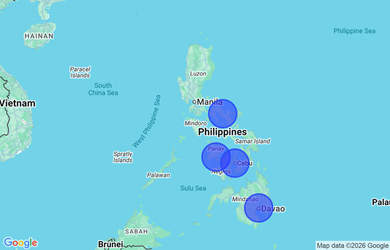
Semi-urban
Western Visayas
Local government have expressed support for the project through communication and/or solicited private-public partnership.
Urban
Central Visayas
Local government have expressed support for the project through communication and/or solicited private-public partnership.
Semi-urban
Bicol Region
Local government have expressed support for the project through communication and/or solicited private-public partnership.
Urban
Davao Region
Local government have expressed support for the project through communication and/or solicited private-public partnership.
1) NEDA. Philippine Development Plan 2023 to 2028 https://pdp.neda.gov.ph/philippine-development-plan-2023-2028/
2) INFF. Development Finance Assessment 2022. https://medium.com/@jp.inff.ph/2022-development-finance-assessment-shows-ph-financing-landscape-in-the-time-of-covid-19-and-the-68dcc39bcc19
3) Savoy, C. and Staguhn, J. (2022). The Role of Water in Catalyzing Gender Equity. Center for Strategic & International Studies. https://www.csis.org/analysis/role-water-catalyzing-gender-equity#:~:text=The%20United%20Nations%20highlights%20three,access%20to%20a%20water%20source.
4) KMC SAVILLS. https://kmcmaggroup.com/research-insights/2014/poor-infrastructure-impedes-ph-from-attaining-maximum-growth/
5) PSA. Majority Families have Access to Improved Source of Drinking Water https://psa.gov.ph/content/majority-families-have-access-improved-source-drinking-water-results-2022-annual-poverty"
6) NEDA. Philippine Water Supply and Sanitation Plan 2019 - 2030. https://neda.gov.ph/wp-content/uploads/2021/09/120921_PWSSMP_Main-Report.pdf "
7) UNICEF. 2 Billion People Lacking Safe Water Twice Lack Safe Sanitation. https://www.unicef.org/philippines/press-releases/two-billion-people-lack-safe-drinking-water-more-twice-lack-safe-sanitation#:~:text=Around%2099%25%20of%20the%20one-fifth%20wealthiest%20households%20are,20%20million%20lack%20access%20to%20basic%20sanitation%20facilities "
8) World Bank. Market Study for Philippines Plastic Circularity Opportunities and Barriers Report. https://www.worldbank.org/en/country/philippines/publication/market-study-for-philippines-plastics-circularity-opportunities-and-barriers-report-landing-page"
9) Business Mirror. Philippines only has 10% of Needed Sanitary Landfill, DENR. https://businessmirror.com.ph/2020/02/05/phl-only-has-10-percent-of-needed-sanitary-landfills-says-denr-exec/"
10) Cruspero, R. (2023, June 25). Private consortium eyes PHP100-M project to manage, operate sanitary landfill. Philippine News Agency. https://www.pna.gov.ph/articles/1123160
11) Mayuga, J. (2021 January 10). The garbage conundrum. Business Mirror. https://www.denr.gov.ph/images/DENR_News_Alerts/DENR_News_Alerts_10_January_2021_Sunday.pdf
12) Philippine News Agency. (2022 May 30). Solid waste segregation remains major challenge in PH: DENR chief. Philippine News Agency. https://www.pna.gov.ph/articles/1175460 13) Rappler (2022) https://www.rappler.com/environment/informal-waste-work-women-twice-vulnerable-invisible/
14) Business Mirror/DENR, 2021. https://www.denr.gov.ph/images/DENR_News_Alerts/DENR_News_Alerts_10_January_2021_Sunday.pdf
15) SMEC, (2016). FS on Small-Scale WTE Plants 16) Statista. https://www.statista.com/forecasts/1222059/waste-collection-revenue-in-the-philippines
17) NEDA (2020 December) https://nro13.neda.gov.ph/wp-content/uploads/2021/10/Pre-FS-Upgrading-of-Solid-Waste-Management-System.pdf
18) ADB (2016 December) Prefeasibility Study – Conventional Waste-to- Energy Project in Quezon City
19) Enventix, Inc. (n.d.) Municipal Solid Waste (MSW). https://enventixinc.com/municipal-solids-waste/
20) Precedence Research (n.d.) Waste Management Market (By Waste Type: Hazardous Waste, E-waste, Municipal Waste, Plastic Waste, Industrial Waste, Others; By Service Type: Collection, Open Dumping, Incineration/Combustion, Landfill, Recycling; By End User: Residential, Commercial, Industrial) - Global Industry Analysis, Size, Share, Growth, Trends, Regional Outlook, and Forecast 2023-2030. https://www.precedenceresearch.com/waste-management-market
21) QC Solid Waste Management Project https://ppp.gov.ph/wp-content/uploads/2018/10/PPPC_PROJ_QC-Intgrated-Proj-Info-Memo.pdf