
Explore the country and target locations of the investment opportunity.
Country
Vietnam
Region
- Mekong Delta Region
- Red River Delta
- Northern Border Provinces
Situate the investment opportunity within sustainability focused sector, subsector and industry classifications.
Sector
Food and Beverage
Development need
In 2021, The Global Food Security Index of Vietnam is ranked 65/113, indicating high food insecurity and poor nutrition (1); very low labor productivity in agriculture production, for instance, 2.4 and 2.1 times less than Indonesia and Thailand respectively (2); Seriously affected by climate change, the impact of floods alone causes a loss of 2.3% of GDP every year (3)
Policy priority
Strong support from the government for rural development (The resolution 26-NQ/TW/2008), including activities in agricultural value chains, e.g market access, technology transfer, access to capital, human resource improvement, infrastructure investment, and business model development (4); food safety for the population (5)
Gender inequalities and marginalization issues
26 m female labor force in the agriculture sector have unstable jobs, low income, and limited access to social welfare (6); a high malnutrition ratio for under-five children in rural areas, being 23.7% as opposed to 6.2% in urban areas (7)
Investment opportunities
Mass production in various crops and livestock, for example, 12.6 m tons of fruits, 22 m pigs, and 512 m poultry (2020) (8); USD 48 billion agricultural/ aquacultural export value in 2021 (9) Post-harvest processing technology - processed products with high added value accounts for only 10-40% of the farm output (10)
Sub Sector
Food and Beverage Retail
Development need
Cold chain services such as storage, transportation, or packaging are underdeveloped leading to spoilage in distribution and processing, and increasing distribution costs (51 USD/ton in 2020 to 87 USD/ton in 2021) (11, 13). High post-harvest loss rate at 10-20%. (7) Issue of food safety: 1,556 cases of food poisoning, with more than 47,400 people infected for 2010-2019. (12)
Policy priority
Decree 57/2018/ND-CP encourages investment in agriculture and rural areas (15), and Resolution 48/NQ-CP/2008 provides supports solutions to minimize post-harvest losses for key agricultural products to improve production efficiency and farmers' income (14); Ensuring food safety by supply chain control is set in the National Food Safety Strategy 2011-2020, vision for 2030 (16).
Gender inequalities and marginalization issues
Post-harvest loss is translated into a reduced income for millions of households, including ethnic minorities, who are making a livelihood on fresh produce. For example, the Highland region, where ethnic minorities are concentrated, accounts for 27% of the national veggies production of 17.6 m tons (17)
Investment opportunities
Estimated USD 300m market for agri-tech solutions, including distribution and retailing (19), estimated USD 1.8 b market for cold chain services (18). Investment in cold chain services can be temperature-controlled storage at single or multiple locations, and combined with other transportation services.
Key bottlenecks
The value chain setting may be challenging for application of high tech solutions. Access to land or land acquisition may be costly, given that storage at commercial centers is convenient for goods movement.
Industry
Food Retailers and Distributors
Discover the investment opportunity and its corresponding business model.
Investment Opportunity Area
Cold storage for efficient supply chain
Business Model
B2B model: Provide cold storage for agricultural perishables (containers and bulk cargo) to serve both export businesses and distributors in the domestic market. The service may also additionally cover refrigerated freight, preservation, quality control, goods sorting, and packaging. Examples of enterprises active in the space:
ITL Corporation operates over 300,000 m2 of standard warehousing space in the North and South of Vietnam. It has its own fleet of 300 container prime movers and three main transport hubs in the South, North, and Centre (34). In 2020, the company secured USD 70 million in loans from IFC for investment in cold chain infrastructure (33).
Learn about the investment opportunity’s business metrics and market risks.
Market Size and Environment
Market Size (USD)
> USD 1 billion
CAGR
10% - 15%
Critical IOA Unit
Vietnam's agriculture GDP is estimated at about USD 40 b (more than 10% of GDP)
As of 2019, Vietnam has 48 cold storage facilities (2 million tons of products), 700 refracted trucks and vans, and 450 refracted container railcars but can only meet 30-35% of storage needs for food, vegetables, and seafood - have not yet met the needs of the Mekong Delta, let alone the whole country and other fields such as processed foods, vaccines, and cosmetics (21)
Indicative Return
GPM
20% - 25%
In 2019, the net profit margin of cold storage and cold transportation was 6% and 16%, respectively. If the business comprises services, storage and transportation, the net profit margin would be ~19% (23).
Investment Timeframe
Timeframe
Medium Term (5–10 years)
This business is capital intensive and requires investment in hard infrastructures such as land, storage, trucks, or cooling system. The payback will take time. Transimex, a listed business, shows an ROE of about 10%; the average P/E of companies in the freight business was 7 in Apr 2022 (24)
Ticket Size
Average Ticket Size (USD)
USD 1 million - USD 10 million
Market Risks & Scale Obstacles
Capital - CapEx Intensive
Infrastructure for cold storage may be costly due to costs associated with land acquisition. The magnitude of investment is up to the targeted scale of the operation.
Business - Supply Chain Constraints
The effectiveness of cold storage services can be undermined by underdeveloped transportation infrastructure and unstable power sources. The replication of the model in urban areas is potentially hindered by the lack of land availability.
Read about impact metrics and social and environmental risks of the investment opportunity.
Sustainable Development Need
The investment in cold storage will help to bring down the high rate of harvest losses from spoilage and price drops due to damage in distribution, processing, and exports. (25)
Cold storage solutions can help farmers preserve their farm outputs to meet the quality requirement of the rapidly growing modern retail outlets and fast-food chains (27).
Gender & Marginalisation
The investment in cold storage help farmers in remote areas, including ethnic minorities and women, to maintain and develop their customer base by providing a more stable supply of farm outputs in both quantity and quality.
Expected Development Outcome
Reduce the rate of post-harvest spoilage of agricultural products.
Increase output and export value of fresh agricultural products.
Gender & Marginalisation
Increase sales for farmers in areas at far distances from commercial centers.
Primary SDGs addressed
12 - Responsible Consumption and Production
12.3.1 (a) Food loss index and (b) food waste index
Current Value
Post-harvest loss of fruit and vegetable group is about 20-30% in 2019 (7)
Target Value
Reducing the rate of food loss, post-harvest staple foods - no specific roadmap has been set (7)
2 - Zero Hunger
2.3.2 Average income of small-scale food producers, by sex and indigenous status
Current Value
Per capita income in rural areas in 2019 reached 39.5 million (1)
Target Value
SDG2. Per capita income in rural areas by 2030: 90 million (1)
Secondary SDGs addressed
8 - Decent Work and Economic Growth
Directly impacted stakeholders
People
Farmers are involved in the production of agricultural products which is required to be preserved for distribution, consumption, processing, and export.
Gender inequality and/or marginalization
Women farmers are empowered by improved economic performance resulting from having better access to preservation facilities for their production outputs. Rural communities with high dependence on agriculture benefit overall with a boost in the local economy.
Planet
Reducing post-harvest losses equates to more efficient use of natural resources such as land & water, and inputs like fertilizers and pesticides that can have a negative impact on the environment.
Corporates
Businesses that distribute, process, and export items that need cold storage will be able to reduce the cost of defects, improve product quality for customers, and can further expand the markets.
Public sector
The burden of the government's budget for supporting farmers in underdeveloped areas is reduced by the increase in income resulting from the reduced post-harvest losses in the value chain.
Indirectly impacted stakeholders
People
Population benefits from the improved quality of farm outputs resulted from improved agriculture processing capacity.
Gender inequality and/or marginalization
Population benefits from the equitable distribution of resources through the upliftment of local communities and agricultural industries.
Corporates
Businesses that provide input supplies for cold storage such as construction services or equipment and digital technology will have revenue increase.
Public sector
The government benefits from increased agricultural competitiveness, opportunities for improving livelihoods and income for smallholder farmers, and contributes to poverty alleviation.
Outcome Risks
Improper use of the cold facilities leads to undermining the effectiveness of the investment, e.g more energy consumption or spoilage cannot be minimized.
Selection of the wrong location for the cold storage (for example, far away from commercial/processing hubs) may lead to low demand, making the investment under-utilized.
Fragile development of cold supply chains, for example, lack of cold facilities at retailers, may also make the investment not efficient.
Gender inequality and/or marginalization risk: The absence of support for market access, as well as high cold storage costs may prevent marginalized groups from using the cold service.
Impact Risks
Insufficient high-quality data exists to know what impact is occurring
Distortion in the property market may make it harder for land access/acquisition, reducing investors' interest in the business.
Gender inequality and/or marginalization risk: Lack of investment to uplift the agriculture sector in under-developed regions will deepen the regional and income disparities in the country.
Impact Classification
C—Contribute to Solutions
What
Investment in cold facilities in the cold supply chain, including cold storage, refrigerated trucks, and added services.
Who
Employees who take the jobs in the cold chain; farmers, including smallholders, will have increased income from reduced post-harvest losses.
Risk
Lack of sufficient investment in various activities (processing, transportation, distribution) in the cold chain will undermine the benefits of the investment.
Contribution
Investment in property for cold storage by private sectors is forecasted to achieve USD 295 million by 2025 (33)
How Much
This IOA will meet the annual growing demand at 12%, equivalent to over 50,000 store shelves, in the domestic market in Vietnam (35).
Impact Thesis
The construction of cold storage systems contributes to ensuring product quality, reducing post-harvest losses, and indirectly benefits the farmers involved
Explore policy, regulatory and financial factors relevant for the investment opportunity.
Policy Environment
National Strategy for sustainable agriculture and rural development: set out strategies for agriculture and rural development to increase productivity, reduce poverty, apply green technology, and develop new rural communities (30)
GoV, Decree 57/2018/NĐ-CP: provides incentives for businesses (including irradiation) to invest in agriculture and rural areas. These are access to land/ water surface, reduced income taxes, research and technology transfer, human resource development, processing facilities, and so on (28)
GoV, Decision 48/NQ-CP, 23/09/2008: Policies to support the reduction in post-harvest losses (29)
Financial Environment
GoV, Decree 57/2018/NĐ-CP: specifies various financial incentives by the State, such as 20% of the cost of site clearance, and 30% of the cost of completing technical infrastructure outside the fence. The state subsidies are on a post-investment base (28)
GoV, Decision 65/2011/QĐ-TTG: loan at a preferential rate from the Bank for Agriculture and Rural Development of Vietnam for investment in cooling facilities (31)
If the newly established enterprise in an area with difficult or extremely difficult socio-economic conditions is entitled to the reduced corporate income tax rate (32)
Discover examples of public and private stakeholders active in this investment opportunity that were identified through secondary research and consultations.
Private Sector
Private sector: Exporting businesses, logistics companies, or supermarket chains. Some significant players: Thermal Refrigeration Co., Ltd., Minh Phu Gemadept, ABA, Hoang Phi Quan, Lotte, An Viet Cold Storage, Phan Duy, Satra, Meto, Alpha, Transimex, and Thilogi.
Government
Local governments - People Committees at provincial and district level, Ministry of Transportation (MoT), Ministry of Commerce and Trade (MoIT), Ministry of Agriculture and Rural Development (MARD).
Multilaterals
Multilaterals: United Nations Development Programme (UNDP), World Health Organization (WHO), Asian Development Bank (ADB), World Bank (WB), The Food and Agriculture Organization (FAO), European Union (EU).
Non-Profit
Non-Profit: Association of Cold Storage Installation, Association of Industrial Cold Storage Vietnam, ietnam Associations of Seafood Exporters and Producers (VASEP).
See what country regions are most suitable for the investment opportunity. All references to Kosovo shall be understood to be in the context of the Security Council Resolution 1244 (1999)
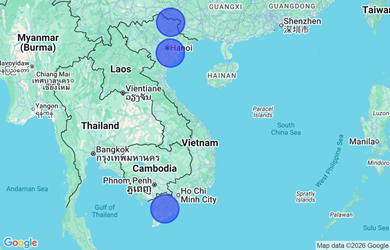
Mekong Delta Region
Localities with seaports, industrial parks and commercial areas. Mekong Delta Region, Red River delta region where fruits and veggies plantations are concentrated.
Semi-urban
Red River Delta
Localities with seaports, industrial parks and commercial areas. Mekong Delta Region, Red River delta region where fruits and veggies plantations are concentrated.
Semi-urban
Northern Border Provinces
The border provinces where the trade activity is concentrated: (Lao Cai, Quang Ninh, Lang Sơn, Cao Bang, Tay Ninh, and Bình Phuoc.)
SECTOR SOURCES
1) https://impact:.economist.com/sustainability/project/food-security-index/Index
2) https://tiasang.com.vn/-quan-ly-khoa-hoc/Nong-nghiep-Viet-Nam-Nhung-van-de-ton-tai-26635
5) https://datafiles.chinhphu.vn/cpp/files/vbpq/2020/02/41.signed.pdf
6) https://thoibaotaichinhvietnam.vn/chat-luong-viec-lam-cua-lao-dong-nu-nong-thon-con-thap-72150.html
7) https://www.undp.org/sites/g/files/zskgke326/files/migration/vn/Bao-cao-QG-SDG_VN.pdf
11) http://baokiemtoannhanuoc.vn/kinh-doanh/xuat-khau-nong-san-gap-kho-vi-thieu-kho-lanh-bao-quan-147952
14) https://vbpl.vn/bonongnghiep/Pages/vbpq-toanvan.aspx?ItemID=85611
15) https://datafiles.chinhphu.vn/cpp/files/vbpq/2018/04/57.signed.pdf
17) https://nhandan.vn/chuyen-lam-an/thuc-day-lien-ket-trong-san-xuat-rau-qua-676654/
18) https://vietnamnews.vn/economy/1086016/cold-storage-is-more-attractive-during-the-pandemic.html
19) https://britchamvn.com/wp-content/uploads/2021/09/Agri-Tech-Sector-Report.pdf
IOA SOURCES
21) https://vietnamnews.vn/economy/1086016/cold-storage-is-more-attractive-during-the-pandemic.html
22) https://vietnamnet.vn/en/more-investment-poured-into-cold-storage-facilities-757451.html
23) https://fiingroup.vn/NewsInsights/Detail/2791237?cat=OurNews
24) https://finance.vietstock.vn/TMS/tai-chinh.htm?tab=BCTT
25) http://baokiemtoannhanuoc.vn/kinh-doanh/xuat-khau-nong-san-gap-kho-vi-thieu-kho-lanh-bao-quan-147952
27) https://www.trade.gov/market-intelligence/vietnamese-cold-chain-food-market
28) https://datafiles.chinhphu.vn/cpp/files/vbpq/2018/04/57.signed.pdf
29) https://vbpl.vn/bonongnghiep/Pages/vbpq-toanvan.aspx?ItemID=85611
31) https://vanban.chinhphu.vn/default.aspx?pageid=27160&docid=152898
32) https://chinhphu.vn/default.aspx?pageid=27160&docid=81476
33) https://vneconomy.vn/gia-tang-dau-tu-bat-dong-san-kho-lanh.htm