
Explore the country and target locations of the investment opportunity.
Country
Vietnam
Region
- Highland
- Red River Delta
- Mekong Delta Region
Situate the investment opportunity within sustainability focused sector, subsector and industry classifications.
Sector
Food and Beverage
In 2021, the Global Food Security Index of Vietnam was ranked 65/113, indicating high food insecurity and poor nutrition (1) due to very low labor productivity in agriculture production, i.e. 2.4 and 2.1 times less than that of Indonesia and Thailand, respectively. (2) Vietnam is also severely affected by climate change, and the impact of floods alone causes a loss of 2.3% of GDP each year (3).
Policy priority
Resolution 26-NQ/TW/2008 offers strong support from the government for rural development, including the activities in agricultural value chains, e.g market access, technology transfer, access to capital, human resource improvement, infrastructure investment, and business model development (4); and food safety for the population (5)
Gender inequalities and marginalization issues
26 m female labor force (in 2016) in the agriculture sector have unstable jobs, low income, and limited access to social welfare (6); a high malnutrition ratio for under-five children in rural areas is 23.7% as opposed to 6.2% in urban areas (in 2020) (7)
Investment opportunities
Mass production in various crops and livestock, for example, 12.6 m tons of fruits, 22 m pigs, and 512 m poultry (2020) (8); USD 48 billion agricultural/ aquacultural export value in 2021 (9); Post-harvest processing technology - processed products with high added value accounts for only 10-40% of the farm output (10)
Key bottlenecks
Inefficient long supply chain, under-developed infrastructure of the supply chain, unstandardized production processes leading to challenges in quality control, and lack of human resources.
Sub Sector
Food and Agriculture
Development need
Low income in rural areas - 1.6 times less than in urban areas (6), limited sustainable agriculture area with 0.3% of total plantation land and 0.5% of aquaculture area certified for sustainable farming practices (7), high post-harvest loss rate at 10-20% (7) Issue of food safety: 1,556 cases of food poisoning, with more than 47,400 people infected during 2010-2019 (12)
Policy priority
Develop a new economic growth model, improve growth quality, labor productivity, and competitiveness of the economy (GoV, Directive 7/CT-TTG, 2020) (13); promote sustainable agriculture and sustainable development (GoV, Decision 150/QD-TTG, 2022) (14); and encourage the application of high technology in agriculture (GoV, Decision, 130/QD-TTg, 2021) (15)
Gender inequalities and marginalization issues
Women’s income is only about 80% of men’s income (16), while they spend 2.1 times more time on housework than men. (7)
Investment opportunities
Estimated USD 300m for agri-tech solution market (17), estimated USD 1.8 b for cold chain services market (18); 100,000 to 120,000 tons of pesticides imported annually (19), and low fruit processing capacity, being 600,000 tons versus total national production of more than 12m tons (20)
Key bottlenecks
The dominance of small households, under-developed agricultural infrastructure, market instability, and strong competition with other sectors in securing human resources (skilled and unskilled labor)
Industry
Agricultural Products
Discover the investment opportunity and its corresponding business model.
Investment Opportunity Area
Agri-tech solutions to improve farm production
Business Model
Provide B2B agri-tech solutions for various activities in agriculture production, including implementing essential tasks, monitoring crops, predictive analysis, and precise agriculture. The investors can target startups at different development stages.
Kamereo is the first technology-applied B2B distributor in Vietnam, sourcing food supplies from various provinces in the simplest and most economical manner for restaurants in Ho Chi Minh. Successfully raised a total investment of USD 5 million, seed, and Series A (21)
MimosaTeck: provide solutions with the best criteria to match the specific demand of the local agricultural industry in terms of both production efficiency and cost/time saving (22)
Learn about the investment opportunity’s business metrics and market risks.
Market Size and Environment
Market Size (USD)
USD 100 million - USD 1 billion
CAGR
10% - 15%
Critical IOA Unit
Vietnam's agriculture: 41b in 2020, growing at 2.7%; 30 companies registered as being high tech (17)
Thailand's agriculture is of similar size to Vietnam, i.e. more than USD 40 billion in export; its Agritech (Smart Farming) market size is estimated at 269m by 2022 (23).
Strong support from the government: agriculture is one of eight areas for digital transformation (24)
Indicative Return
ROI
> 25%
Returns vary based on the cost of technology solutions offered. Investors usually expect the investment value to reach 3-4 times after 3 years in a successful business.
Investment Timeframe
Timeframe
Medium Term (5–10 years)
Varies based on the products and leadership. The market is in a nascent stage, comprising farms that can only afford to invest in the solution. It, therefore, takes time for marketing and to develop a solid customer base.
Ticket Size
Average Ticket Size (USD)
Investment can be in startups at different stages: seed money can be less than USD 500,000, and Series A and B can be in millions. Business case - Kamereo: seed funding - USD 500,000 in 2019, Series A - USD 4.6 million in 2021 (22).
Market Risks & Scale Obstacles
Capital - Limited Investor Interest
The market is nascent, generally confined within the segment of medium-to-large farm businesses; small production farms would neither be able to afford the investment nor are they interested in technology solutions.
Market - Volatile
The agricultural product market is generally volatile, especially if the products are commodities, thereby, hindering the investment in technology solutions by farm businesses.
Read about impact metrics and social and environmental risks of the investment opportunity.
Sustainable Development Need
Vietnam needs to increase the productivity of the agriculture sector. The country is lagging far behind other neighbors in the region
Climate change triggers the need for application of technologies to counter the impact of climate changes (e.g water saving).
Gender & Marginalisation
Gender inequality in rural areas is to be addressed by empowering women through enhanced participation in economic activities, like improvement of access to market information or networking with different actors in the value chain.
Expected Development Outcome
Introduce and apply high-tech solutions in the agriculture industry.
Improve product quality for consumers of agricultural products.
Reduce Vietnam's import reliance on raw-agricultural products.
Gender & Marginalisation
Empower women via solutions enabling women's participation in the supply chain (e.g access to the market)
Primary SDGs addressed
3 - Good Health and Well-Being
2.3.2 Average income of small-scale food producers, by sex and indigenous status
Current Value
The average income of people in rural areas is VND 45 m (equivalent to about USD 2,000) in 2020 (7)
Target Value
Productivity in agriculture is to increase 5-6%/year; income of people in agriculture sector increases 2,3-3 times compared with 2020 (27)
10 - Reduced Inequalities
10.1.1 Growth rates of household expenditure or income per capita among the bottom 40 per cent of the population and the total population
Current Value
99.6% in the period of 2010 - 2018
Target Value
The growth rate of household expenditure or income per capita among the bottom 40 percent of the population is higher than the national average
Secondary SDGs addressed
8 - Decent Work and Economic Growth
12 - Responsible Consumption and Production
Directly impacted stakeholders
People
Farmers who use the agritech solutions will improve productivity and ensure quality products, and buyers of farm output.
Gender inequality and/or marginalization
Women farmers benefit from improved livelihoods from equal opportunities and recognition of their decision-making ability. Rural communities with high dependence on agriculture benefit overall with a boost in the local economy.
Planet
Improve eco-environment (e.g water-saving, reduced use of chemical inputs by applying precise agriculture), and reduce carbon footprint and/or environmental degradation from efficient agriculture technologies, contributing to overall biodiversity and natural resources conservation.
Corporates
Enterprises/ Businesses in the agricultural value chain. Processors improve business efficiency. Distributors benefit from improved quality produce.
Public sector
Contribute to the implementation of the provincial government's policies for agriculture and rural development.
Indirectly impacted stakeholders
People
Other small producers in various locations can replicate the agritech solutions to improve productivity/quality of products
Gender inequality and/or marginalization
Population benefits from the equitable distribution of resources through the upliftment of local communities/industries.
Planet
Contribute to overall biodiversity and natural resources conservation.
Public sector
The government benefits from increased agricultural productivity, improved livelihoods and income for smallholder farmers, and contribute to poverty alleviation.
Outcome Risks
The lack of adequate digital literacy of beneficiaries prevents beneficiaries from taking up the solutions to a full extent
Agricultural businesses may lack adequate capacity to fully exploit digital solutions (e.g lack of digital culture, lack of infrastructure)
Gender inequality and/or marginalization risk: digital illiteracy can hinder women/ marginalized groups in the use of digital solutions.
Impact Risks
Market volatility and underdeveloped perception of agritech values are barriers for this model to be upscaled
Low labor costs in some areas can discourage agricultural businesses to invest in technology for improving productivity
Small production scale at the household level may discourage agricultural businesses from expanding to create an impact on a larger community.
Gender inequality and/or marginalization risk: limited investment by the private sector means less opportunity for women/marginalized groups to benefit from the use of Agri-Tech solutions.
Impact Classification
C—Contribute to Solutions
What
High tech solutions for different activities in agriculture sector, such as implementing essential tasks, monitoring crops, predictive analysis, and precise agriculture.
Who
Farmers and consumers of agricultural products benefit from affordable solutions
Risk
Potential users may not be able to afford the solutions; or the lack of digital literacy and devices/infrastructure, and market volatility may disable the use of the solutions.
Contribution
Investment by private sectors and households in rural development achieved more than USD 8 billion during 2011 - 2019 (32)
How Much
This IOA can meet potential market demand of over USD 200 million from agricultural businesses (23)
Impact Thesis
Foster access to high-tech solutions for productivity improvement or working environment for farmers, contributing to improving the average income of rural areas.
Explore policy, regulatory and financial factors relevant for the investment opportunity.
Policy Environment
National Strategy for sustainable agriculture and rural development: set out strategies for agriculture and rural development to increase productivity, reduce poverty, apply green technology, and develop new rural communities (14)
National program for high tech development to 2030: set out strategies for application of high technology in agriculture (15)
GoV, Directive 7/CT-TTG: measures to improve the national productivity (13)
Financial Environment
GoV, Decree 57/2018/NĐ-CP: incentives for businesses to invest in agriculture and rural areas, including support for access to land/ water surface, reduced income taxes, research and technology transfer, human resource development, processing facilities, and so on (30)
Financial incentives: Financial package of 4,37b USD is offered by the State Bank & other banks for hi-tech business (17)
Regulatory Environment
Law on High Technology, 21/2008/QH: provide regulations on high-tech activities, policies, and measures to encourage and promote high-tech activities.
GoV, Decision 19/2018/QĐ-TTg: stipulate the criteria, competence, and procedures for definite recognition of hi-tech agricultural enterprises (31)
GoV, Instruction 4213/BQP-TM: Instructions on the use of unmanned aerial vehicle UAV (28)
Discover examples of public and private stakeholders active in this investment opportunity that were identified through secondary research and consultations.
Private Sector
Private sector: Various agritech businesses, e.g Pan Group, AgrHub, Nutrition Technology, Kamero, Mimosa TEK, Demeter, Koidra (29)
Government
Government: MARD and local government/ authorities at provincial and district level, State Banks that are actively supporting investment in high-tech agriculture (AgriBank)
Multilaterals
Multilaterals: United Nations Development Programme (UNDP), World Health Organization (WHO), Asian Development Bank (ADB), World Bank (WB), United Nations Children's Fund (UNICEF), The Food and Agriculture Organization (FAO)
Non-Profit
Non-Profit: Vietnam Digital Agriculture Association (VIDA), Vietnam E-Commerce Association, and many associations by product, including Vietnam Food Association (VFA), Vietnam Associations of Seafood Exporters, and Producers (VASEP), Vietnam Cashew Association, and so on.
See what country regions are most suitable for the investment opportunity. All references to Kosovo shall be understood to be in the context of the Security Council Resolution 1244 (1999)
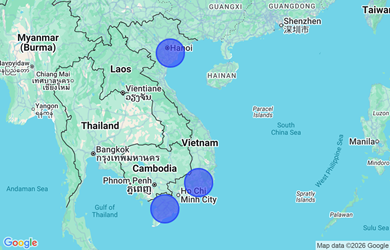
Rural
Highland
Areas where medium-to-large farms concentrate, mainly in Lam Dong province
Rural
Red River Delta
Areas where medium-to-large farms concentrate.
Rural
Mekong Delta Region
Areas where medium-to-large farms concentrate
SECTOR SOURCES
10) https://tulieuvankien.dangcongsan.vn/Uploads/2020/6/7/4/CT-24.signed.pdf
14) http://www.molisa.gov.vn/Pages/tintuc/chitiet.aspx?tintucID=25573
16) https://vnexpress.net/viet-nam-danh-18-tong-chi-ngan-sach-cho-giao-duc-4497087.html
IOA SOURCES
3) https://startup.vnexpress.net/tin-tuc/xu-huong/startup-edtech-ram-ro-goi-von-4359369.html
5) https://topdev.vn/blog/dich-vu-thi-truong-edtech-landscape-2020/
11) http://consosukien.vn/chu-trong-dau-tu-cho-giao-duc-dao-tao.htm
18) http://ncif.gov.vn/pages/newsdetail.aspx?newid=18779
21) https://techcollectivesea.com/2019/12/03/vietnams-emerging-edtech-startups/
23) https://bnews.vn/thieu-hut-nang-ne-lao-dong-tay-nghe-cao-trong-nganh-san-xuat-dien-tu/213982.html
24) https://luattriminh.vn/giay-chung-nhan-dang-ky-hoat-dong-day-nghe.html
26) http://www.congdoan.vn/tin-tuc/doi-song-cong-nhan-503/nang-tam-ky-nang-lao-dong-viet-nam-596999.tld
27) https://vietnam.acclime.com/news-insights/edtech-in-vietnam-a-sector-regulatory-analysis/
29) https://thuvienphapluat.vn/van-ban/Giao-duc/Luat-giao-duc-2019-367665.aspx
34) https://vanban.chinhphu.vn/default.aspx?pageid=27160&docid=73157
35) https://www.undp.org/sites/g/files/zskgke326/files/migration/vn/Bao-cao-QG-SDG_VN.pdf