
Explore the country and target locations of the investment opportunity.
Country
Philippines
Region
- National Capital Region (NCR)
- Central Luzon
- MIMAROPA Region
- Caraga
Situate the investment opportunity within sustainability focused sector, subsector and industry classifications.
Sector
Health Care
Development need
In 2018, public spending on health was only USD 50 per person, i.e., only half the amount spent by ASEAN countries that successfully implemented universal healthcare. Post pandemic, analysts expect that the under-five mortality rate has increased compared to the last reported 2019 data of 12.83%.
This is coupled with multiple closures of last mile healthcare delivery services due to severe cashflow issues during the pandemic. Industry leaders highlight the need for reinvestment in the sector to improve basic healthcare within the country. (1)
Policy priority
The Philippine Development Plan 2023-2028 outlines four priorities to improve the health sector and achieve universal health care in the new normal: (1) improvement of the social determinants of health, especially for the vulnerable sector; (2) people empowerment towards healthy choices and behavior.
Gender inequalities and marginalization issues
Although social health insurance coverage (PhilHealth) was 100% as of 2019 with the signing of the Universal Health Care Act, many are still reliant on out-of-pocket expenditure as their primary source of financing for medical care, which is likely to push Filipino households to poverty.
Investment opportunities
The reduced access to healthcare underlines the investment opportunities for the private sector. Devolution of health services to the local governments provide opportunity for easier coordination for private sector partnerships to develop health care delivery solutions.
Capiz and Quezon City, through their investor forums, have showcased their readiness to partner with private healthcare sector to create further solutions and opportunities in the space.
Key bottlenecks
The decentralization of budget for key services such as health means that local governments have to increase capacity and be able to plan their local health strategy, which can be a bottle neck for investments. As per experts, challenges in cashflow due to dependence on PhilHealth's information system is a key bottleneck for further investments.
Sub Sector
Health Care Providers
Development need
The Philippines' hospital bed density of 1.2 beds for every 1000 people, is one of the lowest statistics in the world. To reach the target of 4 beds for every 1000 population – as that of upper middle-income and high-income countries – additional 400,000 beds are required.
Policy priority
The Philippine Health Facility Development Plan for 2020-2040 (PHFDP) emphasizes the importance of investing in specialty health facilities. Specifically, investment of USD 1.446 billion in infrastructure and equipment is required until 2025 and USD 19.4 billion for Specialized Laboratories.
Gender inequalities and marginalization issues
Low-income population and those in remote areas are the most impacted due to inadequate public health services. Basic care facilities, such as maternal delivery or small scale clinics, often close down due to lack of proper investment and financing solutions, which in-turn adversely impact such communities.
Investment opportunities
Development of Healthcare infrastructure is one of the main objectives for the Philippine Development Plan for 2023-2028, which promotes private sector investments in this area. Multiple healthcare deliveries are lined up for public-private partnerships.
Key bottlenecks
The decentralization of efforts related to healthcare infrastruture puts the burden on the Department of Health and the local governments to seek solutions. These circumstances constitute operational risks because they introduce potential challenges that can impede the effective execution of decentralized healthcare initiatives.
Such obstacles may affect the overall operational efficiency and success of these programs, making them a significant operational risk to be addressed.
Industry
Health Care Delivery
Discover the investment opportunity and its corresponding business model.
Investment Opportunity Area
Affordable Hospital Infrastructure Development
With a focus on underserved areas
Business Model
Invest in construction of new hospitals or expansion of existing healthcare facilities in remote and underserved areas to improve bed capacity. Affordability is at the forefront of this initiative, employing cost-effective, modular hospital designs.
DPWH Covid-19 Facilities: The Department of Public Works and Highways (DPWH) constructed more than 600 COVID-19 facilities, providing a total of 24,513 beds nationwide. These facilities include quarantine and isolation centers, as well as off-site dormitories, and modular hospitals. These healthcare resources are strategically situated in major cities and provinces across various regions in the country, including BARMM.
Camarines Norte District Hospital: Funded through the Development Bank of the Philippines term loan amounting to around USD 8 million, the Province of Camarines Norte initiated the project for the development of the District Hospital. The project includes the construction of a two-storey building with an initial bed capacity of 25 beds.
University of the Philippines - Philippine General Hospital, with funding support from the President and CEO of Sta. Elena Construction constructed the Department of Pediatrics-Hematology-Oncology Isolation Ward. The project is a stand-alone 320-square-meter pediatric ward with a 14-bed facility meant for cancer patients, especially children from poor families. The total project cost is undisclosed.
Learn about the investment opportunity’s business metrics and market risks.
Market Size and Environment
Market Size (USD)
> USD 1 billion
CAGR
10% - 15%
Critical IOA Unit
Median density levels of Government-owned hospitals
In 2021, USD 9.1 billion of the country health expenditure went to spending on hospitals (16) The expansion of hospitals likely contributed to a CAGR of 10.9% from 2014 to 2020. (23) A 2022 study on the Philippine health service coverage finds that the median hospital density in the country is 0.735 - far less than the target of 4 beds for every 1000 population.
Moreover, this number lowers further once only government-owned hospitals are examined with densities of 0.67, 0.42, 0.55 for level 1, 2, and 3 hospitals, respectively. (14)
In 2021, country health expenditure (CHE) was recorded at PhP 1.09 trillion, which is higher by 18.5% than in the previous year. The financing of CHE can be broken down into Government schemes and compulsory health contributions (50.3%), Household out-of-pocket payments (41.5%), and voluntary healthcare payment schemes (8.2%). CHE spending on hospitals amounted to USD 9.1 billion.
Indicative Return
IRR
10% - 15%
Initial studies show a range of 10-15% IRR for both UP-PGH and Mariveles Wellness Center. (12) Private hospitals have positive profit margins, while public hospitals often have negative. (22)
PPPC documents under review suggest that the internal rate of return (IRR) for both the University of the Philippines-Philippine General Hospital (UP-PGH) and the Mariveles Wellness Center could be between 10% and 15%. (12)
Sampled private hospitals kept around USD 4 and USD 2 in median net income out of every USD 100 in total revenues for the period of 2015-2019 and 2020, respectively. Prior to any government subsidies, sampled public hospitals faced continuous negative profitability margins, signaling that they operated on deficits.
With subsidies, the profitability margins of sampled public hospitals were stable, keeping USD 15-18 in income for every USD 100 in revenues.
Investment Timeframe
Timeframe
Long Term (10+ years)
Substantial time is spent between obtaining approvals and actual construction. Returns are only realized upon construction and finalization of operating solutions. For a new private hospital, the investment timeframe is typically shorter since they are not subject to the same procurement process as public hospitals (about 3 to 5 years).
For a new public hospital, the investment timeframe can be anywhere from 5 to 10 years. This is because the government typically has to go through a lengthy procurement process to select a contractor and then approve the construction plans.
Ticket Size
Average Ticket Size (USD)
< USD 500,000
Market Risks & Scale Obstacles
Capital - CapEx Intensive
The construction of healthcare facilities can be capital-intensive especially as suppliers are limited in remote areas. This can make it difficult for small and medium-sized companies to enter the market.
Market - Highly Regulated
Foreign Direct Investments for health sector are heavily regulated in the Philippines through strict export performance requirements.
Read about impact metrics and social and environmental risks of the investment opportunity.
Sustainable Development Need
The country’s hospital bed density of 1.2 for every 1000 population is like that of the poorest countries in the world. To reach the target of 4 for every 1000 population – similar to upper middle-income and high-income countries – additional 400,000 beds are still needed (1).
By 2040, outpatient visits and inpatient bed-days are expected to increase by 60% mostly due to lifestyle- and aging-related noncommunicable diseases. In NCR alone, the projected need of Level 1, 2, and 3 hospital beds are 3189, 1351, and 1985, respectively (1).
The national needs require a sustained investment twice larger than the USD 2 billion (0.6% of GDP) spent by the public and private sector on infrastructure and other capital formation in 2018 (1).
Gender & Marginalisation
Only 2953 of the 3900 primary care facilities in the country are Rural Health Units/Health Centers. Moreover, 50% of Filipinos still have to travel long to access the nearest RHU/HCs. Hence, additional 2,400 RHU/HCs is needed by 2025 to improve health care services especially in far-flung areas (1).
The limited availability of health infrastructure is also a threat for women’s health. The lack of access to proper maternal care facilities, especially in communities, puts pregnant mothers at risk of pregnancy complications and maternal mortality during and after childbirth.
In 2023, the United Nations Population Fund (UNFPA) stated that there was an increase of maternal deaths from 1,458 in 2019 to 2,478 in 2021.
Expected Development Outcome
Healthcare facilities will be able to cater to variety of health conditions by being able to provide multi-specialty services. With an increased capacity of available health infrastructure, the health care and treatment need of the population will be addressed.
With adequate public healthcare facilities, and competent personnel, Filipinos would be encouraged to take care of their health better. Availability of public healthcare facilities, especially in far-flung areas, will entice Filipinos to have their health checked without the challenges of riding a boat to the main island; or traversing a rough path to reach the town.
Gender & Marginalisation
The health system prioritizes the provision of care and services to the marginalized sector. Hence, improvement of the capacity of healthcare facilities will greatly benefit poor and underserved population across the country.
Construction of more healthcare facilities especially in underserved areas will devolve the services provided by existing ones. As a result, it will help in making services more geographically accessible to people living infar-flung communities.
With more public health care facilities manned by competent health care professionals, maternal mortality, among many health concerns, will be addressed. More children would have a chance to live.
Primary SDGs addressed
3 - Good Health and Well-Being
3.8.1 Coverage of essential health services
3.8.2 Proportion of population with large household expenditures on health as a share of total household expenditure or income
Current Value
Coverage based on the Philippine statistics is currently 94% however, due to the impact of the pandemic, significant number of far-flung and low cost healthcare centers have closed down. Additionally, there's a significant gap on available beds versus the population of the country.
3.8s.2 Out-of-pocket health spending as percentage of total health expenditure As of 2021, out-of-pocket health spending is 38.9% of total health expenditure
Target Value
2030 target is 100%. This requires reconstruction and establishment of satellite healthcare delivery infrastructure, low-cost medical services and information and payment solutions.
Target is to maintain a reasonable level at 43.5% by 2030
Secondary SDGs addressed
8 - Decent Work and Economic Growth
5 - Gender Equality
11 - Sustainable Cities and Communities
Directly impacted stakeholders
People
The improvement of medical centers in terms of capacity, accessibility and affordability will promote good health for growing population across the country.
Gender inequality and/or marginalization
The establishment of health facilities in underserved communities will help address the health needs of the marginalized sector, especially women at risk, such as pregnant and lactating mothers. At the same time, it will also contribute to the reduction of mortality rate within those areas.
Public sector
The improvement in capacity of medical centers will allow the health sector to provide increased and quality care to the population.
Indirectly impacted stakeholders
People
The improvement in capacity of medical centers will allow the health sector to provide increased and quality care to the population.
Corporates
PPPs in healthcare infrastructure entail more engagement from the private sector especially in the planning, construction, and even operation and management of facilities.
Public sector
Increased access to healthcare facilities in remote areas will enable a more healthy community that will become more economically productive.
Outcome Risks
Financial Risk: Low uptake of medical services in case of high fees for medical services by private partners
Environmental Risk: Waste generated from activities involved in this IOA, such as the construction of the facilities, need to be treated properly and efficiently.
Gender inequality and/or marginalization risk: Most infrastructure projects are located in urban centers and may still require hours of travel time from marginalized communities, which severely affects women who are usually in-charge in bringing their children to hospitals when sick
Impact Risks
Substandard equipment or materials may pose further health risks instead of providing cure to patients.
Inadequate health facilities for the growing population of patients may further increase mortality rate
Gender inequality and/or marginalization risk: Disparities may still exist if healthcare facilities are not gender-inclusive
Impact Classification
C—Contribute to Solutions
What
Improving health of marginalized communities by providing improved access to medical healthcare infrastructure solutions especially in remote and underseved areas
Who
Potential patients in underserved areas receive treatment in a more responsive manner; Local health workers will also be given opportunity to work in their respective community hospitals
Risk
Considerable risk of continuous lack of hospital beds if not executed which results to stagnation of improvement in quality of health care. Lack of LGU coordination might hamper delivery of operations
Contribution
Improved capacity of the healthcare system, particularly in helping achieve the 4 beds for every 1000 population target
How Much
Improve the mean density level of government owned hospitals, which are currently below 1.00 rates.
Impact Thesis
Improving healthcare quality in underserved areas by creating more medical care delivery infrastructure in coordination with local government support
Explore policy, regulatory and financial factors relevant for the investment opportunity.
Policy Environment
The Philippine Health Facility Development Plan 2020-2040 states the need for large and sustained investments in health infrastructure. It encourages private sector investment on top of increased public spending more than the P13B it spent on health infrastructure and capital investments in 2018 (1).
The National Objectives for Health outlines and elaborates general and specific targets within the health sector’s agenda for every five-year period (2,3).
Administrative Order 2023-0009 of the DOH contains the guidelines on the implementation of projects under the Health Facility Enhancement Program (HFEP) of the current year. The HFEP is the annual manifestation of the plans outlined in the long-term PHFDP 2020-2040 (4).
While the Mandanas Ruling by the Supreme Court in 2018 mandates the revenue increase from the national government to local governments to 55% in the 2022 budget, some local governments expressed concern on their financial and technical absorptive capacities (2).
National Tax Allotment (NTA) shares of local governments decreased in 2023 due to the low revenue collection in 2020 because of the COVID-19 pandemic (3).
Financial Environment
Section 27(B) of the National Internal Revenue Code of 1997 imposes 10% tax on proprietary non-profit hospitals' income.
RA 11712 or the Public Health Emergency Benefits and Allowance for Health Care Workers Act outlines the allowance, compensation package and other benefits entitled to healthcare workers, such as hazard pay and life insurance of USD 18,000 in case of death.
Foreign direct investments is limited to 40% maximum ownership for this sector.
Regulatory Environment
Section 29 of the Universal Health Care Act (RA 11223) defines the equity of healthcare service delivery among public and private facilities giving priority to the underserved and low-income sector (5).
The Republic Act 6957, as ammended by the Republic Act 7718 or also known as the Build-Operate-Transfer (BOT) Law details the general terms of private sector investments and involvement in PPPs involving public infrastructure projects (6).
The Health Facilities and Services Regulatory Board (HFSRB) under the DOH is the primary authority that implements and monitors regulatory policies and standards that ensure the quality of practices and services within health facilities (5).
Discover examples of public and private stakeholders active in this investment opportunity that were identified through secondary research and consultations.
Private Sector
AC Health; Metro Pacific Investments Corporation; QualiMed Health Network SM Investments Corporation, Metro Pacific Investments Corporation
Government
Department of Health; University of the Philippines - Philippine General Hospital; Public-Private Partnership Center; Municipality of Mariveles, Bataan
Multilaterals
Asian Development Bank; World Bank, International Finance Corporation, World Health Organisation
Non-Profit
Unilab Foundation, Inc., Philippine Charity Sweepstakes Office (PCSO), Philippine Business for Social Progress (PBSP)
Public-Private Partnership
Public-Private Partnership (PPP) Center, Mariveles Wellness Center Project
See what country regions are most suitable for the investment opportunity. All references to Kosovo shall be understood to be in the context of the Security Council Resolution 1244 (1999)
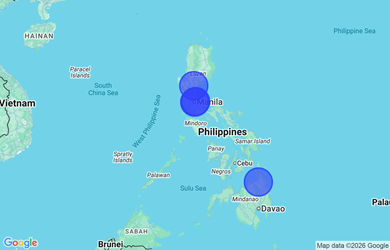
Urban
National Capital Region (NCR)
Further expansion for the basic care of the UP Philippine General Hospital was planned.
Urban
Central Luzon
The Mariveles Wellness Center Project is under development; LGU is equipped and open to PPPs
Rural
MIMAROPA Region
Identified in 2018 as one of three regions without Level 3 hospital; and without an MRI equipment (1)
Semi-urban
Caraga
Identified in 2018 as one of three regions without Level 3 hospital. (1)
1) Department of Health (DOH). (2020). Philippine Health Facility and Development Plan. https://doh.gov.ph/sites/default/files/publications/DOH_PHILIPPINE%20HEALTH%20FACILITY%20DEVELOPMENT%20PLAN%202020_2040_0.pdf
2) Lorito, D. (2021 June 10). Philippines: Mandanas Ruling Provides Opportunities for Improving Service Delivery through Enhanced Decentralization. The World Bank. https://www.worldbank.org/en/news/press-release/2021/06/10/philippines-mandanas-ruling-provides-opportunities-for-improving-service-delivery-through-enhanced-decentralization
3) Ordinario, C. (2022 November 29). Tax allotment for LGUs cute due to Covid scars - DBM. Business Mirror. https://www.pids.gov.ph/details/news/in-the-news/tax-allotment-for-lgus-cut-due-to-covid-scars-dbm
4) Manila Bulletin (2021) https://mb.com.ph/2021/05/10/dpwh-sets-up-modular-hospitals-quarantine-facilities-isolation-units-nationwide-for-covid-19-patients/#google_vignette
5) Development Bank of the Philippines (2020) https://www.dbp.ph/newsroom/dbp-bankrolls-hospital-projects-in-camarines-norte/
IOA SOURCES6) DOH. (2021). The New Normal for Health. https://doh.gov.ph/sites/default/files/publications/The-New-Normal-for-Health.pdf
7) DOH. (2018). National Objectives for Health Philippines 2017-2022. https://doh.gov.ph/sites/default/files/health_magazine/NOH-2017-2022-030619-1%281%29_0.pdf
8) DOH. (2023). Guidelines on the Implementation of Projects Funded Under the Health Facilities Enhancement Program (HFEP) Fiscal Year 2023. https://dmas.doh.gov.ph:8083/Rest/GetFile?id=745861
9) Official Gazette. (2019). Universal Health Care Act. https://www.officialgazette.gov.ph/downloads/2019/02feb/20190220-RA-11223-RRD.pdf
10) Official Gazette. (2022). BOT Law. https://www.officialgazette.gov.ph/2022/03/31/revised-implementing-rules-and-regulation-of-r-a-no-6957-an-act-authorizing-the-financing-construction-operation-and-maintenance-of-infrastructure-projects-by-the-private-sector-for-other-purpo/
11) PPPC (2022). Mariveles Wellness Center Project Market Sounding. https://ppp.gov.ph/wp-content/uploads/2020/04/PROJ_MWC_MarketSounding-20220128.pdf
12) PPPC Unpublished Documents on UP-PGH and Mariveles Wellness Center
13) PPPC, (2022). Sample computation on determining the reasonable rate of return (RROR) for the toll road industry. https://neda.gov.ph/wp-content/uploads/2022/12/PPP-Guidelines-Annex-C-Sample-computation-on-determining-the-reasonable-rate-of-return-RROR-toll-road-industry.pdf
14) Flaminiano et al, (2022). Spatiotemporal Analysis of Health Service Coverage in the Philippines. https://www.pids.gov.ph/details/news/press-releases/27-provinces-with-less-than-0-5-hospital-bed-per-1-000-population-pids-study
15) DOH, (2006). https://hfsrb.doh.gov.ph/wp-content/uploads/2021/05/AO-2006-0004.pdf
16) PSA, (2022). https://psa.gov.ph/pnha-press-release
17) UN ESCAP, (2022). https://www.unescap.org/kp/2022/foreign-direct-investment-and-policies-health-sector-asia-and-pacific-20222023
18) DOH, (2022). https://docs.google.com/spreadsheets/d/e/2PACX-1vSrKKNMbcErl3HfqMdFmHPwTPdpGDq-m94w3nH5E5wC2mk0ge5Py-fTPCayujNU6yyCOBLYNhhr_-vk/pubhtml
19) PPPC. List of Projects. https://ppp.gov.ph/list-of-projects/ 20) DOF, (2020). https://taxreform.dof.gov.ph/wp-content/uploads/2021/04/RA-11534-CREATE-Law.pdf
20) DOF, (2020). https://taxreform.dof.gov.ph/wp-content/uploads/2021/04/RA-11534-CREATE-Law.pdf
21) Ken Research (2022). https://www.globenewswire.com/en/news-release/2022/03/29/2411518/0/en/Philippines-Medical-Device-market-is-expected-to-reach-to-a-value-of-PHP-130-Billion-by-2025-with-a-double-digit-growth-CAGR-during-the-next-five-years-Ken-Research.html